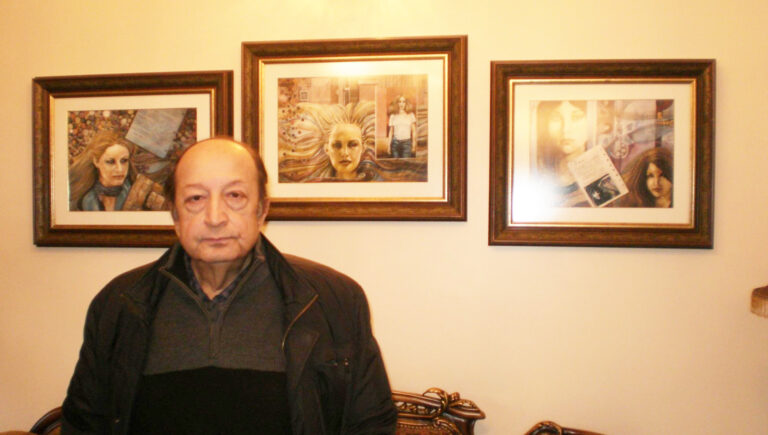
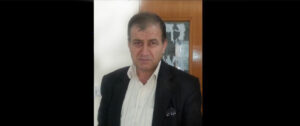
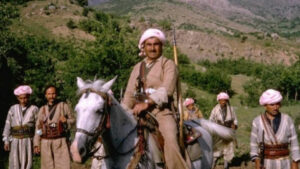
A few days ago marked the tenth anniversary of the passing of the polymath, engineer, art critic, documentary filmmaker, and connoisseur of Kurdish music, Mr. Salah al-Din Khalil Muhammad. I used to travel to Damascus specifically for us to meet; he would surround me with an atmosphere of profound awe, secrecy, and extreme caution, to the point where he would ask, “Did anyone follow you?” In his final years, he would ask, “Is your mobile phone turned off?” In any case, it is difficult to write about dear friends who have departed, yet remembering them by reviving certain stances and expanding on specific subjects remains a motivating endeavor.
It is also difficult to write just a few introductory lines about an exceptional cultural figure whom I knew closely and befriended for nearly a quarter of a century. Nevertheless, I will attempt to present a few sentences that serve as thematic headlines.
Salah al-Din Muhammad was born in 1949 in the “Jabal al-Kurd” (Kurdish Mountain) region in the Afrin countryside. He was the son of Mr. Khalil Muhammad, who was the first to obtain a high school diploma (Baccalaureate) in Jabal al-Kurd, according to the account of the late Salah al-Din himself. This means he was raised in an authentic and educated Kurdish environment. In the late 1960s, he traveled to Turkey to pursue university studies but returned after a while to join the Department of Architecture at the Faculty of Engineering, University of Aleppo. Due to a clash with our formidable common professor, Dr. Alaa al-Din Lolah, his graduation was delayed until 1976, despite his excellence, skill, and exceptional artistic visual vision.
His talent flourished in the field of art criticism more than in architectural design. For many years, he wrote in the field of plastic art criticism and contributed to numerous international conferences and biennials. He also supported and facilitated the rise of several of Syria’s most prominent artists, as he is truly considered one of the founders of systematic art criticism in the Arab world.
To such an extent, he once shared a secret with me regarding the late Omar Hamdi… He asked, “Do you know him?” I said no, so he elaborated: “He was a humble artist but possessed a powerful brush. He was poor, working as a laborer at the Al-Radwan Hotel in Damascus. I helped him practically and supported him artistically and through the media, so he rose.” He then whispered, “Do you know that I was the one who gave him the title ‘International Artist’ through critical studies, and the label stuck easily!” May they both rest in peace. I believed him completely because he was honest and loyal to his friends; indeed, he did even more and greater things than that.
He moved to Damascus early on and loved it passionately. He entered the field of television and media, producing about a hundred documentary films, most of which received prestigious awards. Regarding the documentaries shown on Damascus Television, he told me that Abdul Halim Khaddam called him one day and said: “Salah, your films are good, but I wish they were without this Kurdish music.” This story reveals the dread the pillars of the defunct Ba’ath regime felt toward Kurdish art and culture, as he used to integrate his documentaries with appropriate Kurdish music.
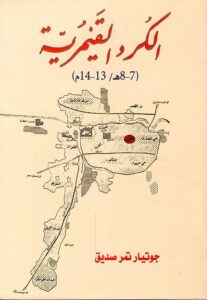
He was interested in ancient and Orientalist art, paintings, photographs, and especially graphics, dealing with them with high professionalism and rigorous academic tools. He loved photography and produced several works for the Ministry of Tourism and Antiquities, and finally for the British Museum. He authored several illustrated books (using advanced visual language), such as a book about “New Damascus”—referring to the Dummar project at that time.
In 2015, while I was in Erbil, he asked me to secure work for him. I obtained a visa for him to the Kurdistan Region of Iraq, and I was planning for him to work at Rudaw Media Network to produce documentaries with total freedom. Later, he changed his mind, saying, “I cannot leave Damascus; I have grown accustomed to Damascus and its environment.” Shortly after that, he contacted me asking to secure a medical visa to Germany. Per his request, I sought the help of our mutual friend, Mr. Adnan Mufti (former Speaker of the Kurdistan Region Parliament). We had a lengthy phone conversation with him, but we were unable to secure rapid treatment for him outside Damascus. The accumulation of worries and cigarette smoke had completely burned his lungs.
Weeks later, he was admitted to Al-Mouwasat Charity Hospital. He continued to contact me; we talked and planned as if we were going to live for many years. I then asked my son Ahmed, who was studying medicine at Damascus University, to visit him in intensive care and try to look after him. However, he passed away quickly. Before his departure, he asked Ahmed to speak to him in the Kurdish language. It seems that hearing the music of Kurdish words was his final wish.
He left us to suffer the early loss of loved ones. Dear Salah died quickly in Damascus, the city he served quietly, wrote about, and loved sincerely. Damascus returned the favor in its own way: it killed him for the sake of its enduring glory.
Note: This text is translated from the original Arabic version… Read the Arabic version:Click here