

Rustem Ehmed
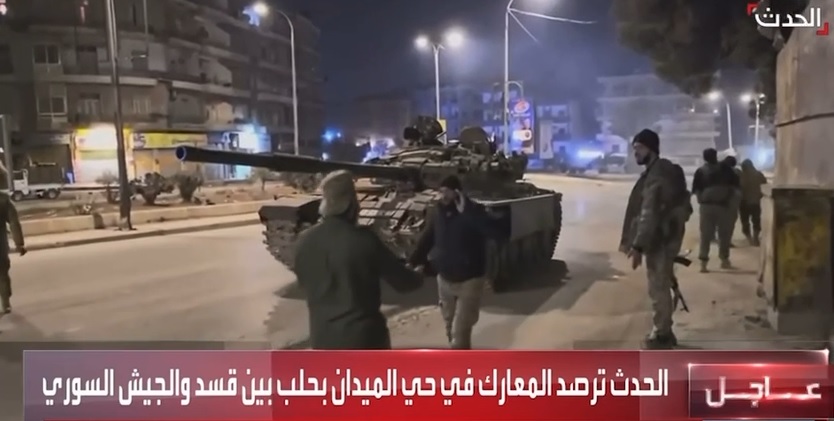
From the moment the spark of clashes erupted in the city of Aleppo, coinciding with threats issued by Turkish Foreign Minister Hakan Fidan from Damascus against the Syrian Democratic Forces, it became clear that the Saudi channels Al Arabiya and Al Hadath had settled their position early on. They chose to stand alongside the forces of Ahmad al-Sharaa (al-Joulani) in their battle against the predominantly Kurdish neighborhoods of Sheikh Maqsoud and Ashrafieh, ignoring what dozens of documented video clips showed—that these forces were the ones who initiated the attack, using heavy artillery and tanks against safe civilian neighborhoods.
Instead of adhering to the most basic rules of journalistic practice, the two channels drifted toward an overtly inciteful discourse that did not stop at distorting the image of the Kurdish forces, but also targeted the civilians residing in the two neighborhoods. Despite the clarity of the visual evidence showing the source of the shelling, the facts were inverted and a one-sided narrative was presented that serves a specific party, behavior that raises serious questions about professionalism and independence.
It appears that some presenters and editors operated from a narrow identity-based logic, based on siding with “one’s own people,” as the saying goes, whether that side is an oppressor or oppressed. As for the other side, as long as it belongs to a different ethnicity, there is no need to convey its voice; and if its narrative is transmitted, it is often distorted or stripped of its substance, merely to give the audience the illusion of a formal balance in coverage.
Here the fundamental question arises:
Is it conceivable that media institutions of the stature of Al Arabiya and Al Hadath would be driven by racist and sectarian tendencies to stand alongside forces that have committed—according to reports and documented facts—grave violations against multiple components of the Syrian people, from the coast to Suwayda, including massacres and violations against the Kurds, simply because the head of authority is classified as a “Sunni Arab”?
The repeated betting on political Islam forces and jihadist currents has never been without cost. Saudi Arabia has paid the price of these choices in previous stages, politically and in terms of security. The question today is: Is the same experiment being repeated, or is there an opportunity for a genuine review that prevents the repetition of the same mistakes?
In this context, the Syrian Democratic Forces issued a statement in which they categorically denied what was promoted about an alleged shelling of al-Razi Hospital in the city of Aleppo, considering what occurred to be a “deliberate fabrication” by the Damascus government and the so-called Aleppo Council and its official media outlets, aimed at misleading and reversing the facts. The statement affirmed that dozens of video clips clearly show artillery and tank shelling carried out by Damascus government factions on the neighborhoods of Sheikh Maqsoud and Ashrafieh and other areas.
The forces also published additional video clips documenting tank and artillery shelling of the two neighborhoods, which have a high population density, constituting—according to their description—an explicit condemnation of these factions and evidence of their direct responsibility for endangering the lives of civilians and committing grave violations of international humanitarian law.
In the end, media is not measured by its size or its reach, but by its ability to tell the truth without bias, and to side with the victims rather than the executioner. What occurred in the coverage of the events in Sheikh Maqsoud and Ashrafieh places Al Arabiya and Al Hadath before a real ethical and professional test: either media that holds power accountable and stands with civilians, or a platform used to justify violence and falsify awareness.


