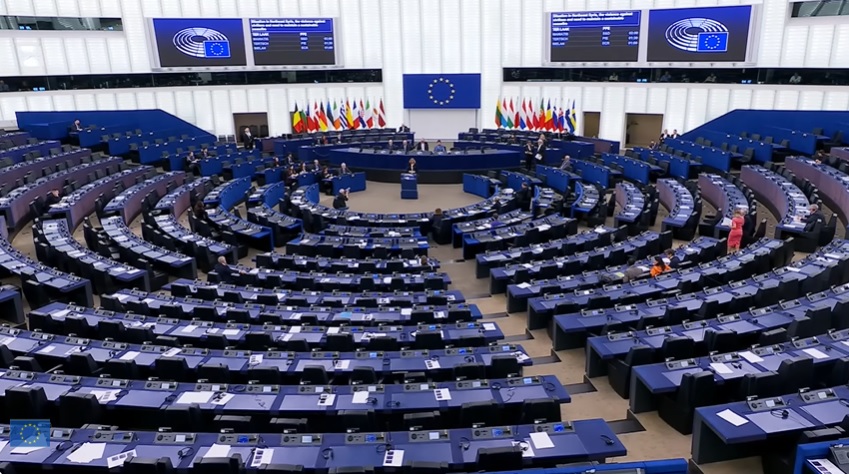
Brussels – Members of the European Parliament (MEPs) have warned that escalating violence in north-east Syria may amount to war crimes, underlining that stability in the region and the full recognition of Kurdish rights are indispensable for a comprehensive, inclusive and just political transition in the country.
In a resolution adopted by 363 votes in favour, 71 against and 81 abstentions, Parliament strongly condemned all violence against civilians in north-east Syria and called on all parties to fully abide by the ceasefire and respect international humanitarian law and human rights.
Serious Violations Potentially Amounting to War Crimes
The resolution stresses that extrajudicial killings, enforced disappearances, arbitrary detention, forced displacement and attacks on civilian infrastructure may constitute serious violations of international humanitarian law and, in some cases, war crimes.
MEPs cited credible reports from the United Nations and non-governmental organisations documenting recent abuses, particularly against the Kurdish population, including desecration of corpses, vandalised burial grounds and the use of unguided munitions in civilian areas. Parliament expressed deep concern over the deteriorating humanitarian situation in north-east Syria and called on the EU to scale up its humanitarian assistance.
Unwavering Support for the Ceasefire and Kurdish Rights
Parliament welcomed the 30 January 2026 agreement between the Syrian interim government and the Syrian Democratic Forces (SDF), which recommitted the parties to the phased military and administrative integration of the SDF into the Syrian state and granted the transitional authorities full control of international borders and oil and gas fields.
MEPs reaffirmed their strong support for the ceasefire and for the recognition of Kurdish civil and educational rights, urging all parties to uphold existing arrangements. They also called on regional actors, including Türkiye, to refrain from undermining the ceasefire through military action or by backing armed groups.
The resolution underlines that stability in north-east Syria is essential for a comprehensive and inclusive political transition. It calls on the Syrian authorities to guarantee the protection and fundamental rights of all communities, including Arabs, Kurds, Sunnis, Shias, Alawites, Christians, Druze and Yazidis.
MEPs stressed that full recognition, equal rights and meaningful political participation of the Kurdish community are indispensable for a stable and inclusive Syria, urging the transitional government to enshrine these guarantees in the constitution, while upholding Syria’s territorial integrity.
Presidential Decree No 13: A First Step
Parliament welcomed Presidential Decree No 13, issued on 16 January 2026 by President Ahmed al-Sharaa, recognising certain Kurdish cultural and civil rights, including Syrian citizenship. MEPs described it as a first in Syrian legal history and an important step towards the right to self-determination of the Kurdish people, calling for these guarantees to be embedded in the new Syrian constitution.
Risk of Daesh Resurgence
Parliament expressed grave concern about the risk posed by escaped Daesh fighters from detention facilities in north-east Syria. MEPs underlined that the indefinite detention of tens of thousands of alleged Daesh affiliates — most of them women and children — without due process and in dire humanitarian conditions is unlawful, inhumane and fuels radicalisation.
They called on EU Member States to repatriate all their nationals, especially children, from the al-Hol and al-Roj camps and to ensure that adults face justice in fair trials. MEPs also voiced concern over the transfer of detainees to Iraq without adequate legal safeguards, stressing the importance of respecting the principle of non-refoulement.
Regretting the US decision to withdraw troops from Syria and Iraq, Parliament urged the EU and its partners to step up efforts to prevent any Daesh resurgence threatening Syria, the region and Europe. MEPs highlighted the decisive role played by Kurdish forces, including women combatants, in the fight against Daesh since 2015.
Condemnation of Foreign Interference
Parliament called for an end to all foreign interference in Syria, including by Iran, Russia, Israel and Türkiye. It denounced Türkiye’s continued military intervention in north-east Syria, including deadly attacks on civilians and civilian infrastructure in Kurdish-majority cities and provinces along the border.
EU Engagement Conditional on Rights and Accountability
While welcoming the renewal of bilateral relations and the EU’s commitment of approximately EUR 620 million for 2026 and 2027 to support socio-economic recovery, humanitarian assistance and reconstruction, MEPs stressed that any engagement with Syria must remain conditional on verifiable progress in civilian protection, ceasefire compliance, human rights and minority rights.
They further underlined that the fragile political and security situation does not warrant designating Syria as a safe country of origin, insisting that any return of refugees must be truly voluntary, safe and dignified, in full accordance with international law.
Finally, Parliament instructed its President to forward the resolution to the Council, the Commission, the Vice-President of the Commission / High Representative for Foreign Affairs and Security Policy Kaja Kallas, and the Syrian interim government, and to have it translated and published in Kurdish and Arabic.
B10‑0115/2026
European Parliament resolution on the situation in Northeast Syria, the violence against civilians and the need to maintain a sustainable ceasefire
The European Parliament,
– having regard to its previous resolutions on Syria,
– having regard to the statement of 19 January 2026 by the Vice-President of the Commission / High Representative of the Union for Foreign Affairs and Security Policy Kaja Kallas on the ceasefire,
– having regard to the statement of 9 January 2026 by the President of the Commission, Ursula von der Leyen, with Council President António Costa and Syrian President al-Sharaa,
– having regard to the Council conclusions of 23 June 2025 on Syria,
– having regard to the International Covenant on Civil and Political Rights,
– having regard to the Universal Declaration of Human Rights,
– having regard to the UN Charter,
– having regard to Rule 136(2) of its Rules of Procedure,
A. whereas on 10 March 2025, following the fall of the Assad regime in December 2024, interim president Ahmed al-Sharaa and the leader of the Syrian Democratic Forces (SDF) Mazloum Abdi signed an agreement paving the way for the integration of the SDF’s civilian and military institutions into the central administration of the Syrian state; whereas the agreement was ambitious but vague, tasking negotiation committees to develop a detailed roadmap by the end of 2025;
B. whereas months of US-brokered negotiations between the transitional government and the SDF failed on 4 January 2026 over disagreement on the deployment of Syrian government forces in north-east Syria;
C. whereas on 6 January 2026, government forces in Aleppo advanced on positions in north-east Syria held by the SDF, in particular two predominantly Kurdish neighbourhoods in Aleppo, triggering a wider military confrontation on 17 January, with the Syrian transitional authorities gaining control of Raqqa and Deir ez-Zor Governorates and moving towards areas in al-Hasakah Governorate;
D. whereas on 18 January 2026, Ahmed al-Sharaa and SDF leader Mazloum Abdi agreed on a ceasefire, extended it for 15 days, and on 30 January 2026 signed an agreement re-committing themselves to the phased military and administrative integration of the SDF into the Syrian state and giving transitional authorities full control of international borders and oil and gas fields; whereas the situation remains fragile with the occurrence of localised security incidents; whereas ambiguities remain with the latest agreement, which leaves room for multiple interpretations and does not offer guarantees to Kurds for their protection from violence or for their right to self-determination;
E. whereas the SDF and its autonomous administration have de facto governed most of north-east Syria since 2011, managing a multi-ethnic, multi-religious region, and have lost more than two-thirds of the territory they previously controlled as a result of the clashes; whereas the Kurdish-led SDF forces were the main ground component of the US-led campaign against Daesh from 2015;
F. whereas on 16 January 2026, President al-Sharaa issued Decree No 13 recognising certain cultural and civil rights of Kurds, such as Syrian citizenship, an issue which had been unresolved since the 1960s;
G. whereas tens of civilians have been killed and, according to the UN Office for the Coordination of Humanitarian Affairs, more than 170 000 people have been displaced as a result of the fighting in north-east Syria, placing a disproportionate burden on host communities and public services; whereas the displaced population is predominantly composed of women, girls and boys, who are disproportionately exposed to protection risks; whereas many more have been cut off from water, food, medical care and other essential goods and services, in particular in the Kurdish-majority city of Kobanî;
H. whereas, although humanitarian corridors allow for some humanitarian convoys to reach the affected areas, access continues to vary depending on operational conditions, route availability and political approval by the transitional government; whereas the majority of the forcibly displaced people have found shelter in host communities, but insufficient humanitarian assistance reaches those communities;
I. whereas winter conditions have only deepened the suffering, and thousands are now enduring freezing temperatures, sheltering in makeshift and overcrowded camps, former schools and unfinished buildings across Syria;
J. whereas, according to Human Rights Watch, forces of the transitional government, as well as the SDF, have committed abuses that violate international law in the current escalation, and have previously committed grave human rights abuses, including extrajudicial killings, summary executions, the recruitment of children and the desecration of bodies and graves, highlighting the need for impartial investigation, accountability and transitional justice;
K. whereas around 30 000 people – mostly women and children – are being unlawfully detained in al-Hol and al-Roj prisons and camps in life-threatening conditions, including about 8 500 foreign nationals from about 60 countries;
L. whereas, according to the UN Special Rapporteur on the promotion and protection of human rights and fundamental freedoms while countering terrorism, prisons and detention facilities in north-east Syria hold approximately 9 000 male Daesh detainees, including boys, of which around 1 500 are foreign nationals, including hundreds of EU nationals; whereas the majority are being held incommunicado without due process, legal representation or family visits, and no information has been provided on their fate or whereabouts;
M. whereas the US military has transferred hundreds of Daesh-linked detainees, including foreign nationals, from Syria to Iraq, and announced that it will move thousands more there; whereas according to Human Rights Watch, detainees transferred to Iraq are at risk of enforced disappearance, torture and ill-treatment;
N. whereas on 20 January 2026, the Syrian Defence Ministry announced that it had taken control of al-Hol camp and other prisons; whereas the escalations in north-east Syria have led to Daesh fighters escaping, and detainees, in particular around 20 000 children, are now at high risk due to widespread disorder and exposure to armed actors and violence; whereas aid workers were unable to access the facilities for days; whereas this poses a direct threat to the safety of many ethnic and religious groups who have been primarily targeted by ISIS;
O. whereas Iraqi intelligence sources recently stated that there had been a fivefold increase in the numbers of ISIS fighters in Syria over the past year, from 2 000 to 10 000, while estimates by the United States and the UN are significantly lower;
P. whereas Commission President Ursula von der Leyen and Council President António Costa met interim president al-Sharaa in Damascus on 9 January 2026, inaugurating a renewed political partnership to support a peaceful, inclusive, Syrian-led transition; whereas the EU has lifted certain economic sanctions while maintaining measures on accountability and security, and has committed significant financial support, including around EUR 620 million for 2026 and 2027, for socio-economic recovery, humanitarian assistance and reconstruction;
1. Condemns the violent clashes between Syrian transitional government forces with SDF forces in north-east Syria, for which civilians, in particular women and children, are paying the highest price; deplores the renewed mass displacement of innocent civilians caused by the violent clashes, further exacerbating the humanitarian situation of Syrians in harsh winter conditions;
2. Is appalled by reports about attacks on civilians, torture, summary executions and the desecration of bodies and graves; calls on the Syrian interim government to promptly and impartially investigate all violations of international law by any actor; highlights that the Syrian Government needs to demonstrate that it is a government for all the people of Syria by abiding by its obligations, guaranteeing the rights and safety of all Syrians and pursuing accountability for atrocities;
3. Urges the Syrian Government, its allied forces and the SDF to fully abide by the ceasefire, protect civilians and respect Kurdish rights, including the right to self-determination, and peacefully and sustainably resolve the conflict in good faith and in respect of international human rights and in line with international humanitarian law;
4. Welcomes the conclusion of the agreement of 30 January 2026 between the interim government and the SDF as an initial effort to step back from military escalation and open avenues for negotiation and compromise; calls on all parties to fulfil their pledges and spare Syrians from further violence;
5. Calls on the Syrian Government to prioritise providing shelter and food in the affected areas and to increase and accelerate the delivery of urgently needed humanitarian aid across the north east, in particular to the tens of thousands of displaced persons; notes that humanitarian assistance is largely focused on formal collective centres, and calls on the Syrian Government to better support the provision of humanitarian aid also to host communities; urges all actors to refrain from restricting aid or blocking access to humanitarian corridors or civilian infrastructure, which is contrary to their obligations under international humanitarian and human rights law; urges the Syrian interim government to ensure safe passage for humanitarian convoys, including via routes cleared of explosive ordnance;
6. Reiterates its full solidarity with the people of Syria, who have suffered for decades at the hands of the Assad dictatorship; renews its full support for a united Syria, a peaceful transition, accountability and transitional justice and equal rights for Kurds and all ethnic and religious groups that make up the country;
7. Welcomes presidential Decree No 13, which recognises Kurdish cultural, language and citizenship rights, a first in Syrian legal history and an important step for the right of self-determination of the Kurdish people; calls on the Syrian interim government to implement the decree and enshrine the rights of Kurds and all other ethnic and religious groups in Syria into the Syrian Constitution, by amending the constitutional declaration of March 2025 and including it in the new constitution, particularly the parts regarding citizenship, legal status, the recognition of identity and language, and political and constitutional guarantees;
8. Denounces the continued application of Assad-era legislation used to suppress civil society and critical opposition and limit civic spaces and freedom of expression; calls on the Syrian interim government to comprehensively identify and repeal these laws;
9. Takes note of the election of the People’s Assembly of Syria in October 2025, but deplores the fact that, besides other apparent electoral shortcomings, polls in the north east and the southern region of Suwayda were postponed for security reasons and that the remaining 21 seats have still not been filled, undermining the political representation of Syrians from these regions; calls on the Syrian Government to complete the electoral process as soon as the situation allows and to actively support minority and women’s participation, including through its remaining 70 nominations to the assembly;
10. Expresses deep concern about violence and disorder in al-Hol and other prisons and detention facilities in north-east Syria, as well as reports of the escape of Daesh fighters; highlights that the indefinite detention of tens of thousands of allegedly Daesh-affiliated persons, most of them women and children, without due process in the poorest security and humanitarian conditions is unlawful, inhumane and breeds radicalisation, and must be resolved in line with international law; urges the Syrian Government to guarantee the safety of all detainees and immediately provide them with urgently needed humanitarian aid; calls on the Syrian interim government to release all unlawfully detained persons, assist their safe and dignified return home, particularly women and children, victims of trafficking and young adults who were abducted as minors, so that they may face due process, investigation and stand trial before competent courts for crimes committed, and cooperate with the EU and the international community to bring the detention facilities under a legal framework;
11. Reiterates its urgent call on the Member States to repatriate their nationals from these facilities, prioritising minors and young adults, taking into account their specific family situations and the best interests of the child as a primary consideration, and to provide the necessary support for their rehabilitation and reintegration in full compliance with international law; highlights that the EU has a responsibility to support Syria in resolving the consequences of the Daesh presence in Syria and the region; calls on the Member States to investigate and prosecute returning nationals in fair trials for crimes committed in Syria;
12. Expresses grave concern about the US administration’s large-scale transfer to Iraq of several thousand individuals suspected to be affiliated with Daesh, reportedly without transparent screening procedures, judicial safeguards, independent oversight or adequate guarantees for the protection of their fundamental rights; highlights that this violates the principle of non-refoulement under international law, since detainees deported to Iraq face a real risk of serious human rights violations, including detention in inhumane conditions, the denial of fair trial guarantees for broadly defined terrorism-related offences, and the imposition of the death penalty;
13. Stresses the need to end foreign interference in Syria, including by Iran, Russia, Israel and Türkiye; denounces the continued military intervention and aggression by Türkiye in north-east Syria, including deadly attacks on civilians and civilian infrastructure in Kurdish majority cities and provinces along the border between the two countries; urges the Turkish Government to immediately stop its military involvement in north-east Syria and enable negotiations for a peaceful solution between the Syrian transitional government and the SDF; calls on the Commission, the European External Action Service and the Member States to address Türkiye’s involvement in Syria in bilateral exchanges with the Turkish Government; condemns Israel’s military aggression and its setting up of checkpoints in south-west Syria, its occupation and annexation of the Golan Heights and its invasion of the demilitarised buffer zone after the fall of Assad, which violates the 1974 disengagement agreement;
14. Calls for the EU and the Member States to use all diplomatic channels to support negotiations and trust-building between the interim government and the SDF, in order to reach a peaceful and stable solution that guarantees an end to the violence, implements the agreement reached in the ceasefire deal, addresses and implements the rights of Kurds and all other ethnic and religious groups, facilitates swift humanitarian access and the return of those internally displaced, and includes accountability mechanisms for crimes committed;
15. Calls on the Commission to immediately make available part of the 620 EUR million financial support package to Syria in order to respond to the humanitarian emergency in northern Syria, in particular to provide shelter, food and heating, assistance with winter conditions and medical assistance for displaced people and civilians who were trapped by fighting;
16. Welcomes the Commission’s renewal of bilateral relations with Syria, following the decades-long Assad dictatorship, in particular its pledge of financial assistance to improve the dire socio-economic situation in Syria and advance reconstruction; is deeply concerned by the persistence of violence, insecurity and the concentration of power in the hands of the interim government; calls, therefore, on the Commission to reiterate its expectation that interim president al-Sharaa and his government fully commit to an inclusive and rights-based political transition process in Syria, in which the rights of all ethnic and religious groups are central and Syrian civil society, young people and women play a key role;
17. Calls on the Commission to publicly and privately demand that the Syrian interim government investigate all violations of international law and hold the perpetrators accountable; encourages the Commission to request that the UN Independent International Commission of Inquiry on the Syrian Arab Republic conduct an independent investigation into all violations committed since 6 January 2026 in Syria;
18. Calls on the Council to consider imposing sanctions on political and military leaders in Syria responsible for human rights violations through the EU Global Human Rights Sanctions Regime;
19. Welcomes the Commission’s first ‘Day of Dialogue’ in Damascus in 2025, and reiterates the important role of Syria’s civil society in contributing to trust-building and reinforcing the foundations for an inclusive future for all the people of Syria; calls on the Commission to make the Day of Dialogue an annual event in Damascus and other cities such as Sweida, Homs and Qamishli, and to increase outreach and communication with Syrian civil society and diaspora communities;
20. Calls on the Commission, in its disbursement of the pledged financial support package, to prioritise civil society in Syria, particularly women’s initiatives and locally led interventions across the ‘triple nexus’ between humanitarian, development and peace-building support; highlights the importance of closely consulting with the diverse civil society in Syria in designing and implementing EU funding for Syria, ensuring that schemes are easily accessible to local initiatives and taking into account financing of the regions;
21. Calls on the Syrian interim government to prioritise transitional justice efforts moving forward, and calls on the Commission and the Member States to allocate further financial and technical resources to supporting transitional justice activities in Syria;
22. Reaffirms that the fragile and evolving political and security situation of the country does not warrant deeming Syria, or parts of it, a safe country of origin for the return of Syrian nationals living forcibly displaced in Europe and around the world; reiterates the EU’s position that any return needs to be truly voluntary, safe and dignified, and underpinned by refugees being given all the information they need to make informed decisions about their futures, in full accordance with international law and the principles set out by the Office of the United Nations High Commissioner for Refugees; calls, in this context, on the Member States to allow and facilitate ‘go and see visits’ and to guarantee protection status for those choosing to visit Syria;
23. Calls on the Member States to reverse any decision that suspends asylum applications by Syrians and guarantee a full, individual and merit-based assessment of each asylum claim in a fair and transparent procedure; urges Member States that suspend decision-making on asylum claims to limit this suspension to a short and clearly defined period of time;
24. Stresses that any change in the protection status of Syrian refugees should be made only after a thorough assessment and securing of evidence that the political and security situation has changed in a fundamental and durable way, as required by the 1951 Refugee Convention and the Qualification Directive, and offers safety and stability, as well as human rights guarantees; emphasises that the withdrawal of international protection from individuals must follow the procedure set out in the Asylum Procedures Directive[1]; encourages the Member States to assess alternative grounds for granting residence permits to Syrians, including naturalisation, family reunification, long-term residence or humanitarian grounds, as well as other durable solutions to displacement; reiterates that no asylum-seeker may be forcibly returned, as this would violate countries’ non-refoulement obligation;
25. Calls on the Member States and non-EU countries, including Türkiye, Lebanon and Jordan, to allow, as a matter of urgency, Syrian refugees and asylum-seekers residing in their countries to choose to temporarily travel to Syria without losing their protection status;
26. Calls on the Commission to adopt a standalone strategy on Syria and ensure that Syrian civil society and diaspora communities are meaningfully consulted;
27. Instructs its President to forward this resolution to the Council, the Commission, the Vice-President of the Commission / High Representative of the Union for Foreign Affairs and Security Policy, the interim government of Syria, and to have it translated and published in Kurdish and Arabic.
Read the Arabic version: Click here