Mazloum Abdi: The current deadline will be followed by serious steps toward integration, and the SDF is ready to implement the December 18 agreement with Damascus within a short period
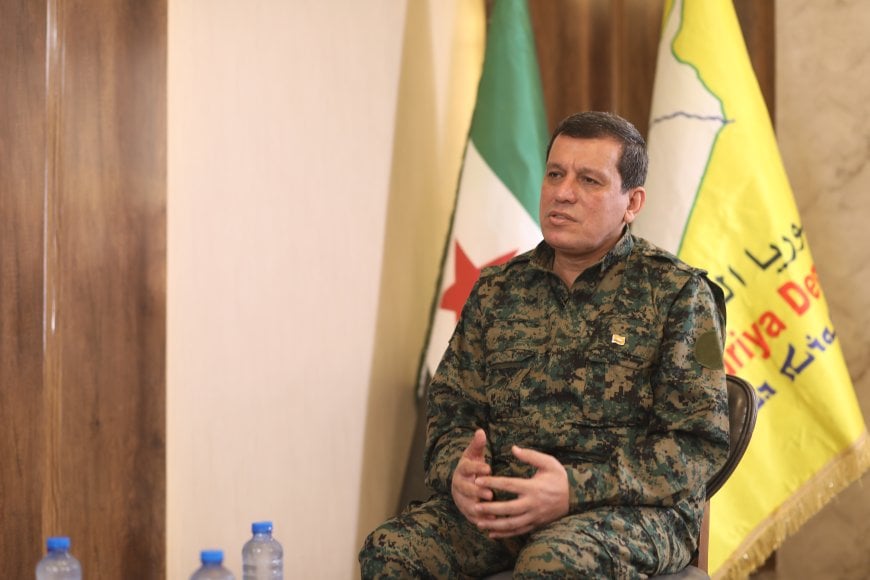
TheCommander-in-Chief of the Syrian Democratic Forces (SDF), Mazloum Abdi, affirmed that the recent ceasefire agreement came under U.S. sponsorship, noting that dialogue with the government in Damascus is still ongoing, with additional details to be discussed in the upcoming phase.
In a special interview with Ronahi TV, Abdi said that the current deadline will be followed by serious steps toward integration, explaining that the Syrian Democratic Forces are ready to implement the December 18 agreement with Damascus within a short period. He confirmed that names have been proposed for the positions of Deputy Minister of Defense and Governor of Hasakah, though no mutually agreed-upon list has been reached so far.
He clarified that the agreement stipulates that “the Syrian army will not enter Kurdish areas,” pointing out that the meeting held in Erbil aimed to solidify the ceasefire, amid a desire by all parties to reach political solutions away from militarization, with “positive” results.
Negotiations under international sponsorship
Abdi noted that the negotiations with Damascus are taking place under international sponsorship, with the participation of the United States through its political and military institutions, in addition to French President Emmanuel Macron. At the same time, he stressed that what is happening cannot be considered a final agreement, adding: “We want to be transparent with our people.”
He explained that there are international efforts to de-escalate tensions, the success of which depends on Damascus’s commitment and implementation of the presented demands, affirming that these efforts will succeed unless “unacceptable” conditions are imposed.
The interim government agreed that Kobani would not be entered
Regarding Kobani, Abdi congratulated the Kurdish people on the anniversary of the city’s liberation, affirming that the resistance of Kobani marked a pivotal moment in the history of Rojava and contributed to unifying the Kurdish ranks. He emphasized that the attacks currently targeting Kobani “will be broken.”
He also announced that a request had been made to Damascus not to enter the city, and that the latter had expressed its agreement, voicing hope that this commitment would be upheld.
The return of the displaced is a necessity
He pointed out that the agreement also addressed the files of Afrin, Serekaniye, and Tal Abyad, stressing the necessity of the return of the displaced to their areas, and that any solutions applied in Qamishlo and Kobani must also include those regions.
Policies aimed at sowing discord must be exposed
In a related context, Abdi spoke about violations against Kurds in Raqqa, Tabqa, and other areas, calling for accountability for those responsible and warning against attempts to spread racism and incitement between Kurds and Arabs. He urged the Kurdish people not to be dragged into what chauvinists seek to do through the violations they have committed, and for everyone to adhere to their morals and political principles.
He confirmed that the ranks of the Syrian Democratic Forces include martyrs from Arab communities, particularly from Raqqa and Deir ez-Zor, stressing the importance of exposing policies that seek to sow discord among the various components.
Kurdish areas are a “red line”
TheCommander-in-Chief of the Syrian Democratic Forces, Mazloum Abdi, said that the withdrawal from Raqqa, Tabqa, and Deir ez-Zor came to spare bloodshed and avoid escalation, affirming that protecting Kurdish areas is a “red line,” and that the SDF is prepared for all possibilities while adhering to the political option as the only solution. He added: “Until we reach a comprehensive political solution, we will continue resistance and the protection of our areas.”
Anha