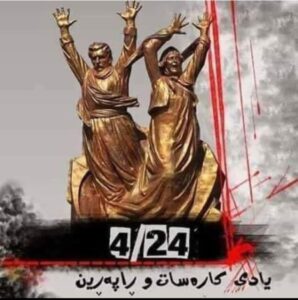
The Third Phase of Anfal: The Largest and Most Brutal in Scale and Casualties
The third phase of the Anfal operations, which targeted villages in Chamchamal, Sangaw, Kifri, Kalar, and Qadir Karam—covering an area of 600 square kilometers—commenced on April 7, 1988, and lasted for two weeks until April 20, 1988. This stage is considered the most extensive and violent phase of the Anfal campaign in terms of both geographical area and the number of victims.
On April 14, 1988, the Ba’athist regime brought its criminal “Anfal” campaign to its peak in the Garmian region. During this period, the regime executed the operation with a savagery rarely paralleled in human history, using a title of a Quranic Surah as a name for this crime to grant religious legitimacy to acts of extermination. In other words, Islam was used as a cover for the Anfal operations. The High Iraqi Criminal Court has since classified this crime as genocide by all standards. The regime led vast numbers of villagers to an unknown fate, effectively ending all signs of life in this region (Garmian, the Third Anfal zone).
This is evidenced by Document No. 285 issued by the Army General Staff on April 7, 1988, which stated:
To: First Corps Command / Second Corps Command
Subject: Directive
Further to our Top Secret and Personal Letter No. 273 dated April 3, 1988, regarding the Third Anfal Operations, and the meeting held today, April 7, 1988, with your Corps Commanders, we have directed the following:
We emphasize that no trace of life shall remain in the Third Anfal operation zone. This is to be achieved by demolishing and removing all villages and scattered houses, destroying artesian wells and water sources, and removing electricity and telephone poles and transformers to be handed over to the relevant authorities in the governorate.
All village residents are to be gathered in special camps; contact with them is prohibited, and they are to be dealt with according to the directives of the Northern Bureau.
This is how the crime was described by its perpetrators…
During this phase, the Ba’athist regime led thousands of residents from 515 villages belonging to four sub-districts to where they were buried in mass graves. After rounding up the residents, the “Anfalled” victims were isolated and classified by gender and age. They were transported directly to detention camps in Topzawa and Quratu, and subsequently moved to desert regions in southern Iraq—specifically Arar and the Samawah desert. Their remains were discovered in several mass graves in the periods following the fall of the regime. The most recent mass grave site was found in the Sheikhiya desert (Samawah), containing 10 mass graves. Two of these were opened, containing 325 martyrs who were returned to the embrace of Kurdistan and reburied at the Anfal Monument in Chamchamal.
The defunct regime executed the Anfal operations with such absolute secrecy that it is said even the excavator and bulldozer drivers were killed after the extermination process. The regime believed it could completely erase the evidence of the crime so it would never be uncovered. However, by Divine wisdom, the miraculous survival of a few victims became the means to expose these atrocities. Despite this, evidence remains scarce. When the fallen regime executed these operations, the international community remained silent, turning a blind eye and a deaf ear. Following the liberation of Iraq, many mass grave sites were identified by the International Coalition, and international organizations—most notably the ICMP and the International Red Cross—began supporting excavation efforts. Nevertheless, due to the limited evidence available, the Anfal crimes have remained somewhat confined to a local scope and are not widely recognized internationally.
Among the painful stories told by survivors of the “death pits” is that of Faraj Tobkhana. During an interview, he recounted: “They tied me and my cousin together and threw us into the pit. They fired at us randomly, and we fell on top of each other. I felt the heat of blood flowing from my cousin’s body, who was martyred instantly. I was hit by bullets but did not die by the power of the Almighty. Then, they covered the bodies with earth using bulldozers.” God miraculously saved him to reveal this crime. Faraj’s tragic narrative—from his escape from the pit to the moment destiny led him to safety—is detailed enough to serve as a poignant, tragic cinematic work.
Timur Mohammad, another survivor, speaks of the crime where regime men killed his entire family; their remains were later found in the Sheikhiya graves in the Samawah desert. Timur recounts: “I saw my mother with blood flowing from her head and my sister taking her last breaths. I was clutching the executioner’s leg, begging him to have mercy and not kill my family, but he threw me into the pit. I survived miraculously to tell what I saw with my own eyes—the scene of Judgment Day inside those pits.” There are dozens of such tragic stories from these bloody operations.
What distinguished this stage from others was that it did not begin with chemical shelling, as was the case in most Anfal phases. Instead, regime forces attacked villages one by one, rounding up residents and transporting them with the assistance of mercenaries from the “Light Regiments” (Jash). Peshmerga forces belonging to the Patriotic Union of Kurdistan (PUK) and a unit from the Communist Party hiding in the area resisted the attacks with great bravery. They recorded a heroic epic during which 22 Peshmerga were martyred after the regime resorted to chemical weapons.
As we remember the victims of the Third Anfal, tens of thousands of victims remain missing, their fates unknown to this day. Their families wait with burning impatience for the return of their pure remains. On this occasion, we call upon the relevant authorities to:
Hasten the process of uncovering the fate of Anfal victims and returning their remains.
Ensure justice is served and provide fair compensation to the families of the victims.
Implement Article 132 of the Permanent Iraqi Constitution and the rulings of the High Iraqi Criminal Court.
Prosecute those involved in assisting the regime who are still wanted.
Rebuild the destroyed villages and provide psychological rehabilitation for the survivors.
Finally, I bow in reverence to the blood of the Anfal martyrs.