The scholar Waddell posits that more than fifty percent of the common words used in English today are of Sumerian origin, retaining the same characteristics of the original word in both sound and meaning.
He demonstrates that based on his detailed analytical and comparative results between Sumerian and the Aryan language family, he concluded that the Sumerian language is Aryan in its vocabulary, structure, and script. Furthermore, he asserts that all languages of the Aryan family, along with their written alphabets, were derived from Sumerian.
This conclusion was mentioned in the introduction of his work, the Sumer-Aryan Dictionary. Therefore, I decided to select portions of its content and translate them into Arabic, providing some comparisons and commentary based on this significant dictionary, despite its first edition being published in London in 1927.
Sumerian and its pictorial written signs represent the legitimate father of the ancient and modern Aryan language family—specifically English, Anglo-Saxon, Norse, Greek, Latin, and Sanskrit. Unexpectedly, it is also the father of the ancient Egyptian language and script. This is because this Aryan language and its writing spread throughout the ancient world via the Phoenicians, who were the vanguard of Sumerian sailors, or the early Aryans.
Waddell states that the Sumer-Aryan Dictionary—which took sixteen years to complete—presents the detailed results of his analytical, comparative, and exploratory study of the Sumerian and Aryan languages. This is particularly true regarding English, which is revealed to be one of the main branches of Sumerian and Phoenician-Aryan.
All Sumerian words are Aryan in their roots, and 75% of contemporary English words are borrowed from Sumerian. Even the ancient Egyptian language, which is often said to have no relation to Aryan, is similarly linked to Aryan origins, including its hieroglyphic writing system.
Sumerian writing was pictographic, meaning it relied on images instead of letters. These pictorial signs used in Egypt were called “Hieroglyphics” by the Greeks (meaning “Sacred Writing”) because they were used by priests. Later, they became alphabetic or symbolic. Sumerian pictography is the original source of Egyptian hieroglyphics.
Hieroglyphic symbols—images—are estimated at six hundred pictorial signs. These ancient symbols are often images of well-known natural objects or things that suggest a recognized meaning, such as heads or essential parts of the human body (men, women, and children), symbols derived from animals, birds, fish, insects, trees, plants, fruits, grains, and celestial bodies like the sun, moon, and stars. They also include earth, mountains, water, fire, light, weapons, tools, furniture, buildings, castles, towers, chariots, boats, clothing, crowns, jewels, food, and drink. There are some symbols whose referents remain unknown to us despite our knowledge of their phonetic value (pronunciation).
A scientific attempt to analyze and read the ancient Sumerian text engraved on the Persepolis rock (in Elam/Kurdistan) was conducted by the Irish researcher and Egyptologist, Dr. E. Hincks. Though he had never been to Mesopotamia, he published a comprehensive article in 1846 titled:
On The Three Kinds Of Persepolitan Writing
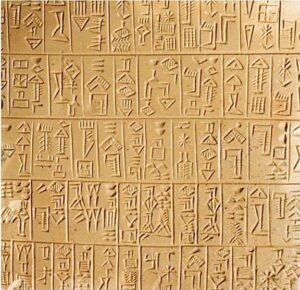
In this article, through his knowledge of the Egyptian language, he demonstrated that the symbols found in the second and third lines of the tablet—see the image of the engraved tablet at Mount Behistun / Elam—are syllabic writing, not alphabetic. Through the phonetic values of keys for names known in Persian, he was able to read many words. He was the one who discovered many Sumerian and Assyrian names such as Nebuchadnezzar, Sennacherib, Jerusalem, and others.
Each of these signs carried the phonetic value or the name of the depicted shape, which became the primary meaning of the relationship or the written pictorial symbol.
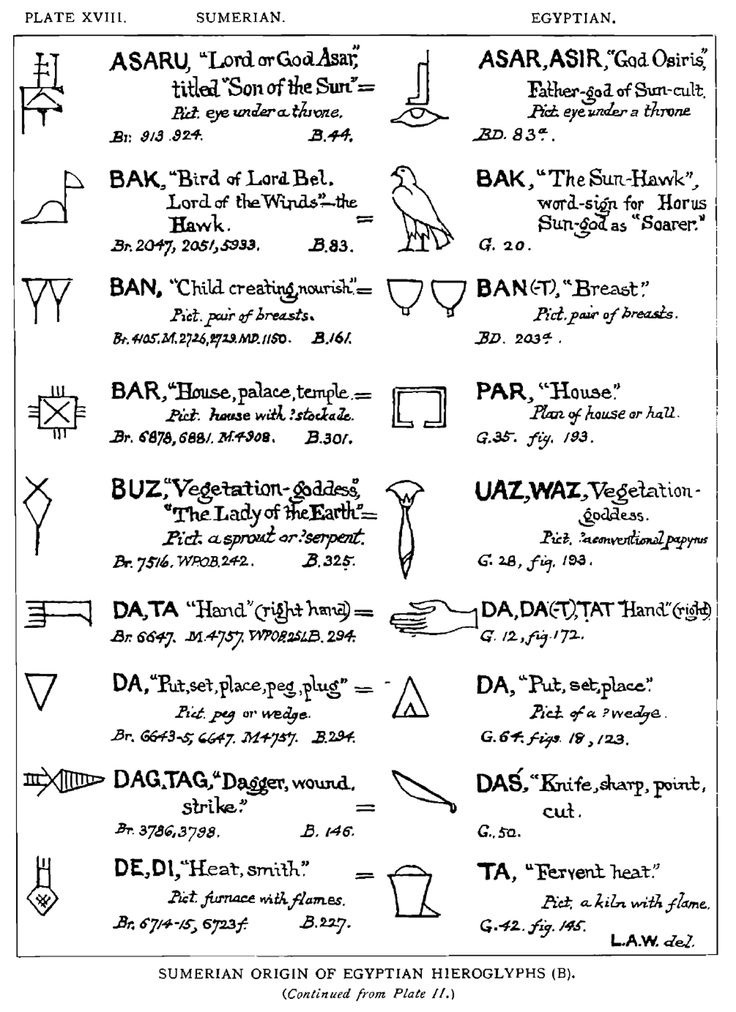
We notice in the attached table some of these models of Sumerian pictographic symbols with their word meanings, which we often find carrying the same basis for the word’s form and meaning in English. Alongside them, you find Egyptian hieroglyphic symbols with their word meanings, phonetic values, and meanings similar to Sumerian. The oldest hieroglyphics are derived from simple Sumerian and are related to the form of Sumerian writing.
The Sumerians used pictorial syllables to express speech and abstract thoughts. They made the pictorial symbol also express various ideas related to the depicted object. For example, the symbol depicting the Sun does not only mean “sun” or its name; it also means brightness, light, radiance, warmth, heat, day, etc. The Moon symbol means shining, month, darkness, death, and fate—and so on.
The specific meaning of a word becomes clear through the symbol’s position in the sentence, the context, or through the prefix or suffix of the word. In this usage, the symbol is called an Ideogram or Ideograph.
As in other Aryan languages and English, Sumerian possesses a number of homophones (words with the same pronunciation but different meanings). We also find many synonyms (words that differ in pronunciation but have the same meaning). Most words in Sumerian have two, three, or more meanings; some have ten or more. Consequently, Sumerian proper nouns written in syllables that have synonyms are difficult, if not impossible, to accurately reconstruct in Roman letters. Linguists, following their habit of reading or rewriting these names, choose one or more phonetic syllables from different synonyms based on their personal perception. This results in significant differences in names, leading to widely varying readings for a single name. Sometimes, the difference is not just between the correct name and the translation, but the reading or translation of the name is entirely wrong, few are correct, and some are purely imaginary.
Fortunately, we now have a key to the names of ancient Sumerian kings through the detailed list of early Aryan kings preserved in Indian myths. Sumerian origins have been revealed for the heroes of historical myths, and research has indicated their Sumerian identity. In Greek mythology, we find the gods Bacchus, Uranus, and the goddesses Athena and Diana are of Sumerian origin, and it appears they moved to Egypt as well.
Furthermore, the names Osiris, Isis, Ra, and Amun are also of Sumerian origin. As for Iron, in its Sumerian name Bar or Bir, it is the origin of the Latin Fer-rum, the French Fer, and the English Iron, referring to the early Aryans’ possession of the metal iron.
Note 1
If we scrutinize the reading of the table published alongside this article—which is one of the tables set by Waddell comparing Sumerian and Hieroglyphics, adding English words with Sumerian origins still used in contemporary English—we will find that some of these words are still used in Kurdish. This demonstrates the close relationship between Kurdish and Sumerian.
For example, the word for Hand:
Sumerian: Da or Ta
Hieroglyphic: Da, Dat, Tat
Contemporary English: Hand
Kurdish: Dest or Das (derived from the same Sumerian root Da).
Similarly, the Sumerian word for Dagger is pronounced Daj or Dagh. In Hieroglyphics, it is Das; in English, Dagger. In Kurdish, the word Das is applied to a Sickle.
In Sumerian, De means Hot; in Hieroglyphics, it is Ta; in English, Heat. In Kurdish and Persian, Dagh means Hot. Thus, it is possible to find other linguistic relationships between Sumerian and Kurdish in the tables mentioned in this important dictionary. I will attempt to demonstrate their relationship to contemporary Kurdish in subsequent articles.
See: L. Austine Waddell, Sumer-Aryan Dictionary, London 1927.
Source: Al-Ittihad Newspaper, October 3, 2006.
Note: This text is translated from the original Arabic version.