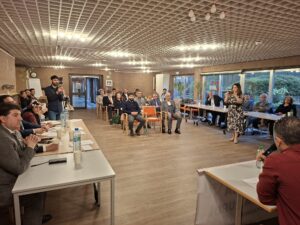
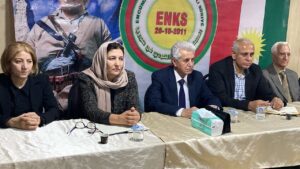
A group of Syrian Kurdish parties issued a joint statement today, Saturday, following their second consultative meeting held on May 9 and 16, 2026. The meeting, convened at the invitation of the Kurdish Democratic Unity Party in Syria and the Kurdish Democratic Progressive Party in Syria, discussed a range of political issues and topics concerning both the Syrian national and Kurdish arenas.
The statement noted that participants discussed, on a general Syrian level, the shifts and events the country has witnessed since the fall of the Ba’ath regime, as well as the actions of the Interim Authority on both international and domestic fronts. It clarified that while the Interim Authority has made progress internationally and regionally regarding the lifting of the blockade and economic sanctions imposed on Syria during the previous phase, these steps “have not tangibly reflected on the economic and living reality of citizens.” This comes as millions of Syrians continue to suffer from poverty and live in displacement and refugee camps both inside and outside the country.
The statement added that the participants believe the performance of the Interim Authority “did not rise to the level of sacrifices made by Syrians for the sake of freedom and dignity,” asserting that it failed to initiate solutions for the fundamental issues facing Syrians—particularly regarding their genuine participation in political and economic decision-making.
Furthermore, according to the statement, attendees noted that the centralization of power in the hands of Hay’at Tahrir al-Sham (HTS) and its inner circle “has raised a state of anxiety and unease among many components of Syrian society.” This concentration of power contributed to “massacres and painful security incidents that claimed the lives of thousands of victims and created a wide rift in the Syrian social fabric.”
The statement emphasized that the current Interim Authority “continues to exclude and marginalize the Kurdish people,” noting that Decree No. 13 “does not meet the aspirations of the Kurdish people and does not reflect the scale of their sacrifices and political struggle.”
On the Kurdish level, the statement explained that the participants discussed developments in the Syrian Kurdish scene since the signing of the March 10, 2025 agreement, through the Conference for Kurdish Unity and Position and its resulting delegation, the January 29, 2026 agreement, and ongoing attempts to form a Kurdish political reference.
The attendees observed that the Kurdish situation is witnessing a “clear state of division and unilateralism in political decision-making based on narrow partisan and framework agendas.” They considered this to have led to the marginalization of the outcomes of the Conference and the joint Kurdish delegation. They also pointed out that “attempts to monopolize decisions and positions within state administrations during the merger process in Al-Hasakah Governorate and the Kobani region” contributed to deepening the division within Kurdish ranks.
The statement mentioned that the meeting discussed efforts to form a Kurdish political reference that fairly represents all Kurdish regions and populations, including all Kurdish parties in Syria, in addition to social and cultural activities and civil society organizations.
The participants stressed that any Kurdish political reference must enjoy independence in Syrian Kurdish political decision-making and remain distant from the principle of “quota-sharing and parity” (muhasasa) adopted in previous Kurdish agreements. They argued that those past experiences “have proven their failure” and that reproducing them “will not be feasible.”
The statement asserted that the sought-after Kurdish reference should be the authorized body for making decisions regarding the Kurdish cause in Syria, including managing dialogue and negotiations with any party.
Finally, the participants stressed that the Kurdish issue in Syria “is not an issue of quotas or the sharing of positions and jobs,” but rather “a national and constitutional issue concerning the political and national rights of the Kurdish people.” They emphasized the necessity of resolving it through a democratic constitution that guarantees the legitimate national rights of the Kurdish people and ensures genuine partnership, justice, and equality among all components of the Syrian people.
Issued in Qamishli, May 17, 2026, with the participation of:
Kurdish Democratic Unity Party in Syria (Yekîtî)
Kurdish Democratic Party in Syria (Al-Parti)
Kurdish Democratic Left Party in Syria
Kurdistan Azadi Movement in Syria
Syrian Kurdish Democratic Accord Party (Wifaq)
Kurdistan Democratic Peace Party
Kurdish Left Party in Syria
Kurdish Democratic Progressive Party in Syria
Note: This text is translated from the original Arabic version… Read the Arabic version:Click here