Not all holidays are merely temporal markers repeated in the cycle of the year; rather, some transcend their celebratory function to become a concentrated expression of an entire worldview. In this context, the festival of Çarşema Sor (Red Wednesday) stands out in Yazidi heritage as more than just a religious occasion. It is an integrated narrative of creation, rewritten annually through rituals, through which the questions of the first beginning, existence, and the relationship between humanity and the world are reclaimed. Contemplating this feast reveals a complex symbolic structure where myth intertwines with philosophy, and ritual with meaning, to produce a unique conception of the universe and life.
The Egg as a Primordial Symbol
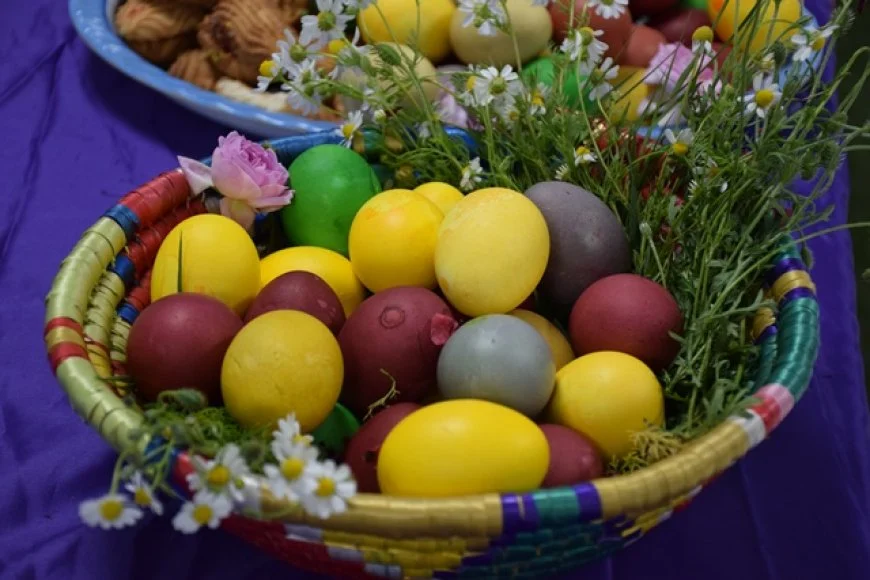
The egg occupies a central position in this narrative as a primary symbol of creation. In its symbolic representations, it refers to the state of cosmic enclosure before formation—a world not yet shaped, self-sufficient, yet carrying within it the potential to explode into life. The breaking of the egg, as manifested in Yazidi rituals, is not merely a celebratory act but a symbolic reenactment of the first moment of emergence, when the universe transitioned from latency into action. Here, the egg transcends its material form to become a philosophical metaphor for transformation and the transition from static unity to living multiplicity.
The Divine Order and the Role of Tawûsî Melek
Within this horizon, the descent of Tawûsî Melek (the Peacock Angel) acquires pivotal significance in organizing the world. The Yazidi narrative is not content with a mere physical conception of the creation of the universe; it emphasizes the necessity of an organizing principle that moves existence from chaos to order. The presence of this spiritual entity at the moment of foundation imbues creation with an ethical and spiritual dimension. Here, the universe is not understood as a mere material accumulation, but as a meaningful system subject to a delicate balance of forces.
Lalish: The Cosmic Center
This vision cannot be separated from the place where the festival’s rituals are embodied: Lalish. It is not reduced to a geographical location but takes the form of a symbolic cosmic center. In this space, meanings are intensified, and the place becomes a mirror of the universe itself. The lighting of lamps, distributed according to the number of days in the year, is not just a religious rite but a symbolic rearrangement of time and an attempt to bestow meaning upon its cycle. In Lalish, the sacred is not only celebrated but reproduced through collective action, making the human presence an integral part of the cosmic structure.
Ritual as a Philosophical Act
The rituals associated with Red Wednesday reveal a deep philosophical dimension that transcends the mundane. Coloring eggs, hanging flowers, and lighting lamps are not purely spontaneous or traditional acts; they represent forms of “symbolic representation” of the idea of creation. Here, the human being transforms from a recipient of the narrative into a participant in its reproduction. Ritual, in this sense, is not mere repetition but an interpretive act through which society reformulates its relationship with the universe and affirms its presence within its system.
The most profound ideas of this holiday manifest in the view of nature as a living being. Refraining from working the land during this day is not understood merely as a religious prohibition, but as an acknowledgment of the sanctity of nature and its right to “rest” or “renewal.” This vision reflects an early ecological consciousness that recognizes the relationship between humans and the earth is not one of exploitation, but one of balance and respect. In this, the feast can be read as an implicit call to rethink the human position within the natural world.
Contemporary Human Meaning
However, the true significance of Çarşema Sor lies not only in its cosmic dimensions but in its ability to transform into contemporary human meaning. In a world of accelerating transformations and threatened identities, this holiday becomes a means of reaffirming belonging and reviving collective memory. It does not stop at telling the story of creation; it links it to current human needs: the need for hope, renewal, and a sense of continuity.
In conclusion, Çarşema Sor appears to be more than just a holiday; it is an existential experience where symbolism intertwines with practice to produce a living meditation on the meaning of creation. Through this journey, from the egg to the universe, humans do not merely revive the past but rediscover themselves as part of this universe and witnesses to its constant transformation. Here, celebration becomes a philosophical act, inseparable from the deeper question: What does it mean to be part of this world?
The Meaning of Belonging
At first glance, this question may seem open to infinite possibilities, but reading the festival in its symbolic context allows for an approach to a possible answer. To be part of this world, according to the rituals of Red Wednesday, does not mean mere physical existence within it, but engagement with its deep rhythm—recognizing that we are not the center of the universe, but one of its manifestations. From this perspective, man is not the master of nature as much as he is a partner in it, subject to its laws even as he contributes to its continuity.
The reenactment of the moment of creation every year serves as a reminder that the beginning is not a disconnected event in the past, but a continuous process renewed through human action itself. When a person colors an egg, lights a lamp, or hangs flowers, they are not just recalling an ancient story; they are re-entering themselves into the circle of creation as a being capable of bestowing meaning upon their existence. In this sense, the holiday becomes an act of consciousness, not just a ritual.
Consequently, it can be said that the meaning of being part of this world manifests on three interconnected levels:
Awareness of belonging to a broader cosmic order.
Assuming responsibility for this belonging by respecting the balance of nature.
The ability to transform individual experience into a collective meaning, preserved and passed down through generations.
Here, the human being is no longer an isolated entity, but a link in an extended chain that begins from the moment of creation and does not end. With this understanding, celebrating Red Wednesday is not merely a recollection of the past, but a living practice of an existential philosophy that sees humans as participants in creation, not mere spectators. Perhaps therein lies the power of this holiday: in its ability to transform the existential question from abstract theoretical contemplation into a lived experience, where man finds—even if temporarily—his place within this changing universe.