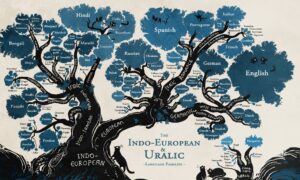
The Kurdish language belongs to the Indo-European language family, specifically the Indo-Iranian branch. The bond linking Kurdish to this linguistic group is evidenced not only by the presence of thousands of Avestan, Pahlavi, and Old Persian terms within Kurdish but also by similar grammatical structures regarding verb conjugation and sentence construction. This extends to semantic shifts, phonology, and the syllabic division of speech. However, belonging to this linguistic group does not, under any circumstances, negate the independence of the Kurdish language among the living languages of the world. Despite the many similarities it shares with other languages in this group in the aforementioned aspects, it possesses its own origins, grammar, developments, semantics, and derivations; it is not a branch of any other language. While acknowledging a linguistic kinship with modern Persian, for instance, Kurdish remains a distinct language that has preserved its independence. This is supported by all phonetic, ethnographic, and comparative studies conducted by the German scholars Rüdiger and Pott (1840 AD). Through continuous comparative linguistic research between Kurdish words and Iranian languages, they proved that Kurdish—with its grammar, vocabulary, origins, and phonetics—is a distinct and independent language, despite its affiliation with the Iranian languages.
This view was subsequently supported by the Russian Orientalist Peter Lerch in his valuable research published under the title Studies of the Kurds in both Russian and German (1857 and 1858) in Saint Petersburg (Leningrad), as well as his significant work Studies of the Kurds of Iran (1856) in Saint Petersburg in Russian. This opinion was also endorsed by prominent Orientalists such as Renan, Dorn-Arsh, Mueller, and Jaba.
Major Edmonds, a specialist in Kurdish history, stated in an article published in the Journal of the Central Asian Society (Issue 11):
“It has become quite clear that the Kurdish language is not a distorted or turbulent Persian dialect, but rather a known pure Aryan language with its own characteristics and ancient developments.”
Similarly, Minorsky, a researcher specializing in Oriental languages, confirms this. He believes that while the Persian language belongs to the Southwestern group, the Kurdish language belongs to the Northwestern group and possesses a character entirely distinct from Persian. He provides linguistic evidence proving the existing differences between the two.
The Origin of the Kurdish Language
To study the origin of the Kurdish language, one must review the oldest written works in Iranian languages. Perhaps the oldest of these works is the Avesta (the book of the Zoroastrian religion), which was written around the 7th century BC.
Zoroaster was born in Urmia (the current city of Rezaia); he is of Kurdish origin and is the Aryan prophet from the people of Medes and the Maz sect. He called for the worship of Ahura Mazda, the all-knowing God, to be the deity for all human sects. However, he faced great persecution from his people, so he migrated east to the lands of King Vishtaspa (Kashtasb) in Balkh. He converted the king and his subjects to his religion, and they defended this faith so fiercely that it spread gradually. Nevertheless, not all Iranians followed the religion of Zoroaster until the end of the Achaemenid and Parthian eras; Zoroastrianism did not become the official state religion until the Sassanid era.
Historical studies indicate that the Zoroastrian books that have reached us are but a small fraction of what they once were. Al-Masoudi mentioned in The Meadows of Gold (Muruj al-Dhahab) that the Abastaq—meaning the Avesta—was written in twelve thousand volumes in gold, containing promises, warnings, commands, prohibitions, and other laws and rituals. Kings continued to act according to this book until the time of Alexander the Great, who burned parts of it. This was also mentioned by Tansar, the chief religious scholar during the reign of Ardashir Babakan, in his letter to Ghasanif Shah, the King of Tabaristan:
“You know that Alexander burned our religious book consisting of twelve thousand cowhides in Istakhr; only a third of it remained preserved in memories, and even that consisted entirely of stories and traditions.”
As for Dr. Muhammad Moein, he states that the Roman historian Pliny, from the first century AD, quoted the Greek historian Hermippus (who lived in the third century BC) as saying that he read the doctrine of the Iranians in their religious book composed by Zoroaster in a thousand verses.
In the Shahnameh, it is mentioned that the chapters of the Avesta, numbering one thousand two hundred, were written on a gold tablet. The English scholar West mentions that the Avesta consisted of 345,700 words, of which only 83,000 remain in the current Avesta—less than a quarter of the original.
The Avesta consists of five parts: Yasna, Visperad, Vendidad, Yashts, and Khordeh Avesta. For the sake of this brief overview, we are only concerned with the Yasna due to its close connection to our research. It consists of 72 chapters, 17 of which are known as the Gathas, considered the oldest parts of the Avesta because they are widely believed to be the words of Zoroaster himself. The word Gatha (singular: Gath) means a hymn or a poem interspersed with verse. They were all written in poetic language, though it is not like modern Iranian poetry which follows Arabic prosody; rather, it is closer to the poetry of Indo-European peoples.
The chapters of the Gathas consist of five sections: Ahunavaiti, Ushtavaiti, Spenta Mainyu, Vohu Khshathra, and Vahishto Ishti. The Gathas comprise 238 pieces, 896 verses, and 5,560 words. Modern linguistic studies indicate a linguistic proximity and close connection between the language in which the Gathas were written and the current Kurdish language, as the 17 chapters were written in the Median language.
The scholar Ihsan Nuri states that the word “Zoroaster” itself is an authentic Kurdish word:
“They used to call Zoroaster ‘Zarathustra Spitama,’ which means ‘Zoroaster of White Origin.’ These words, which belonged to the language of Zoroaster’s people—the Medes—do not have fundamental differences from the current Kurdish language…”
Note that “Zarathustra Spitama” in the Kurdish language translates to “The Golden Ray of the White Sun.”
The Kurds and Media
All current ethnographic studies indicate that the Kurdish nation descends from the Median lineage. Perhaps one of the greatest Orientalists to defend this view is the scholar Minorsky. Professor Ihsan Nuri says in this regard:
“In truth, although Median terms and words have mixed with Turanian and Semitic words on one hand, and passed through different eras that caused significant changes—which cannot be denied or avoided—on the other hand, they remain closer to the Kurdish language than to any other language.”
Professor Derik Kinnane also agrees with this view, stating:
“The Kurdish language is branched from the Median language, as the Medes are considered a primary ancestor of the Kurds.”
This view has also been supported by many Arab authors, including Dr. Muhammad Sayyid Ghallab, Professor of Anthropology at Cairo University, who said:
“The land of Al-Jazeera and Northern Iraq continued to receive Indo-European Bedouin migrations from Central Asia, carrying the trait of blondness. This region is the homeland of the Kurds today, who are the descendants of the ancient Medes that appeared in the first millennium BC. Blondness is clearly widespread among them, they speak an Indo-European language, and they occupy the shared border region between Iraq, Iran, and Turkey.”
Thus, we finally reach an inevitable conclusion: the oldest Kurdish literary work discovered to date is the Gathas section of the Avesta, written in the 7th century BC, based on the fact that Zoroaster himself was Median, spoke the language of the Medes, and that the Medes are the Kurds of today. Major Soane, a British governor and an expert in the Kurdish language, also wrote about this view in his report on the Sulaymaniyah province:
“It has become accepted that Zoroaster, who spoke the Late Median language, was born in the northern Median province, now known as the Mukri province. This language of Zoroaster, as we see it in the Zend-Avesta, is very close to the current Mukri dialect of Kurdish.”
August 2006
Note: This text is translated from the original Arabic version.