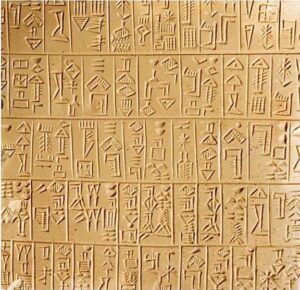
The Hurrians left us few sources about their religion, as much of Hurrian mythology was known through Hittite mythology, which is fundamentally Hurrian mythology, as well as through the antiquities discovered in (Ugarit).
Hurrian beliefs spread in the region of Central Asia, where the peoples of this region adopted the Hurrian religion, and the features of the Hurrian deities clearly appear in the religions of these peoples. The Hurrian religion had a particularly significant impact on Hittite beliefs. For example, inscriptions in (Yazılıkaya) indicate that the Hurrian deities officially became deities of the Hittite Empire, that Hittite queens had Hurrian names, and that Hurrian mythology appears in Hittite poetry. The Hittites also adopted the Hurrian myth “Song of ULLIKUMMI”.
The deities of the Hurrians had their own temples, as was the case for the ancient inhabitants of southern Mesopotamia or Egypt. The Hurrian kingdom was later a religious center for the moon god, while the town of (KAHAT) was a religious center for the Mitanni kingdom after its establishment. The temple of (NERGAL) was built in the late third millennium BC, and the deity (SHAUSHKA) had an important temple in Nineveh when the city was under Hurrian rule.
The Hurrians practiced special religious rites and had festivals at specific times, which they celebrated in temples and in small sacred groves. Their rites consisted of activities to purify the soul, obtain divine blessing, and equip themselves with magical influences. The Hurrians were also interested in talismans, prophecies, divination, and fortune-telling.
Hurrian documents and myths indicate that the Hurrian deities lived like humans, marrying, having children, falling ill, and dying, just as humans do; however, humans worshipped their deities and prostrated to them, as is the relationship today between the Creator and humans. They offered sacrifices to the deities and performed religious worship rituals, as many Hurrian rituals were found in the Hittite kingdom in Anatolia. There are also many indications of the Hurrians practicing magic and incantations.
In addition, non-human sacred entities, such as the sky and the earth, were of great importance to the Hurrians, and the same applies to the deities of mountains and rivers. In Hurrian mythology, the evil side of the deities often triumphed over the side of good.
The Hurrians worshipped many deities, with the main Hurrian deities being: the king of the deities, who is the weather god (TESHUP), the mother goddess (HEBAT), who was the sun goddess among the Hittites, the god (SHARRUMA), who is the son of both the weather god and the mother goddess, the god (KUMARBI), who is the predecessor of the weather god and whose primary center of worship was the city of Urkish, the goddess of fertility, war, and healing (SHAUSHKA), whose center was in Nineveh, the sun god (SHIMEGI), and the moon god (KUSHUH). Below, we briefly review the most important Hurrian deities.
(Shawushka) – She is the goddess of fertility, war, and healing, and is the wife of the king of gods (Teshup). She was mentioned in documents from the era of the Third Dynasty of Ur, and her main center of worship was the city of Nineveh. She was worshipped under many names, the most famous of which was Ishtar of Nineveh. The prevailing belief was that her statue healed the sick, and the statue was sent twice to Egypt to heal the Egyptian Pharaoh Amenhotep III (Gernot Wilhelm: The Hurrians: Their History and Civilization, translated by Farouk Ismail, Dar Jadal, Aleppo, First Edition, 2000 AD, pp. 98 – 101, 123; Fadhil Abdul Wahid Ali: From Sumer to the Torah, p. 154).
(Teshub) – He was the king of the deities and the weather god. According to mythology, (Teshub) deposed his father (Kumarbi) from the throne of divinity through the use of violence and became king. In this regard, he resembles the Greek god (Zeus), who deposed his father (Kronos). The war chariot of the king of deities (Teshub) was drawn by the bull gods (Seris) (day) and (Hurris) (night) (Gernot Wilhelm: The Hurrians: Their History and Civilization, translated by Farouk Ismail, Dar Jadal, Aleppo, First Edition, 2000 AD, p. 98). The main temples of (Teshub) were located in (Arrapkha) (present-day Kirkuk) and in Aleppo. The city of (Kumme/ Kummija) was one of his most important centers of worship, which is mostly located in the mountainous region in the Zakho area, and his name was mentioned in texts from the third millennium BC (Gernot Wilhelm: The Hurrians: Their History and Civilization, translated by Farouk Ismail, Dar Jadal, Aleppo, First Edition, 2000 AD, p. 98). In the East (northern Mesopotamia), the goddess of love and war (Shawushka) was his wife, while in the West (Anatolia), the goddess (Hebat) was his wife. (Teshub) was also worshipped in both the land of the Hittites and (Kizzuwatna).
(Kumarbi) – (Kumarbi) was the father of all deities according to Hurrian beliefs. His rank was sometimes at the level of the chief of the Sumerian deities (Enlil) and the god of plant fertility among the Western Semites (Dagan). He possesses wise thoughts and leads the staff. The city of (Urkish) was a religious seat for the Hurrians and a center for the Hurrian god (Kumarbi), who is the predecessor of the weather god (TESHUP); Source 1, 2).
(Imbaluris) – He was the messenger of (Kumarbi). He is sent to warn the sea that (Kumarbi) must remain the father of the deities.
(Nergal) – The god (Nergal) was the god of the sky and held a high rank in worship. The temple of (NERGAL) was built in the late third millennium BC during the reign of the Hurrian king (Atal-shen).
(Hannahanna) (Nintu, Mah) – She is the mother of all deities. She has a connection with (Gulses). After (Telepinu) disappears, the storm god complains to her. She sends him to search for himself, and when he stops searching, the mother of the deities (Hannahanna) sends a bee to punish him by purifying this god through the bee stinging his hands and feet and wiping his eyes and feet with wax.
(Upelluri) – Similar to (Atlas), this giant god carries the world on his shoulders. The ancient deities built the earth and the sky upon this god, and despite that, he did not notice this structure, even when the earth and sky were separated with a cleaver.
(Seris or Serisu) – This is one of the sacred bulls of the storm god. In preparation for battle, the storm god has (Tasmisus), who oils his horns and takes him to the peak of Mount (Imgarra) along with the bull (Tella) and the battle chariot.
(Tella) – This is another sacred bull of the storm god. In preparation for battle, the storm god has (Tasmisus), who paints his tail with gold and takes him to the peak of Mount (Imgarra) along with the bull (Seris) and the battle chariot.
(Aranzahus) – He is the deified Tigris River. He is the son of (Anu) and (Kumarbi), and was the brother of the storm god and (Tasmisus). He was spat out from the mouth of (Kumarbi), onto Mount (Kanzuras). Later, he conspires with (Anu) and the storm god to destroy (Kumarbi).
(Tasmisus) – He is the son of (Anu) and (Kumarbi) and is on good terms with both the storm god and (Aranzahus). He was the brother of the storm god and (Aranzahus). He was spat out from the mouth of (Kumarbi), onto Mount (Kanzuras). Later, he conspires with (Anu) and the storm god to destroy (Kumarbi).
He serves as the helper of the storm god.
(Suwaliyattas) – He is a warrior god and was likely the brother of the storm god.
(Hebat) – She is the revered wife of the storm god (Teshub). She is the goddess of sex and fertility. According to Hurrian beliefs, when (Teshub) and (Hebat) engage in sex with each other, heavy rains fall, which breathe new life onto the face of the earth, increasing the productivity of agricultural fields and multiplying flocks of sheep and horses. At times, she is depicted standing on her sacred animal, the lion. After the storm god and (Astabis) failed to attack (Ullikummi), the giant forced her to leave the temple, which led to her losing contact with the deities. She became anxious that (Ullikummi) might have defeated her husband. She expressed her concern to her servant (Takitis), tasking him to convene the council of deities and obtain news of her husband. She presumably received news of her husband’s defeat. (Tasmisus) visits her in the high watchtower and informs her that the storm god has been placed in a humble position for a long period of time. The goddess (Hebat) is the mother of (Sharruma).
Writings in the city of Hattusa mention the name of Sharruma, son of the goddess Hebat, and his two children (Sharmanis) and (Alunzunis). Sharruma, son of Hebat, was known in the land of the Urartians by the name (Tella), while Hebat herself was known by the name (Hupa).
The name (Hebat) appears in the Hittite Kingdom period in the writings of (Yazılıkaya), where the image of the goddess (Hebat) was carved on that tablet. The goddess (Hebat) appears on that tablet riding the back of a leopard, with her name written in Hittite hieroglyphic letters above her right fist. These writings were written during the reign of the Hittite King Hattusili III in the mid-thirteenth century BC.
(Wuruntemu) – Sun goddess of (Arinna), lady of the lands of (Hatti), queen of heaven and earth, lady of the kings and queens of (Hatti), managing the government of the king and queen of (Hatti). This goddess later becomes similar to (Hebat). She created the land of the cedar. She is the first goddess in (Arinna), with (Taru) as her consort. She is the goddess of battle and is associated with Hittite military victory. She is the mother of the storm god of (Nerik) and thus may be connected to (Ereshkigal), whom the goddess (Wuruntemu) helps to bring back from the underworld.
(Sharruma) – “Calf of (Teshub)”, he is the son of (Teshub) and (Hebat). This god is symbolized by a pair of human legs, or a human head in the form of a bull. He is later identified with the weather god of (Nerik) and (Zippalanda).
(Takitis) – He is the servant of (Hebat). After (Hebat) was removed from her temple, (Hebat) expressed to her servant (Takitis) her concern for her husband and tasked him with convening the council of deities to learn her husband’s fate.
(Mezzullas) – She is the daughter of the storm god and the sun goddess of Arinna. She and her parents possess an abundance of hidden power emanating from the stars that affects people’s lives and destinies.
(Zintuhis) – She is the granddaughter of the storm god and the sun goddess of Arinna.
(Telepinu) – The “noble god” who is an agricultural god. He is the firstborn son of the storm god and his favorite son. It was said of him that he is “combs and plows”. He watered the fields and made crops grow. He prepares the soil, levels it, plows the land, waters the fields, and makes plants grow.
(Ullikummi) – The diorite man (diorite is an igneous rock). He is the son of the god (Kumarbi) and the rock. This god is composed entirely of diorite. He was born to be used as a weapon to defeat the storm god and his ally, the sun god of heaven. This god is one of the just deities and sometimes the king of all deities. He is an ally of the storm god. He writes notes for the giant (Ullikummi) in the sea and visited the storm god, refusing to eat until he writes reports of his news. After he has done so, the storm god declares that the food is on the table and must become palatable, which indeed happens, and thus the sun god enjoys eating his meal and returns to his path in the sky.
(Hapantallis) – He is the shepherd of the sun god.
(Kashku) – He is the moon god. He fell from the sky onto the “kilamar” gate complex and disappeared. The storm god (Taru) caused a rainstorm after him that terrified him. The Hurrian kingdom was later a religious center for the moon god.
(Inaras) – She is the daughter of the storm god and the goddess of wild animals of the steppe (a steppe is a vast treeless plain).
(Illuyankas), the dragon (dragon means a very violent person). He defeated the storm god at (Kiskilussa). Later, he and his children were lured out of their lair by the elegant (Inaras) under the pretext of inviting them to a feast. After their blood was too congested to return to their lair again, the storm god, accompanied by other deities, killed him.
(Hedammu) – He is the serpent who loved Ishtar.
(Hapantalliyas / Hapantalli) – This god took his place alongside the moon god when he fell from the sky onto the gate complex and cast magic.
(Kamrusepas) – She is the goddess of magic and healing. She witnessed and announced the fall of the moon god from the sky onto the gate complex.
(Astabis) – He is a Hurrian warrior god. After the first unsuccessful attack of the storm god on (Ullikummi), he led seventy deities in battle chariots in an attack on the volcanic rock giant. They tried to draw the water away from him, presumably to work on stopping his growth, but they fell from the sky and (Ullikummi) grew even larger, soaring above the gate of (Kummiya).
(Uliliyassis) – He is a minor god who duly removes sexual impotence.
(Kubaba) – She is the primary goddess of the Hittites, who became Cybebe to the Phrygians and Cybele to the Romans.
(Yarris) – He is the god of pestilence. A festival was held for him every autumn.
(Hasamelis) – He is the god who can protect travelers, possibly by making them invisible.
(Zashapuna) – He is the chief god of the city of (Kastama), where he is respected there more than the storm god, and he may have gained such influence by winning the admiration of many other deities.
(Papaya) – He is one of the deities who sat under the wild hawthorn tree awaiting the return of (Telipinus).
(Istustaya) – He is one of the deities who sat under the wild hawthorn tree awaiting the return of (Telipinus).
(Miyatanzipa) – It is not known whether this deity was male or female. This deity is one of the deities who sat under the wild hawthorn tree awaiting the return of (Telipinus). This deity also sat under the golden root tree when (Hannahanna) found the hunting bag.
(Uruzimu) – A god who participated in bringing back the storm god of (Nerik).
(Hahhimas) (Frost) – When the sea god detains the sun god, (Hahhimas) detains the other deities and the plants and animals of the land areas and paralyzes them. He is a half-brother to the brothers of (Hasamili) and refrains from capturing them.
Sources
Paul Thieme (1960). The Aryan Gods of the Mitanni Treaties, Journal of the American Oriental Society 80, 301-317.
Güterbock, Hans Gustav (1950): “Hittite Religion”; in Forgotten Religions: Including Some Living Primitive Religions (ed. Vergilius Ferm) (NY, Philosophical Library, pp. 88–89, 103–104.
4 / 2 / 2014
Note: This text is translated from the original Arabic version… Read the Arabic version:Click here