By: Sabah Kanji
The small town of Bahzani is one of the most beautiful Yezidi villages in Iraq. It is bordered to the north by Mount Maqlub and to the south by the Mosul Plain—the second-largest city in Iraq after the capital, Baghdad.
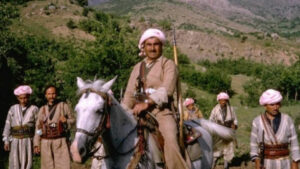
This town is distinguished by the unique traditional attire of its men and women, and its specific dialect, which is a blend of Kurdish and Arabic. It is also notable for the abundance of ziggurat-style domes scattered across its hillsides, built with white plaster. Most of the Qawwals [1] reside there along with their leader; these are the clerics who have formed the backbone of Yezidi religious oral literature throughout history, embodying the town’s mythological significance.
I grew up remembering—among many things—that deep pool of water at the entrance of Gully Al-Sanjak (Sanjak Valley), which we called the (GOM). Mothers would constantly warn their children against going near the Gom for fear of drowning, especially during the flood season. At that time, the small stream feeding into it would transform into a fierce, fast-flowing river, sweeping away rocks, cattle, goats, and sometimes young children.
I can say that my interest in Sumerian mythology began long ago with this local name, (GOM). I started searching for similarities and correspondences between the customs of the Yezidis—as remnants of an ancient religion still present in scattered parts of Kurdistan, particularly the Mosul regions and other countries—and the customs, rituals, and primitive religion of the Sumerians. It first caught my attention that the word (GOM) in the Sumerian language means a “gathering” or “collection.” Thus, I realized by chance that this local naming has deep historical roots.
I present this somewhat lengthy introduction as a prelude to a new chapter in the context of researching the comparison between the Yezidi religion and the ancient Sumerian religion. I will delve into the maze of shared linguistic synonyms after having gathered a substantial collection of them, for the following reasons:
-
My belief that this shared linguistic connection and correspondence is not a mere coincidence or a meaningless similarity. Rather, it is a unique state of historical-mythological continuity, embodied in the Yezidis’ loyalty to their origins despite the vast temporal gulf between the two religions, which exceeds 6,000 years. This period was characterized by deep transformations and complexities due to various forms of oppression that accompanied most of its eras, leading to countless disasters. Yezidi oral literature speaks of (72) Fermans (decrees of genocide) that befell them, which will be the subject of our research in a later chapter.
-
This linguistic connection and similarity almost entirely correspond in the most complex mythological issues, specifically in the story of creation and genesis, in both its synonymous parts: the creation of the universe and the creation of man, and sometimes in the derivatives, concepts, and names branching from them.
-
Some names and concepts used in the Arabic language—including the words for “Religion” (Din) and “Earth” (Ard), which Yezidi Kurds use in their contemporary language—are not purely Arabic. They have roots in Sumerian and later Babylonian, from which they entered Arabic. This caused confusion and illusion among some Arabic writers and historians, leading them to attribute the Yezidis to Arabs and Muslims, considering them a “deviant Islamic sect,” etc.
-
We will attempt to investigate the concept of “Yezidism” among the Sumerians as a related topic, regarding the naming of contemporary Yezidis and the extent of its usage in Sumerian literature where possible, according to new research and studies. We believe this subject holds great scientific and historical importance deserving of attention and scrutiny.
Four essential components lie at the heart of Sumerian and Yezidi mythology: (Earth – Sky – Water – Air). Similarities and correspondences can be observed in both language and mythological significance, as well as the derivation of these names.
Earth—KI or CI-GI for the Sumerians—is a female goddess with many names but one persona. As the wife of the male sky god (AN), she is called ANTUM (the feminine form of An), and she is also NIN-MAH. The name Nin-mah indicates the essence of this deity in the Sumerian mind; it is composed of two affixes: (NIN), meaning lady or great, and (MAH). We still call a mother or grandmother by the term “Nina.” The second affix is Mah, from which the word “MAK”—circulated among Yezidis to this day—is derived. The translation thus becomes “Lady Mother,” “Great Mother,” or “Grandmother.”
KI was also known as NINTO, a name that carries the meaning of motherhood because (NIN = Lady + TO = gives birth), meaning “The Lady Who Gives Birth” or “The Mother.” She was also called ARSH, meaning earth, and held the titles MAMI, MAMA, and MAH, all of which contain the “M” of motherhood [2].
In the Babylonian era, which inherited the remnants of Sumerian mythology with some changes in the names of gods, some names evolved. Thus, Earth became CI and ARD GI [3] after passing through an intermediate stage, ARSH. In Sumerian mythology, an overlap between “Earth” and “Woman” is observed, embodied in fertility and procreation; their roles are so similar that GI is the “Mother-Earth” [4]. Therefore, the concept of plowing was commonly used to express sexual activity among the Sumerians. As mentioned in a Sumerian poem sung by the goddess Inanna to her lover Dumuzi:
“Plow my vulva, man of my heart” [5]
And in earlier verses of the same poem:
“As for me, for my vulva / For the high-piled hillock / For me, the virgin, who will plow it for me? / My vulva, the watered land, for me / For me, the queen, who will station the ox there?” [6]
The Sumerians called their subterranean world—the underworld—KUR [7]. This is taken from the concept of a monster they imagined lived underground, who kidnapped a goddess named Ereshkigal to live with him as a wife in the underworld.
Mr. Al-Qumni confirms in his research: “The word Kur shifted from signifying the lower monster to signifying the underworld in general, as a result of imagining the underworld kidnapping the living on earth to bring them down as dead into its belly” [8]. In one of the supplications of the goddess Inanna for her lover Dumuzi, we find another name for the underworld: AN or EDIN (DIN). It is the world of Din, and the word EDIN originally means “plain,” from which the term Garden of Eden originated.
After these diverse citations from various ancient and modern sources about the Sumerians, we come to the comparison to see that contemporary Yezidis share many names of the earth and their linguistic and mythological derivations with the Sumerians:
-
They (the Yezidis) call the (KI-GI-ARD) Sumerian synonyms ARD, which is the same usage without change despite the passage of time.
-
Yezidis refer to a specific place on earth with the term CI-GI, from which comes (Ciyewan = their place) or (Ciyaware wan), meaning their dwelling place or home—the land upon which a building is constructed.
-
The Sumerian term KUR for the underworld means “depth” to the Yezidis. KUR is depth, from which comes (Korik = the hole). The deep connection between the concept of “below” and “depth” in both cases is clear.
-
Yezidis use the name (Gor or Gorstan) for graves. This name carries deep mythological dimensions signifying the transition of man to the underworld. Here, the concepts of depth (Kur) and the underworld (Gor) or the lower layers of the earth coincide again between Sumerians and Yezidis.
-
Most importantly, the naming of the earth overlaps with the mother in the Yezidi language, just as the earth overlapped with the mother mythologically for the Sumerians. Yezidis say (DI – de – CI – Day – Dayik – Ciyamin), meaning “my mother,” or “Jiyata,” meaning “your mother.” She is the symbol of fertility and giving, like the land that grows crops; hence, the words for mother and earth (GI-CI) became synonymous to express both concepts without confusion.
-
Both parties call the new homeland or new place by the same name without any change: (Nu-war).
-
Likewise, the word (RAST), meaning “straightness” or “integrity,” is shared between the two with the same meaning and significance.
This pertains to the earth and its significances. Similarities can be observed in the rest of the basic components: Water (A) in Sumerian is (Af) in Yezidi. The term (Ashu kani) is (Sere kani) in Yezidi; both mean “head of the spring.” Sky (AN) in Sumerian is (Asman) in Yezidi.
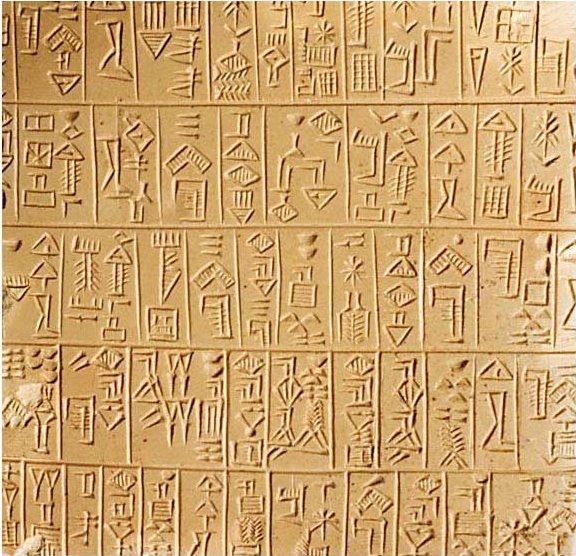
As for the name Yezidi itself—often used in the Arabic form “Al-Yazidiyya” by some Arabic writers who erroneously attribute it to Yazid bin Anisa or Yazid bin Muawiya—there is no doubt today, following new archaeological discoveries, that it is a purely Sumerian and circulated term. Its use recurred in Sumerian literature preserved through baked clay tablets in many poems, epics, and legends. It is the name of the temple (Ezida), as first noted by the late Iraqi researcher George Habib in his book The Yezidis: Remnants of an Ancient Religion. Habib stated:
“Nabu was the god of the city of Borsippa on the Euphrates, where his temple called (Ezida) stood, while the city of Babylon lay on the opposite bank where the god Marduk was worshipped in a temple called Esagila…”
He adds:
“In the inscription where Hammurabi recounts the building of (Ezida) in Borsippa, you find certain expressions proving the claim that Nabu was being intentionally neglected; he speaks of Marduk as the lord of Esagila and the lord of (Ezida). It reached the point where Nabu was granted a shrine within Esagila in Babylon, which was named (Ezida)” [9].
This view has been validated by dozens of new studies. We mention a few as examples: In the book by the well-known Russian researcher Klishkov, Spiritual Life in Babylon (Appendix II, Shurpu Tablet), a long poem lists the names of gods and temples in Babylon and elsewhere:
“May Eridu forgive… May the place where the Abzu is forgive / May Marduk, king of the Igigi, forgive / May Zarpanit, queen of Esagil, forgive / May Esagil and Babylon, the dwelling of the great gods, forgive / May Nabu and Nanaya in Ezid forgive / May Shimtum, the great bride, forgive / May Ditnu, bearer of the crown of Esagil, forgive…” [10]
Researcher Firas Al-Sawah, in his work The First Adventure of Reason, quotes from the fourth tablet of the Enuma Elish (noting that the Enuma Elish was not yet complete, and the rest follows according to a damaged tablet):
“Nabor Belsho, son of Na’id-Marduk, son of Hadar. He wrote it for the rest of his soul and the endurance of his house and kingdom. It was written in the temple of Ezida” [11].
In the research of Dr. Khalil Jindi, Towards Knowing the Reality of the Yezidi Religion:
“One of the experts in archaeology and ancient languages (Sumerian, Babylonian, and Assyrian) recently discovered that the word (Yezidi), as written in cuneiform in the Sumerian era, means ‘the good spirit,’ ‘the unpolluted,’ and ‘those who walk on the correct path'” [12].
In the research of Dr. Fadhil Abdul Wahid Ali, Professor of Sumerology at the University of Baghdad, titled From Sumer to the Torah, he lists events of the ninth year of King Nabonidus’s reign:
“King Nabonidus remained in Tayma while the prince, officials, and army were in Akkad. The king did not attend the Nisan festival, and the god Nabu did not come to Babylon, nor did the god Bel go out in procession from the Esagila temple. The New Year celebration was cancelled, but offerings to the gods of Babylon and Borsippa in both the Esagila and Ezida temples were presented strictly according to the rituals” [13].
The same book by Dr. Fadhil also contains the following text:
“By the order of Nabu who dwells in the temple of Ezida / May he have no offspring or successor / In the month of Adar, the twenty-first day of the year of Honani, governor of Borsippa / Do not take a tablet / Or break anything from the library tablets / For that is forbidden by Ea, king of the waters of the deep” [14].
After these numerous citations in which the name (Ezida) appears as a temple among the Sumerians, we can affirm that the name Yezidi is derived from it. Or perhaps more accurately, the name Yezidi is derived from the name of the god for whom the temple was built, signifying the identity of the people living in its vicinity or those who believe in that deity.
We can add that the Sumerians and Yezidis share a name for a class of chanting clerics, a matter we discussed elsewhere under the title Music in the Yezidi Religion, published in the third issue of ROJ magazine.
We would also like to add, regarding this new subject, the existence of another class of clerics (besides the Qawwals) called (Baro) or (Al-Baro). This term is not foreign to Yezidis and has mythological meanings for them. It describes the state of certain priests when they merge with the Divine Self to discover the secrets of the future. These are the (Kochak) (plural: Kwachak) who predict the future according to their parapsychological abilities. Yezidis call this state (Bar), or say he “fell into the Bar,” or the “Bar came to him.” This is the moment of parapsychological meditation regarding the unknown, accompanied by intense trembling of the hands and lips and unusual speech in unintelligible words, embodying the state of possession that affects the person. I believe the word (Baroka), which means extreme fear, is derived from this word due to the similarity between the state of a fearful person and the state of one experiencing the “spiritual tremor,” as the common factor is intense shivering.
Names—both of persons and places—further confirm the similarity between Sumerians and Yezidis. In fact, many Yezidi names used today have Sumerian origins and meanings: e.g., (Kamho) means wheat, (Bar’o) means the great house, (Jia Sur) means Red Mountain, (Roz) means sun/day, (Karmo) means vineyard… etc., in addition to dozens of shared synonyms such as (Kar) meaning work.
The dialect of the Yezidi Sinjar tribes is the closest point of comparison due to the purity of their dialect and its unique synonyms. For example, (Ar.. Ar), which Sinjaris say in states of anger, denunciation, or sarcasm to express dissatisfaction with an action, meaning “What is this?!”. In Sumerian, the term (Ar.. Ar) means exactly “What is this? What is this?” and is also used sarcastically.
The Sinjar tribes refer to speech as (Gal.. Gal), which are the same Sumerian words concerning address, voice, or speech. We have previously touched upon the subject of (Kalu), (Kala Mak), and the Qawwals, and see no need to repeat it.
What remains most important is for specialists in language and history to continue research to uncover more shared synonyms, which we believe are more extensive than what has been presented here.
Appendix: Some Shared Words
| Sumerian | Meaning | Kurdish (Yezidi Dialect) |
| 1. Gum / Kum / Kom | Collection of water / Pool | Gom |
| 2. ARD | Earth / Land | Ard / Eerd |
| 3. KI / GI | Earth / Mother | CI / Day (Mother) |
| 4. Kur | Deep | Kur / Koour |
| 5. Gor | Underworld / World of the dead | Gor |
| 6. A | Water | Af |
| 7. An | Sky | Asman |
| 8. Ciyasur | Red Mountain | Jiyayi Soreiya |
| 9. Gal-Gal | Speech / Discussion / Argument | Gal-Gal |
| 10. Kalu-Kala | Cleric / Chanter / Priest | Qewal |
| 11. Baro | Diviner / Seer | Bar (State of a Kochak) |
| 12. Ar-Ar | What is this? | Ar-Ar (Sinjar dialect) |
| 13. Kar | Work | Kar |
| 14. Nu war | New homeland / Place | Nuwar / Warenu |
| 15. Urnamu | Message of Ur | Urname |
| 16. E-Zi-Di | Religion of Truth | Ezidi |
| 17. Dannu | Water grain (Cereal) | Den |
| 18. Daapu | Push | De’af (Sinjar dialect) |
| 19. Nagir | Caller / Announcer | Gizir |
| 20. Shi | Horn | Shakh (Sax) |
| 21. Abzu | Eternal waters / Waters of the deep | Af zi / Af ju |
| 22. Cibar | Priest’s place | Cibar / Jilkhana |
| 23. Enten | Winter | Zistin / Zistan |
| 24. Sipa | Shepherd | Shivan |
| 25. Umu-uru | Day / Today | Roz / Efroz / Eiro |
| 26. Umu | Day | Roz / Ro |
| 27. Ninda | Bread | Nan / Nin |
Note: This is just a drop in the ocean; we have dozens of shared words between the two languages and will add them later to the tables attached to the research.
Sources and References:
-
ROJ Magazine, Issue 3, Music in the Yezidi Religion, p. 80.
-
The Story of Creation – Sources of Genesis, Sayyid Al-Qumni, Dar Kanaan, 1st Ed, Damascus 1994, pp. 26-27.
-
The Flood in Cuneiform References, Dr. Fadhil Abdul Wahid, Baghdad 1975.
-
The Story of Creation, Ibid, p. 66.
-
Sacred Sex Rituals of the Sumerians, Samuel Noah Kramer, trans. Nihad Khayyata, Alaa El-Din Press, Damascus 1993, 2nd Ed, p. 245.
-
Samuel Kramer, Ibid, p. 92.
-
Samuel Kramer, Ibid, p. 92.
-
The Story of Creation, op. cit., p. 54.
-
Ibid, p. 54.
-
Spiritual Life in Babylon, Klishkov, trans. Dr. Adnan Akif Hammoudi, Al-Mada Publications 1995, Appendix II, p. 151.
-
The Yezidis: Remnants of an Ancient Religion, George Habib, Dar Al-Ma’arif Press, Baghdad 1978, p. 76.
-
The First Adventure of Reason, Firas Al-Sawah, 10th Ed, Dar Alaa El-Din 1993, Damascus, p. 76.
-
Towards Knowing the Reality of the Yezidi Religion, Dr. Khalil Jindi, 2nd Ed, Sweden 1988, p. 20.
-
From Sumer to the Torah, Dr. Fadhil Abdul Wahid, p. 112.
-
Ibid, p. 114.
June 2006
Note: This text is translated from the original Arabic version.