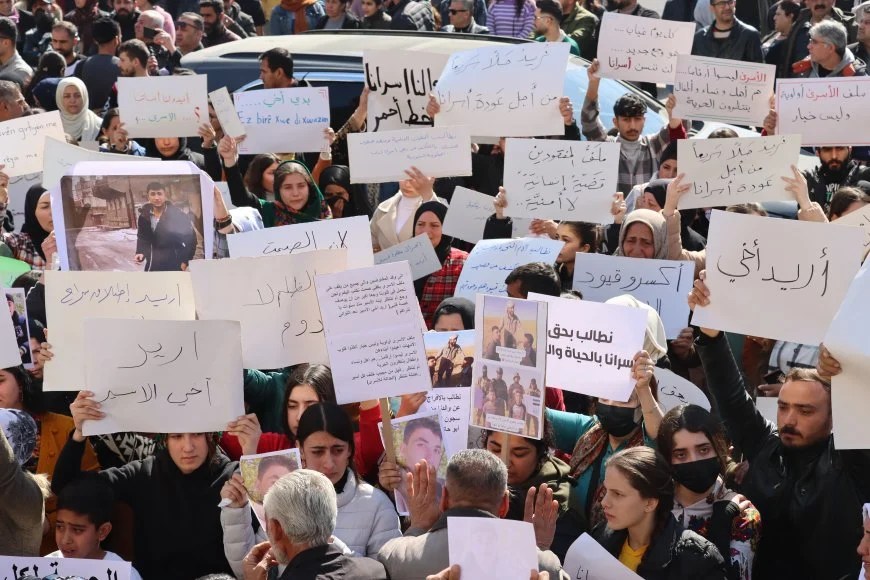
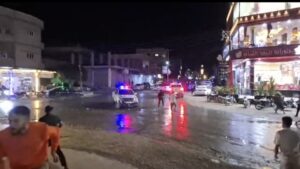
Hundreds of relatives and comrades of fighters from the Syrian Democratic Forces (SDF) took part today in a large march in the city of Qamishli in Rojava (northeast Syria), demanding the release of fighters held in the prisons of the Syrian interim authority led by Hayat Tahrir al‑Sham.
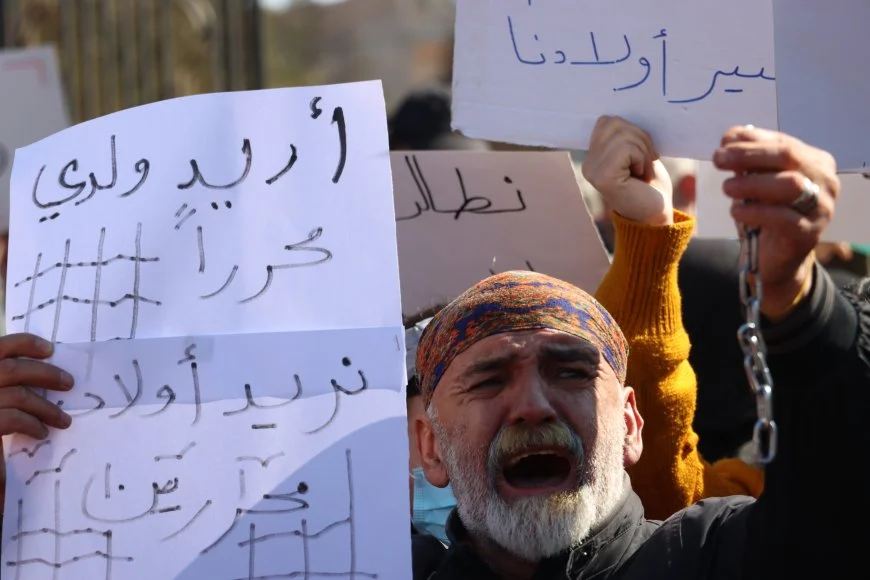
According to the Hawar News Agency, the march began in front of the Mohammad Sheikho Center for Culture and Art, where participants carried photos of the detained fighters and banners reading: “We demand the right of our prisoners to life and freedom,” “Justice for the prisoners,” “It is time to open the prisoners’ file,” “We demand clarification of their fate and the release of our sons,” “Injustice does not last,” “Break the chains of the prisoners,” “Return our prisoners to us, prisoners are a red line,” “We demand the immediate release of the prisoners,” “We demand the release of our sons in the prisons of the mercenary Hatem Abu Shaqra,” “Do not postpone freedom, life does not wait,” “I want my son to be free,” and “We want our sons to be free.”
The march moved through the city’s main streets before turning into a protest sit-in in front of the office of the United Nations High Commissioner for Refugees, where participants chanted slogans calling for the immediate release of the detained fighters in the prisons of the interim government.
Speaking on behalf of the protesters, Yusuf Koti said:
“We now stand in front of the United Nations headquarters, which has not carried out its role or duty toward the peoples of the region, and before our people whose blood has been shed, who sacrificed their lives and whose hearts have burned. We stand before the United Nations, which ignores its own laws and principles.”
Koti added that “the attack that began on January 6 on the neighborhoods of Sheikh Maqsoud and Ashrafiyah, and then extended to Deir Hafer, Maskanah, Raqqa and Tabqa, was a treacherous attack carried out by two states with the support of the entire world,” noting that Turkey and the interim government “did not adhere to the agreements and imposed a tight siege on our sons.”
Koti condemned the shedding of Kurdish blood, considering that the international community had played a negative role and was a partner in what had happened, saying:
“We, the families of the prisoners and the missing, say that if our sons are not released, these activities will continue.”