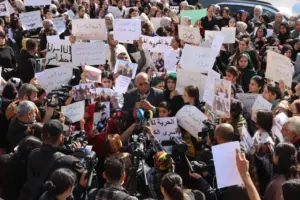
Families of detainees held by forces of the Syrian Interim Government gathered in the city of Qamishli in Rojava (northeast Syria) and issued a statement calling for the release of their sons.
The statement indicated that the families addressed an appeal to the Kurdish people in Kurdistan and across the world, stressing that the call comes “with hearts heavy with pain and eyes fixed on a hope that has not faded.”
The statement added: “Our sons and brothers detained in Rojava remain in custody of the Syrian government for more than a month, despite the announcement of an agreement reached with the Syrian Democratic Forces (SDF) that stipulates their release. However, this agreement has not been implemented so far, and their fate remains unknown. Their families are also deprived of any information regarding the situation of their sons.”
The statement explained that the mothers, fathers, children, and wives of the detainees are living under difficult conditions marked by pain and sorrow, while anxiously awaiting the fulfillment of the hope for their release. In their statement, the families stressed that they appeal to the conscience of humanity and to all defenders of freedom to stand by them and respond to their demands for the immediate release of the detainees.
In the conclusion of the statement, the families of the detainees called on the Kurdish people in the four parts of Kurdistan and across the world to organize peaceful mass demonstrations in order to convey the voices of the detainees’ families everywhere.
A few days ago, hundreds of families and companions of fighters from the Syrian Democratic Forces took part in a large march in the city of Qamishli in Rojava (northeast Syria), demanding the release of the captured fighters held in prisons of the Syrian interim authority led by Hayat Tahrir al-Sham.
These developments come amid a military escalation that began on January 6, 2026, when forces of the Syrian interim authority, represented by Hayat Tahrir al-Sham, launched military operations targeting the neighborhoods of Sheikh Maqsoud and Ashrafiyeh in the city of Aleppo, before taking control of them on January 10, 2026.
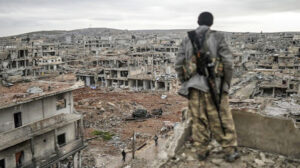
Later, the operations expanded to areas east of the Euphrates, particularly in Raqqa Governorate and the northern countryside of Deir ez-Zor, and extended to other Kurdish areas including Kobani, the countryside of Al-Hasakah, and the countryside of Qamishli. This resulted in the killing, arrest, disappearance, and displacement of thousands of civilians and families of Kurdish and Arab fighters within the ranks of the Syrian Democratic Forces, in addition to other violations that included indiscriminate killings, targeting civilians during displacement, and shelling residential homes, according to Rights Monitor Syria.