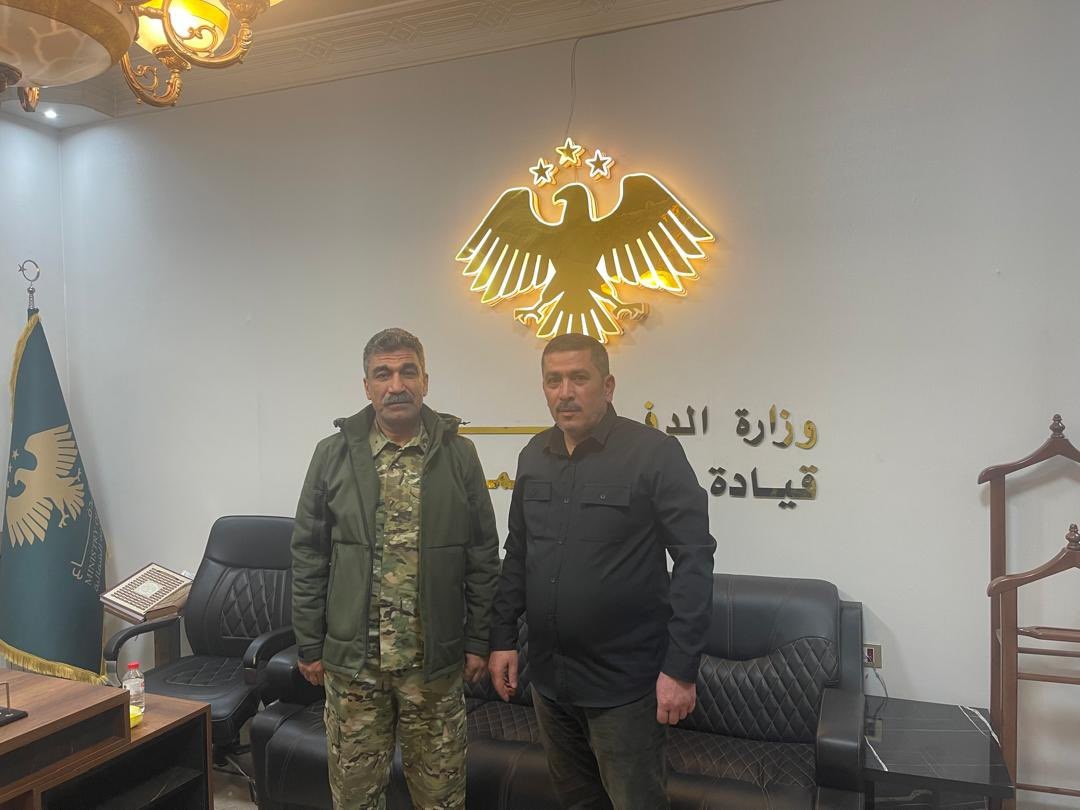
The Syrian Assistant Minister of Defense for the Eastern Region, Samir Ali Oussou—better known as Sipan Hamo—announced a meeting with the Assistant Minister of Defense for Northern Affairs, Brigadier General Fahim Issa. This step reflects significant shifts in the Syrian military and political landscape.
In a post on the “X” platform, accompanied by a photo of the meeting, Oussou stated: “Today, I visited the Northern Region Command headquarters and held a friendly meeting with the Regional Commander, Brigadier General Fahim Issa.”
This meeting serves as an indicator of an unprecedented rapprochement between two figures who represented opposing sides in the Syrian conflict. Sipan Hamo previously served as the General Commander of the People’s Protection Units (YPG), while Fahim Issa is known for leading the Turkish-backed “Sultan Murad Division,” which was one of the most prominent military formations to engage in confrontations with Kurdish forces in northern Syria.
This development comes within the context of restructuring the military establishment under the Syrian Ministry of Defense, headed by Murhaf Abu Qasra, as part of the transitional government formed by Ahmed al-Sharaa following the fall of former President Bashar al-Assad’s regime. This restructuring involves merging previously warring forces and factions into a unified military structure.
A Controversial Record
Despite the “friendly” nature of the meeting, it has raised widespread questions, particularly in light of previous reports documenting serious violations committed by Fahim Issa’s faction during the war years.
The Syrian Observatory for Human Rights (SOHR), in a report published on September 22, 2019, revealed large-scale practices within the “Sultan Murad Division” prisons, including physical and psychological torture, as well as assaults on detainees from various backgrounds, including both civilians and military personnel.
According to testimonies cited in the report, detainees were subjected to beatings, insults, and deprivation of food and medical care, in addition to being held in poor conditions. The report also pointed to instances of extortion and theft of property, as well as cooperation with Turkish intelligence during the interrogation of detainees.
Furthermore, the report documented violations against women, including cases of assault, alongside preferential treatment for members of the “Islamic State” (ISIS) within the prisons compared to other detainees, which drew sharp criticism of the faction’s conduct.
The meeting between Oussou and Fahim Issa reflects a radical shift in the map of alliances within Syria, as the two parties moved from a state of direct military hostility to joint action within a single official institution. However, it simultaneously poses challenges regarding accountability and justice, especially given the past records associated with human rights violations.
Read the Arabic version: Click here