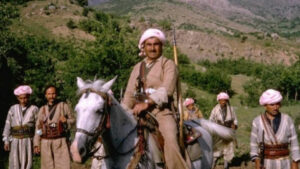
On this day, more than four decades ago, a man stepped down from life who was not merely a military commander, but the embodiment of an entire phase in the history of his people. Mustafa Barzani departed in body, yet his image remained suspended in the memory of the mountains and in the conscience of generations who continued to repeat his name as a symbol of resilience, not merely nostalgia.
Barzani never knew stability in its conventional sense. He lived pursued, exiled, a fighter, and a negotiator when necessity required. Between successive revolutions and fragile agreements, he understood that the road to freedom was longer than the lifetime of a single man, and that the battle was not only fought with rifles, but also with political will, national awareness, and social cohesion. For this reason, his struggle was not merely a military confrontation with successive regimes in Baghdad, but a project to build a political identity for a people who sought to make their voice heard within a complex regional equation.
When the September Revolution erupted in 1961, it was not merely an armed rebellion, but a declaration rejecting marginalization and an attempt to impose a new equation in the relationship between the center and the periphery. Then came the March 11 Agreement of 1970, opening a rare window of hope, as it recognized—for the first time—certain national rights of the Kurds within the framework of the Iraqi state. Yet that window soon closed under the pressure of regional calculations and international rivalries, turning hopes into disappointment and promises into papers whose implementation was postponed.
However, a deeper reading of Barzani’s experience cannot be reduced to interim outcomes. The military defeat in 1975, following the Saddam Hussein–Mohammad Reza Pahlavi Algiers Agreement, did not end the idea he had planted. He realized that conflicts in the Middle East are not decided in the mountains alone, but also in the balance of international power. Nevertheless, he never bargained over the essence of the cause, nor did he turn it into a personal card in the game of influence. He believed that leadership is a historical responsibility, not a passing privilege.
Barzani, in practice, established a political school built on three pillars: the unity of the Kurdish ranks, realism in dealing with Baghdad, and openness to both regional and international spheres without compromising fundamental principles. This triad still constitutes, to this day, the theoretical framework for any serious discussion about the future of the relationship between Erbil and Baghdad.
On the anniversary of his passing, the discussion is not merely about a man, but about the meaning of leadership when coupled with sacrifice, and steadfastness when alliances change and doors close. He lived without rest, moving between battlefronts and exiles, yet he left behind a political legacy that paved the way for the phase of autonomy after 1991, and for the experience of the Kurdistan Regional Government as a constitutional entity after 2005. Interpretations may differ over the details, but what remains certain is that the roots of this experience go back to those years in which Barzani shaped the equation of “existence first.”
Today, as the political landscape in Iraq and the region changes, the legacy of Mustafa Barzani remains present as an open question: how do we preserve the essence of the struggle without personalizing it? And how do we transform historical legacy into a sustainable institutional project that is not tied to individuals but to values? The most dangerous challenge facing any liberation movement is when it turns into a ceremonial memory instead of remaining a renewed project.
Recalling Barzani should not be merely an emotional invocation, but also a critical review. Great leaders are honored when their projects are continued in the spirit of the times, not when they are frozen as a portrait hanging on a wall. True loyalty to his memory lies in strengthening unity of decision, consolidating institutional governance, and safeguarding a just partnership within federal Iraq.
Peace be upon the one who made the mountain a school of patience, and the cause a compass that does not deviate. And peace be upon the memory of a leader who believed that peoples who know what they want may be late in reaching their destination, but they never lose the way.