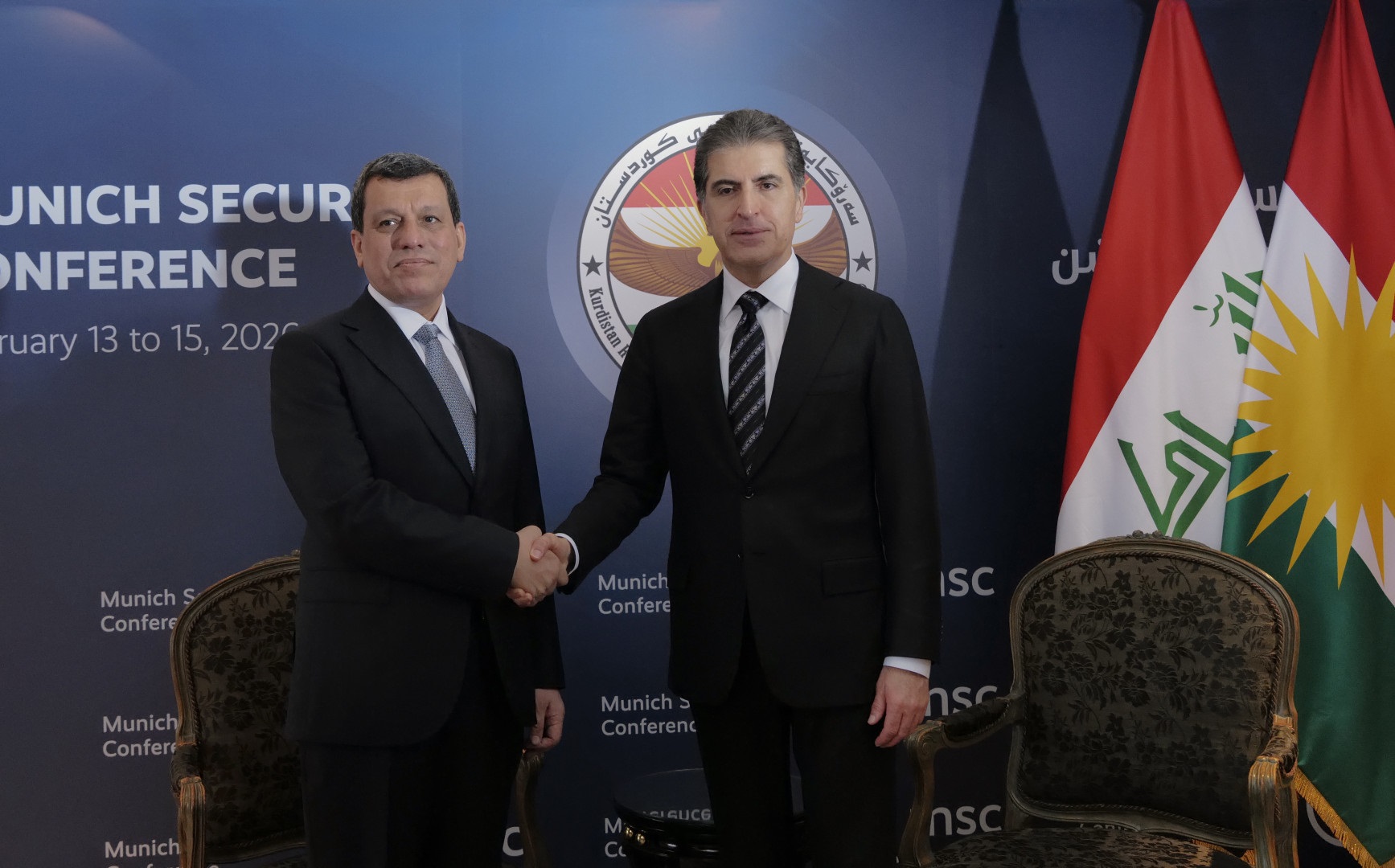
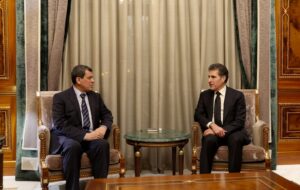
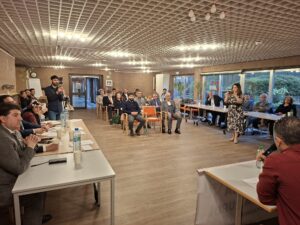
The President of the Kurdistan Region, Nechirvan Barzani, affirmed his support for the recent agreement between the Syrian Democratic Forces (SDF) and Damascus, stating that during meetings held in Munich with all parties, they stressed the need to monitor the implementation of the agreement.
In an interview with Rudaw Media Network on the sidelines of the Munich Security Conference, Barzani noted that “without Turkey’s assistance and support, much of what has been achieved would not have been possible.”
Regarding demands for autonomy, Barzani emphasized the need for realism, saying: “If it is imagined that what we have in the Kurdistan Region of Iraq can be replicated as it is in Syria, that is not possible.”
Below is the full transcript of the Rudaw Media Network interview with Nechirvan Barzani, President of the Kurdistan Region:
Rudaw: Greetings to our viewers from Munich. I am Ala Shali, and I would like to direct some important questions to the President of the Kurdistan Region, Mr. Nechirvan Barzani, in this special interview. Your Excellency, thank you very much for this interview.
You have been very busy over the past few days. We wish you continued health and well-being. Here in Munich, you met with many presidents, leaders, and global officials. My question is: Is the world ready to continue supporting the Kurdistan Region, and does the Kurdistan Region have the capacity to continue as a cooperative partner of the international community?
Nechirvan Barzani: Our participation in these conferences is mainly to meet people face to face, to see world officials, and to reaffirm the role of the Kurds in the region in general and in Iraq. Regarding your question about the Kurdistan Region, yes, I believe European and international policy is clear in its desire to see a strong Kurdistan within a federal Iraq. This is clear among all countries and leaders. They want the Kurdistan Region to play an effective and serious role, to remain stable, and to be strong within the framework of federal Iraq. What distinguishes us is that we operate within the framework of the permanent Iraqi Constitution. Of course, we do not say this constitution is perfect or without flaws, but we have certain rights and also understand that there are responsibilities upon us under this constitution. International policy so far is: a strong Kurdistan within a federal Iraq.
Rudaw: A strong Kurdistan, but Your Excellency, you held many meetings—were there criticisms directed at the Kurdistan Region because, after a year and four months since the elections, parliament has not yet been activated and the government has not been formed?
Nechirvan Barzani: Yes, this was one of the topics raised. It is discussed within the international community. The people of Kurdistan placed great trust in all parties, with voter turnout reaching around 73 percent. That reflects the confidence of the people. Certainly, more than a year has passed without forming a government, and this is subject to criticism abroad. It is not something pleasant for us either. Ultimately, it is an important issue that must be resolved as soon as possible. We are continuing our efforts to reach a framework and mutual understanding with other parties, particularly the Patriotic Union of Kurdistan, to form this government.
Rudaw: Turkey is a major power in Syria and the region. You were in continuous contact to stop the fighting and restore peace between the Syrian government and the SDF. How was Turkey’s role during this period?
Nechirvan Barzani: When this issue occurred in Syria, I was personally in constant contact with Turkey. I can tell you that Turkey’s role was very positive. Without Turkey’s assistance and support, much of what has been achieved would not have been possible. For example, what happened in Aleppo and the safe exit of people from there—Turkey played a major role in that. Turkey’s role has been very positive, helping the SDF and the Syrian government reach a joint agreement. That is what I have seen and continue to see—an extremely positive role.
Rudaw: In your meetings with many international officials, one of the key topics was the Syrian issue and Rojava Kurdistan. Can we say there are guarantees to protect the Kurds in Rojava? And can we say that establishing autonomy in Rojava is now on the table? What form does the support take?
Nechirvan Barzani: If you ask Damascus, they may believe they have granted the Kurds a great deal. If you ask the Kurds, they may believe they have received very little. But in my personal view, what has been achieved could be good for both sides. Our policy in the Kurdistan Region is that our brothers and sisters in Rojava Kurdistan should reach a good outcome with Damascus. Our policy supports them in reaching a good result within a united Syria. I believe what matters most is how this agreement is implemented. In the meetings we held in Munich with all parties—Americans and Europeans—we stressed the need to monitor its implementation. This is important for us. What I heard from the Syrian foreign minister and from President al-Sharaa is that they want to implement the existing agreement as it stands. What we also mean—and what is very important for us—is that everything achieved regarding Rojava Kurdistan and other components within Syria must in some form be enshrined in the Syrian constitution. We welcomed the decree issued by President al-Sharaa. I believe it was a very good beginning on the right path, and it is important that we all work to solidify these matters within the framework of the Syrian constitution.
Rudaw: You met with Mazloum Abdi and with the Syrian foreign minister, as you mentioned. The Syrian foreign minister told me that the Kurds have not yet requested autonomy. Was this discussed in your talks?
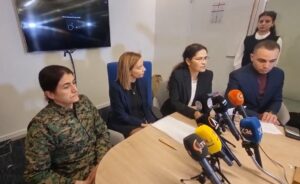
Nechirvan Barzani: We must be realistic about this matter. If it is imagined that what we have in the Kurdistan Region of Iraq can be replicated as it is in Syria, that is not possible. We hope that the autonomy being discussed will ultimately be autonomy for the region, granting authority within those geographical boundaries that include Kurds, Arabs, and Christians together, so they can manage their own affairs there. That is what matters. For example, they have now agreed on sending the name of the governor of al-Hasakah to Damascus, and it has been approved. I believe this is a very positive step forward. Therefore, we must be realistic and look at what can be implemented on the ground. In our discussions with General Mazloum and Ms. Ilham, we also emphasized that at this stage, the Kurds—meaning them—must be serious about implementing the agreement they have now concluded with Damascus.
Rudaw: President Masoud Barzani, Your Excellency, and Mr. Masrour played an important role. All the people of Kurdistan and all Kurdish parties showed strong unity and support for Rojava. Did this unity attract the attention of international officials?
Nechirvan Barzani: Yes, it was notable. Of course, I would like to thank all the people of Kurdistan everywhere. Kurds, whether abroad or at home and in other countries, were united on this issue. This Kurdish consensus in support of Rojava Kurdistan was very influential. In this process, President Barzani, Mr. Masrour, myself, and all of us did everything we could for Syria’s stability. Truly, we spared no effort. Each of us, according to our position, made serious efforts. For us, this is not a favor we grant them; rather, we fulfilled our duty toward our brothers and sisters in Syria.
Rudaw: My final question: How would you describe your meetings in Munich this year? They were truly different from last year.
Nechirvan Barzani: If you look at all the meetings, they were very good. This is not personal—we represent our people, and we are proud that the world respects the people of Kurdistan in this way. It is a source of pride for us to hold this position, and it is the result of the struggle and sacrifices of the people of Kurdistan in general. I believe the level of the meetings and the importance given to the Kurdistan Region are a source of pride for all of us.
Rudaw: But since the region is now under real threat…
Nechirvan Barzani: Certainly, our policy acknowledges that the region is under threat, but in reality, we want these issues to be resolved through dialogue and peacefully. We do not believe that war solves any problem. We want problems to be resolved peacefully.
Rudaw: Your Excellency, thank you very much for being with us.