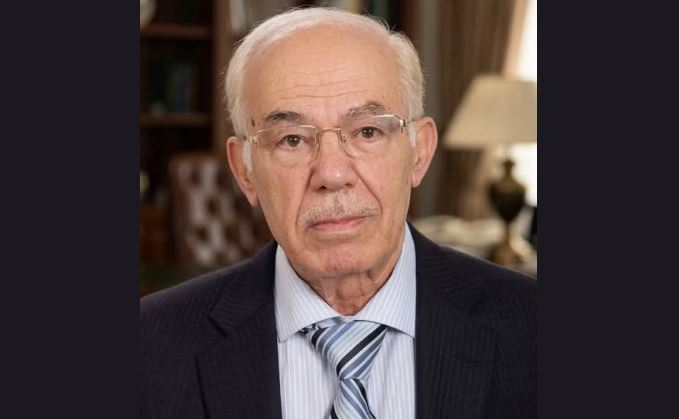
DAMASCUS – Prominent Syrian opposition figure Hassan Abdul Azim passed away yesterday, Saturday, April 25, 2026, in Damascus. He was the former Secretary-General of the Arab Democratic Socialist Union Party in Syria and the General Coordinator of the National Coordination Committee for Democratic Change (NCC).
The Arab Democratic Socialist Union Party in Syria mourned its former leader, who passed away at the age of 94. His death follows a political career spanning over half a century, during which he was a key founder of the party in 1964 and a pillar of internal political opposition within Syria.
In an official statement, the National Coordination Committee for Democratic Change in Syria expressed “profound sadness and sorrow,” mourning the “struggler Hassan Abdul Azim.” The statement noted that he “dedicated over sixty years of his life to resisting tyranny, steadfastly fighting for the freedom of Syria and its people, and for its transition toward a unified democratic state.”
The statement added: “Hassan Abdul Azim ‘Abu Mamdouh’ (1932–2026) was a national and pan-Arab figure. With his passing, the Syrian arena has lost one of its most significant voices in defending national and regional causes. He was a founder of the Arab Democratic Socialist Union Party, the National Democratic Rally, and the National Coordination Committee for Democratic Change in Syria.”
The Syrian Democratic Council (SDC) also issued a cable of condolences, praising the career of the lawyer and politician. The SDC described him as “one of the most prominent faces of the Syrian democratic opposition” and a “composed voice that never wavered in its belief in a political solution.”
A Career Defined by Activism
Abdul Azim began his professional life as a teacher before transitioning to law after graduating from the Faculty of Law. Influenced by Nasserist ideology, he was a staunch admirer and theorist of the late Egyptian President Gamal Abdel Nasser’s thought, and was drawn to leftist pan-Arab movements.
He initially joined the Socialist Unionists Movement before joining the Arab Democratic Socialist Union Party in July 1964 under the leadership of Jamal al-Atassi. He held several positions within the party until he was elected Secretary-General following al-Atassi’s death in 2000. Additionally, he served as a member of the Syrian People’s Assembly between 1971 and 1973 and as the spokesperson for the “National Democratic Rally” starting in May 2000.
The Damascus Spring and the Revolution
With Bashar al-Assad’s accession to power in 2000, Abdul Azim played a prominent role in the political and intellectual movement known as the “Damascus Spring,” a period of brief, limited political opening. In 2005, he co-founded the “Damascus Declaration for Democratic National Change,” a landmark document signed by various opposition parties and national figures.
Following the outbreak of the Syrian Revolution in 2011, Abdul Azim helped establish the “National Coordination Committee” in June 2011, serving as its General Coordinator. He also participated in the second iteration of the “High Negotiations Committee” (HNC) for the forces of the revolution and opposition, which emerged from the “Riyadh 2” conference in 2017.
Opposition from Within
Hassan Abdul Azim was distinguished by his practice of political activism and opposition to the Assad government from within Damascus—a rarity among Syrian opposition figures. He maintained a sharp distinction between what he termed the “internal opposition” and the “external opposition.”
He frequently criticized the formation of the “Syrian National Council” and the “National Coalition” outside Syria, rejecting what he described as their reliance on “foreign support.” He maintained that true opposition must stem from within the country and remain independent of foreign agendas.
Abdul Azim is considered one of the last icons of Syria’s pan-Arab leftist political generation, balancing opposition to the government with a rejection of foreign intervention in Syrian affairs. He leaves behind a legacy of political struggle both inside and outside of prison, and significant intellectual contributions to the path of democratic transition in Syria.