Yazidis in Syria have been subjected to violations described as “immense” over the course of a decade. These actions have been concentrated at the hands of Turkish forces and factions formerly known as the “Turkish-backed Syrian National Army” in the areas they controlled within Syria.
The violations against Yazidis in Syria began following the protests that erupted in the country in 2011, which transformed into an armed conflict within a few months. Their areas of residence in Afrin and Ras al-Ayn/Sere Kaniye witnessed the first attacks.
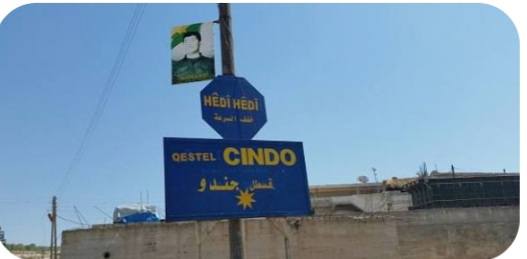
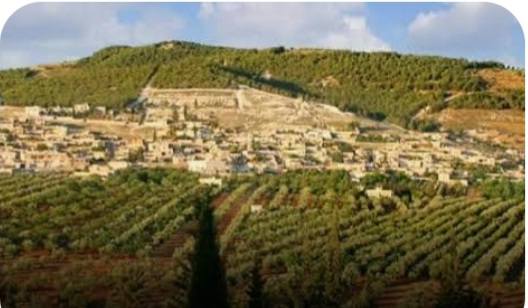
At the end of October 2012, the villages of Qastal Jando, Baflon, and Alaqlino—in the Sharran district of the Afrin countryside, whose inhabitants are Yazidis—were subjected to a military attack. This followed the seizure of the neighboring city of Azaz by formations that called themselves the “Free Army” at the time, under the pretext of the inhabitants “professing a religion other than Islam.”
In the same year, in the Sere Kaniye (Ras al-Ayn) region, the first attacks against Yazidis date back to November 2012, when “extremist Islamic organizations” attacked the city and committed widespread violations against the residents, including followers of the Yazidi faith.
At dawn on August 16, 2013, extremist factions attacked the village of Al-Asadiya (10 km south of the city), where the majority of the population was Yazidi, inhabited by more than 20 Yazidi families. The attack claimed the life of a Yazidi man, Murad Sadou, who was injured while resisting those groups; they detained him and left him to bleed to death. They also executed his brother, Ali Sadou, by firing squad.
On May 29, 2014, the Islamic State (ISIS)—which considers the Kurdish Yazidi community “infidels” and their religious rituals “heresy”—attacked the village of Al-Taliliya/Taliliya in the Hasakah countryside, which housed a Kurdish Yazidi community. A group of internally displaced persons (IDPs), mostly women and children from As-Safira, Aleppo, had settled in the village. The foreign ISIS elements did not understand what those they were killing were saying, “believing they were Kurdish Yazidis.”
Violations against Yazidis took various forms and patterns following Turkish military operations in northern Syria, which led to the displacement of tens of thousands of indigenous inhabitants, including Yazidis.
Various Forms of Violations According to International Human Rights Reports
In a report published in September 2018, the International Commission of Inquiry documented patterns of arrests, beatings, and kidnappings carried out by armed groups affiliated with the “Free Syrian Army.” In addition to conducting large-scale looting and the seizure of civilian homes, victims described to the Commission how houses were looted to the point of being “stripped of furniture, electrical appliances, and all decorative items.”
The Commission’s previous report also included information regarding the looting of hospitals, churches, and a Yazidi shrine, as well as reports of the destruction of other Yazidi religious sites in attacks that appeared to have a sectarian character. these were the first UN indications of violations against Yazidis in Afrin.
In March 2020, the Independent International Commission of Inquiry on Syria confirmed that the Kurdish population in Afrin was primarily targeted, and most victims of abduction and detention were males of Kurdish origin. In August of the same year, the Commission published another detailed report addressing violations committed in Afrin, noting the arrest of eleven women by the Hamza Division, among them a Yazidi woman and three Kurdish women. It also documented other detentions of Yazidi women by factions that called on those women to “convert to Islam” on at least one occasion. The Commission stated at the time that it was investigating 49 detentions of Kurdish and Yazidi women in Turkish-controlled areas.
According to several sources, Kurds constitute more than 95% of the population of Afrin, including approximately 50,000 Yazidis before the Syrian conflict. The Turkish military operation known as “Olive Branch” led to the forced displacement of about 90% of Afrin’s Yazidi population.
Many Islamic and Yazidi shrines in Afrin—approximately 28 religious shrines—were subjected to various attacks by armed opposition groups for numerous reasons. On May 15, 2020, members of an armed group excavated a Yazidi shrine in “Qibar Village” called (Chilkhana/Çilxana) with the intent of searching for antiquities; the temple served as a shrine visited by many families for blessings.
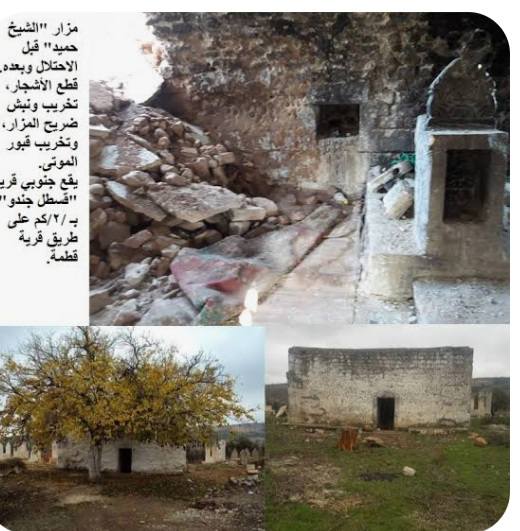
According to the organization “Syrians for Truth and Justice,” the same armed group excavated another Yazidi shrine in the same month in the village of Qastal Jando, which is the “Sheikh Hamid” shrine. The military group was identified and found to be affiliated with the “Sultan Murad Division” and the “Levant Front” (Al-Jabha al-Shamiya). The same source also reported that many Yazidi graves in the “Qibar Village” cemetery were deliberately vandalized by elements of the “Mu’tasim Billah” faction after the end of the “Olive Branch” operation (i.e., during March 2018).
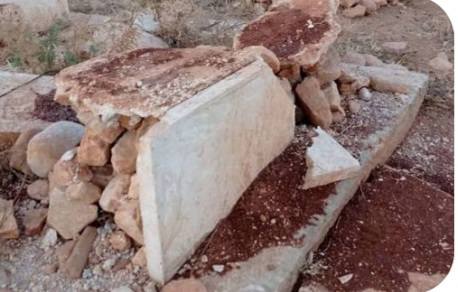
The “Sheikh Hamid” cemetery near the shrine of the same name was repeatedly vandalized, first by members of armed military factions (specifically the Levant Front), and later these attacks were repeated by displaced persons arriving in the area, despite local residents’ attempts to restore their tombstones.
Yazidi religious institutions were not spared from attack and destruction. Kuwaiti and Qatari organizations built a religious school on the ruins of the “Yazidi Union” building after its destruction by Syrian opposition factions in 2018. Various patterns of violations against Yazidis in Afrin were also documented, ranging from the seizure of houses to assaults on indigenous residents.
Furthermore, the “White Hands” (Al-Ayadi al-Bayda) association, affiliated with the Muslim Brotherhood movement, built a mosque in the Yazidi village of Qastal Jando under the name of the “Noor al-Huda” project, despite its original inhabitants professing the Yazidi religion, with support and funding from the states of Qatar and Kuwait.
In addition to these practices and violations, the three villages (Qastal Jando – Alaqlino – Baflon) were converted into a waste dump by the Azaz City Council. This causes the spread of diseases and epidemics, not to mention the proliferation of stray dogs around these three villages, causing increasing anxiety among residents who recently returned to their villages due to health risks (such as rabies) and security threats, especially to children and the elderly. This phenomenon is due to the accumulation of waste and the deterioration of the urban environment. Moreover, overgrazing in farmers’ fields by those brought into these villages—particularly in the complex known as the “Cooperation Camp” (Mukhayyam al-Ta’awun)—is no less dangerous than the spread of stray dogs; rather, it constitutes an additional factor hindering the return of displaced and expelled residents.
No party to the conflict may treat the civilian population in their collective capacity as legitimate military targets; rather, they must be treated as protected persons within the meaning of Common Article 3 of the four Geneva Conventions. Furthermore, they must be treated humanely in all circumstances, and there is absolutely no justification for acts or failures to fulfill the duty of humane treatment.
As the Yazidis are a group of the civilian population in the armed conflict zone in Syria, it is clear from the UN report that they have been and continue to be deliberately targeted as civilians. Yazidis have been deprived of necessary protection measures and subjected to inhumane treatment practices and other violations of international humanitarian law by the armed factions controlled by Turkey, according to the report.
In light of the above, we appeal to the international community, the Syrian Interim Government, and the administration of the Afrin region specifically to assume their legal and humanitarian responsibilities toward their citizens. We call on them to address the reasons hindering the return of the displaced and expelled to the Afrin region, including the Yazidi villages, and to provide them with basic services so they can lead a life of dignity as indigenous citizens on the historical land of their fathers and grandfathers. We also call for pressure on the displaced (newcomers) in the Cooperation Camp and in the three villages to leave and return to their original homes following the fall of the former regime and the establishment of security and stability in their regions.