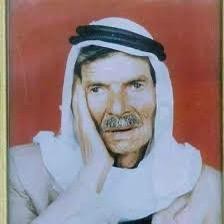
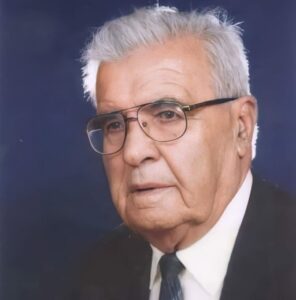
The Kurdish folk artist Baqi Khiddo is considered one of the most prominent figures in the field of folkloric singing in northern Syria, particularly in the city of Kobani (Ain al-Arab). His career represents a clear model of the interaction between Kurdish heritage and the social, political, and artistic environment of the twentieth century. Furthermore, it highlights his pivotal role in preserving folk songs and transmitting them to subsequent generations.
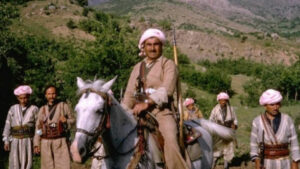
Baqi Khiddo, the singer of the Deshta Surujeh (Suruç Plain) and the Kobani region, was born in 1913 in the village of Moktala near Kobani. However, his official identification is registered in the village of Shiran, where he spent a portion of his life. He was born to his father, Khiddo Hindawi, and his mother, Amsha Masto, and had two sisters. His grandfather’s origins trace back to the Harran Plain, from where he later migrated to settle in the Suruç Plain region. The artist’s father belonged to a family well-known for its interest in local heritage; he was renowned for accompanying the Kurdish Prince Misho Bek Kapur Berazi and for his early artistic activities, which included performing traditional epics such as Dewreşê Evdî and Gezal. This provided Baqi Khiddo with a fertile environment to nurture his musical talents from an early age.
Sheikh Nabi, Baqi Khiddo’s grandson and a singer himself, states that Baqi learned singing from his father, Khiddo Hindawi, and Misho Bek Kapur Berazi. He performed many songs of his own composition, as well as various Kurdish epics and songs. He was accompanied by the violinist Mohammadi Duman and the drummers Hamdi Hadi and Mohammadi Koli, all of whom were from Kobani.
The Kurdish writer Shahin Bekore Sorekli mentions that the singer Baqi Khiddo transcribed the epic of Dewreşê Evdî in story form and sent it to him in 1987. Sorekli subsequently documented and published it in a book, which is now available to readers.
The song of Dewreşê Evdî has been performed by many Kurdish singers in their own styles, just as Baqi Khiddo performed it in his unique way. It held a prestigious position among the Kurdish people and became one of the primary sources for that epic.
Beyond the Kurdish community, other peoples learned about Kurdish culture and history through Baqi Khiddo. For instance, a Swiss woman wrote her thesis in English on the epic of Dewreşê Evdî as sung by Baqi Khiddo.
Similarly, the artist Mejo Kendesh says of Baqi Khiddo’s singing that the vocal style of Deshta Surujeh supported Baqi, as the generation that followed him enjoyed broader opportunities. Baqi Khiddo, as a representative of Deshta Surujeh singing, did not limit himself to narrating the stories of Kurdistan; he sang and performed songs using the specific language and characteristics of the Deshta Surujeh region.
During their lifetime, Baqi Khiddo’s father and Misho Bek Kapur visited Mir Celadet Bedirxan in Damascus, the capital of Syria. At that time, Mir Celadet Bedirxan wrote an article about their visit in Hawar magazine.
Baqi Khiddo possessed knowledge of several languages, including Kurdish, Arabic, Turkish, Armenian, and French, which enabled him to communicate with broad segments of society. His travels abroad were limited to Turkey, Lebanon, and Iraq, and were mostly for artistic purposes, though his fame reached various Kurdish regions.
Throughout his artistic journey, he was accompanied by his close friend Mohammed Khalil Ghazi (Mohammed Duman), who played the violin and performed songs with him, exerting the greatest influence on the development of his artistic style. He also met with several artists such as Jamil Horo and Ali Tajo, the writer Shahin Bekore Sorekli, and the researcher Ordîxanê Celîl. Additionally, he conducted multiple interviews with local media outlets, including the program Zembîlfiroş on Mesopotamia TV and Kurdsat TV.
In recognition of his contributions, he was honored on several occasions, including events by students of the University of Aleppo, the Nowruz 2006 celebrations in Kobani, and the “Mîrem Xan” festival at Ja’bar Castle.
Baqi Khiddo passed away on the morning of Saturday, February 7, 2009, in Aleppo Governorate and was buried in the cemetery of Tarmik Bezan village. His funeral turned into a popular artistic event attended by a large number of people from Kobani and its guests. A forty-day memorial service was later held as a youth initiative, becoming an annual occasion to commemorate his artistic legacy.
Baqi Khiddo established a deep-rooted school of Kurdish folk singing and compiled a comprehensive archive of heritage and folklore, making him one of the pillars of folk art in Kobani and Kurdistan at large. His cultural and musical legacy remains a primary reference for the study of Kurdish folk singing, and his name continues to be enshrined in the records of those who have achieved artistic glory.