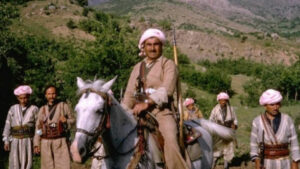
In the history of nations, there are defining moments that are shaped not only by events themselves, but also by individuals who possess the ability to transform pain into awareness and injustice into a project of resistance. In Kurdish history, the name of Mustafa Barzani stands out as one of those leaders who were not merely actors in a political event, but who became a symbol of an entire historical phase of the Kurdish struggle for rights and recognition.
Mustafa Barzani was born in 1903 in Barzan, within a religious and social environment known for its role in the Kurdish reformist movement. His father, Sheikh Mohammed Barzani, was an influential religious figure in the region, which meant that Barzani grew up in a milieu that combined religious education with a spirit of resistance. Many historical studies indicate that, since the early twentieth century, Barzan had been a center for social and political movements opposing the policies of marginalization to which the Kurds were subjected in the Ottoman state and later in the emerging Iraqi state.
The features of Barzani’s leadership personality began to appear early. From his youth, he took part in Kurdish uprisings and was among the participants in the Barzan uprising in the 1930s against the Iraqi royal government. In 1931, together with his brother Sheikh Ahmed Barzani, he led an armed resistance against attempts to impose direct governmental control over the region, which later resulted in his arrest and exile along with a number of members of his family.
However, the most influential stage in Barzani’s career came after the Second World War, when he became one of the most prominent military leaders of the Kurdish Republic of Mahabad, which was declared in Iran in 1946 under the leadership of Qazi Muhammad. Barzani assumed command of the republic’s military forces, and his troops played a fundamental role in protecting the nascent entity at that time. But the fall of the republic at the end of that same year led Barzani to one of the most dramatic episodes in Kurdish history, when in 1947 he led about 500 of his fighters on a long march toward the Soviet Union. The journey lasted nearly three months across mountains and borders and later became one of the most famous stories of resilience in Kurdish history.
Barzani remained in his Soviet exile until 1958, when he returned to Iraq following the July 14 Revolution that overthrew the monarchy under the leadership of Abdul Karim Qasim. He was received at the time with a large popular reception in Kurdistan, where many regarded him as a symbol of a new phase of hope for achieving Kurdish national rights within the Iraqi state.
However, the relationship between the Kurdish movement and the Iraqi government soon entered a new phase of tension, leading to the outbreak of the September Revolution in 1961 under Barzani’s leadership. The uprising lasted for more than a decade and became the longest and most extensive armed movement in modern Kurdish history. This phase ended with the signing of the March 11, 1970 Agreement between the Iraqi government and the Kurdish movement, which included recognition of autonomy for Kurdistan—at the time considered a historic step in the course of the Kurdish issue.
Nevertheless, the subsequent collapse of the agreement and the renewed outbreak of conflict in 1974 led to another phase of war, which ended after the Algiers Agreement of 1975 between Iraq and Iran. That agreement resulted in the withdrawal of Iranian support for the Kurdish movement. Following these events, Barzani was forced to leave Iraq once again and settled in the United States, where he died on March 1, 1979, at Georgetown University Hospital in Washington.
Recalling the life of Mustafa Barzani does not merely mean revisiting the past; it also means understanding the transformations that shaped Kurdish political consciousness during the twentieth century. Barzani was not simply a military leader, but the founder of a political school of struggle based on combining armed resistance with political action, and defending identity while seeking to build political institutions that represent the aspirations of the people.
For this reason, March 14—the day of Barzani’s birth—is not remembered merely as a personal anniversary, but as an occasion to reflect on a historical experience that contributed to shaping the course of the modern Kurdish issue. Leaders who leave a profound mark on the history of their peoples do not become merely names in history books; rather, they become part of the collective memory of the nation.
Mustafa Barzani lived a life that stretched between the mountains and exile, between war and politics. Yet in the end he left behind a legacy that transcends the boundaries of time—a legacy built upon a simple yet profound idea: that rights are not born from silence, but from the will of a people who believe in their cause and find among their men the ability to transform that will into a clear path for future generations.