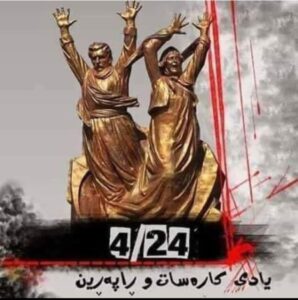
The people of Kurdistan remember with profound sorrow the anniversary of the Anfal of Jalmord village and the Khalkhalan plain. This village stands as a symbol for the victims of the notorious Anfal operations; despite its small size, it sacrificed more than 450 innocent lives. Their only “guilt” was belonging to an oppressed people who loved to live in peace.
On this day, May 9, 1988, as part of the fourth stage of the infamous Anfal operations, the bloody Ba’athist regime attacked Jalmord and the Khalkhalan plain within the boundaries of the Aghjalar sub-district (part of the Chamchamal district in Sulaymaniyah). Located approximately 60 km from the road connecting Kirkuk and Sulaymaniyah, the regime rounded up the majority of the village’s 550 inhabitants—including men, elders, women, and children—and led them toward an unknown fate. They were killed in cold blood while still alive in the southern deserts, and their fate remains officially unknown to this day.
The Ordeal of the Babrusha Cave
Eyewitnesses who survived the crime, many of whom are relatives of the victims, recount that following the shelling of the villages of Askar and Goptapa on May 3, 1988, the residents of Jalmord and surrounding areas fled their homes in fear for their lives. They sought refuge in the Babrusha Cave in Mount Khalkhalan, southwest of their village. For a brief period before their discovery, they endured harsh conditions, deprived of all basic necessities of life.
After their location was betrayed by collaborators and mercenaries loyal to the regime, the command of the force executing the Fourth Anfal operations issued a threat on May 5, 1988. They demanded those hiding in the cave surrender immediately, threatening to shell them with chemical weapons if they refused. Having witnessed the previous bombardment of nearby villages and being fully aware of the regime’s barbarity, the villagers surrendered to protect their lives. Consequently, the regime arrested more than 450 people out of the 550 inhabitants of Jalmord, leaving many families with no survivors at all.
Statistics indicate that the total number of those “Anfal-ed” (subjected to the Anfal process) in the Babrusha Cave reached 1,000 people, including residents from villages neighboring Jalmord.
An Eternal Wait for Justice
The families of the martyrs in this region continue to wait with bated breath for the remains of their murdered loved ones. Their eyes remain fixed on the southern deserts, and their ears are attuned to any news that might reveal their fate. Whenever a mass grave is uncovered in the south, their wounds are reopened, their grief is renewed, and their tears turn to blood. They demand the return of even fragments of their martyrs’ bones to soothe wounds that may never fully heal.
As we commemorate the martyrs of Jalmord, we are heartened to see one of the criminals accused of murdering and torturing innocents, Hajjaj al-Tikriti, facing justice. He stands convicted for his inhumane treatment of detainees at the Nugrat Salman prison and for committing premeditated murder and torture. This serves as a testament that injustice does not last forever and that oppressors must eventually face the consequences of their actions. As the saying goes, “God grants respite, but He does not forget.”
Retribution is undoubtedly coming, just as it reached the heads of the regime before him—most notably the criminals Saddam and “Ali Chemical,” who directed the slaughter of innocents. Everyone who participated in the Anfal crimes will be punished. We look forward to the day when the collaborators and mercenaries—the “Mustashars” and heads of special detachments who aided the regime—stand trial, as their names are already listed as defendants by the Iraqi High Tribunal.
Rights and Reparations
The compensation of victims is a demand that the next Iraqi government must prioritize, based on the rulings of the Iraqi High Tribunal. Furthermore, the provisions of Article 132 of the Constitution must be implemented to provide aid and support to the families of the victims.
In conclusion, if Halabja—with its high number of casualties—is the central symbol for the victims of chemical warfare, then the village of Jalmord—with its small area and the sheer scale of its losses—is the definitive symbol for the victims of the notorious Anfal operations.
Eternal glory to the souls of our righteous martyrs, who nourished the land of Kurdistan with their pure blood.