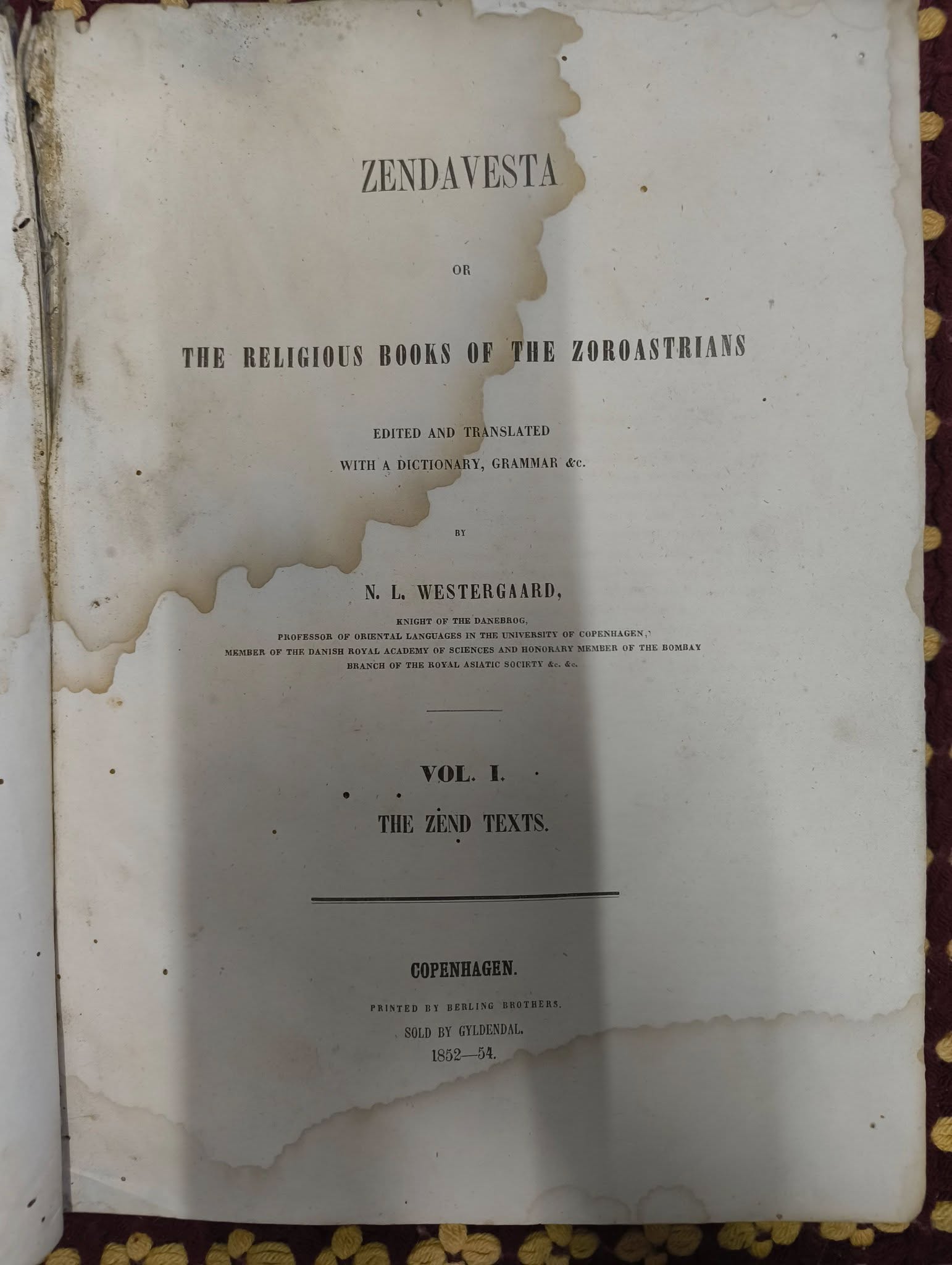
N. L. Westergaard published the remaining Zend (Avesta) texts from previous eras, preserved at the University of Copenhagen. These texts were successfully acquired by Erasmus Rask during a scientific visit to Bombay in 1820, along with other texts obtained from his friend Dr. John Wilson in Bombay, and additional manuscripts belonging to the British Museum, the Oxford Library, the Imperial Library in Paris, and those belonging to Eugène Burnouf.
Westergaard published them in the first volume of his book Zend-Avesta and translated them into English. Professor Westergaard was a Professor of Oriental Languages at the University of Copenhagen, and he published his work in three volumes between 1852 and 1854.
Zoroaster, the prophet of the Zoroastrian religion, was mentioned by a Greek author in the 4th century BCE—one thousand years before the advent of Islam. The Zend-Avesta is the sacred book of the Zoroastrians. We observe two distinct dialects in the language of the Zend-Avesta that are older than the Old Persian language known during the time of Darius—the language that used the cuneiform script deciphered by Assyriologists and Sumerologists through the Sumerian tablet in Elam (Kurdistan), which is the closest branch to the Zend language.
In Arabic, “Elam” is pronounced “Ilam,” and it is one of the cities of Iranian Kurdistan. Its historical capital is called “Susa” in Arabic. The Elamite civilization is one of the well-known ancient civilizations contemporary to Mesopotamia.
Zoroastrianism has managed to preserve its teachings despite the passage of time, and it still has followers in Iran and India—in India, they are called the “Parsi.” Zoroastrianism was written in two languages: the first is Zend, which dates back to an ancient period and comprises the older text; the other is Pahlavi, which dates to a more recent period and is used in translating the Zend texts.
The Zend-Avesta consists of a collection of sacred texts inherited by the followers of Zoroastrianism; these are the surviving texts from the Zoroastrian era in Iran. The Danish scholar Westergaard succeeded in publishing what was collected of them in three separate volumes:
The first volume contains the texts of the Zend-Avesta books.
The second volume concerns the Avestan language, examining its texts, grammar, and comparing it with the Old Persian of the Achaemenid era.
The third volume is a translation of the Zend-Avesta texts from Sanskrit into English.
In this article, I translate the most important parts of Westergaard’s introduction from English to Arabic, adding my own notes, to serve as a resource for exploring this ancient religion and its sacred book. It is worth noting that it was a widespread religion in Iran, Kurdistan, and Iraq, but it receded after the Islamic conquests. Its followers were unjustly labeled “fire worshipers” to diminish their religious status and facilitate their elimination.
The word “Zend” (pronounced Zend with a short ‘i’ or Zand with a short ‘a’) is a translation of the word Avesta. The language of the Zend is Pahlavi, used by Persians, including a group in India called the Parsi. The Parsi are the Zoroastrians of India, a small but wealthy community living in Bombay who migrated to India from Iran after the fall of the Sassanid state. They were the ones who used Sanskrit to write the Avesta.
Neriosangh, the translator of the Avesta into Sanskrit, mentions that he translated the Yasna—a Zoroastrian text that is part of the Zend-Avesta—from Pahlavi into Sanskrit.
The misunderstanding of the word “Zend” dates back to modern times. W. Jones mentioned in 1789 that Bahman, a Zoroastrian priest, told him that the letters of the prophet Zoroaster’s book are called Zend, and the language of the book is called Avesta. Westergaard states that all copies of the Zend-Avesta obtained across different periods, despite their variations, contain the same text. The copies differ greatly in the spelling of words, but regardless of spelling differences, the word itself remains the same. Even if we cannot trace its original form sometimes due to accidents or neglect, we find that word follows word in the same system, phrase after phrase, passage after passage, and chapter after chapter, in a consistent order.
Another fact we glean from the similarity of the copies is that the era in which they were collected is not the same era in which they were composed. We can say that the ancient text of the Zend-Avesta we possess belongs to two periods: the first is the time of the text’s production, and the second is the time of the text’s collection—the surviving text we have in its current form.
Ancient traditions influenced Zoroastrianism, and it is natural that this scripture—the Zend-Avesta—was not the creation of just one person, whether Zoroaster himself or one of his disciples. The Zend-Avesta does not contain specific teachings or a personal, dogmatic, and instructional legal-religious system. In the same vein, the Vedic hymns and the Edda songs—passages in the Zend-Avesta—must have ancient roots and likely came from various poets and teachers who presented different subjects, each based on their own vision.
The writing of the Zend-Avesta indicates that it belongs to Northern Iran and consists of two dialects: the first is found in the Yasna (the first part of the Avesta), which is the dialect of people living in rugged mountains; the second dialect belongs to people of the plains. Thus, the first is the early dialect belonging to the northern branch of Iran, while the second belongs to the era of Darius from Western Iran. (Western Iran is a term usually applied to Elam, the land of the Lurs and Feyli Kurds, whose Sumerian capital was Susa—translated from Sumerian into English as Susa).
We can represent the comparison between them as that between Polish and Russian, which share common origins. However, because the Iranian languages used in the Zend-Avesta date back many centuries, the differences between them are not as large as the differences between other languages.
The Zoroastrian conception of God and His attributes was undoubtedly of profound philosophical depth. Such a deep idea of God had never existed before with such prevalence and faith. With the entry of Alexander the Great into Iran, a major change occurred that was not in favor of the national culture. All of Iran fell under foreign rulers, and Hellenistic culture struggled to gain a foothold. Succession of various peoples ruled for centuries, causing the language of the Zend-Avesta to change slightly; for example, the ancient word Mipro changed to Mihiro.
Another danger struck Zoroastrianism from the East: Buddhism. It spread during the time of Emperor Ashoka (around 263 BCE) and reached the northern borders of India. In the 1st century BCE, its followers reached Balkh—located today in Afghanistan, but formerly a large province extending across Iran and Afghanistan. From that date, the decline of Zoroastrianism began.
Zoroastrianism was neglected and forgotten. We must not forget that Alexander the Great ordered the burning of ancient sacred books; nevertheless, people remained steadfast in their faith. When the Sassanids appeared on the stage about five centuries later (around 226 CE), they found strong support through the faith and creed of the people. Ardashir, his son Shapur, and their grandsons called themselves “Mazda-worshipers.” It is told that Ardashir gathered the Mobeds (temple priests) to revive the Zoroastrian religion and collect ancient books. Cuneiform was used by the Achaemenids, and we have its remains, but we find no other letters among the inhabitants of Northern Iran. As for the early Hellenistic kings, they used Greek letters on their coins, while their contemporaries in the East used Indian language and symbols.
The people of Balkh did not use any Iranian language. However, when they found they could use a language of their own, they used an Indian dialect with an Aryan alphabet—an alphabet they borrowed from the inhabitants of the Hindu Kush mountains.
Since this alphabet had arrived in India long ago and was used when necessary (as by Emperor Ashoka, and later in the Parthian era and finally by the Sassanids), it is very likely that the people of Balkh possessed such letters. Zoroastrianism was likely recorded in Persia and Balkh long before the Sassanids. Traditions attribute to Ardashir the honor of collecting Zoroastrian texts, and mention that Nushirvan (Khosrow I) collected stories of kings and heroes from all corners of his empire in the 6th century and stored them in his library. The Sassanid Shah Yazdegerd resumed this work and entrusted one of his most brilliant followers in the court of Ctesiphon, the Dehghan Danishwar, to organize what Nushirvan had collected and address the gaps with the help of the Mobeds (priests).
After the Achaemenids collected the ancient Zoroastrian sacred books and texts, the Sassanids—who were proficient in writing and used the cuneiform symbols common in Elam, Sumer, and Babylon—took care of them. Zoroastrianism became the official religion of the Sassanids, and they rewrote the texts in Pahlavi or Persian. In India, it was translated from Pahlavi into Gujarati. The fall of the Sassanid Empire in 636 CE and the fall of the city of Nahavand in 641 CE dealt a fatal blow to Zoroastrianism. The era that followed was a long struggle with death.
During the first centuries following the fall of the Sassanid Empire, “fire worshipers” were considered infidels, but their presence was tolerated. As Islam advanced in Iran, fire temples were demolished, and the old religion disappeared or retreated to limited areas. The religion of the new masters, Islam, became prevalent. Wherever the new religion spread, Zoroastrianism vanished. The old sacred books that were once abundant were lost; sons who converted to the new religion were not keen on keeping them because of the trouble caused by the books of “infidel fathers” from the perspective of the new Islamic religion, which viewed them with hostility. Consequently, Zoroastrianism retreated to Yazd and Kerman. Only in these regions did the sacred books survive total loss, passing from one generation to another.
Due to the recession of Zoroastrianism, the withdrawal of its followers, and the collapse of their economic foundations, they became poor. They lost their books, and only a few copies remained—those necessary for performing religious rituals. Therefore, we find some texts exist in only a few copies, or even in a single manuscript. It is certain that we do not possess all the sacred texts that existed in the Sassanid era or the one following it.
Westergaard says: “During my time in Yazd and Kerman in 1843, the number of Zoroastrians was about a thousand families in the city of Yazd and about a hundred families in Kerman—approximately five thousand five hundred people. They all lived in extreme poverty. As for the books they had, I was only able to benefit from them slightly.” The Oriental Christian Spectator magazine, published in Bombay in January 1849, mentioned that as a result of the Shah’s death, Zoroastrians were subjected to severe persecution; about five hundred citizens fled from Kerman to the mountains to save their lives, and a similar number fled from Yazd.
The Parsis—the Zoroastrians in India—have a better position. They arrived in India shortly after the fall of the Sassanid Empire, pointing to Hormuz Island as their starting point. It is likely that the first immigrants came to India from Southeast Persia, which is closest to India. There is no doubt that commercial relations had existed between them for a long time, and perhaps the profits of their trade, rather than persecution, are what brought them to India. The first immigrants must have arrived in limited numbers, followed by their followers from Persia over time.
The Parsis found a caste-divided society in India, forcing them to form their own class to maintain their existence and avoid merging into the new society. Although they fled religious persecution, they were not diligent in caring for their books and texts. As Burnouf noted, they did not maintain continuous contact between the Zoroastrians of India and Persia. Some sacred books were brought from Yazd and Kerman—dating back to modern eras—which is why we find they have a strong relationship with the Persian language.
We conclude from the above that the important parts of the Zend-Avesta date back to eras older than the Achaemenid period. In the early Sassanid era, the Zend-Avesta texts were collected with sincerity and integrity and written in the cuneiform alphabet used at that time; they might have been written in other languages that are now lost. Although the copies available to us are relatively modern, those who transcribed them from their original languages tried their best to faithfully reproduce the original as it was. Most of the copies that reached us are from Eastern Persia and descended from various directions carrying the Sassanid influence.
Westergaard states that the original Zend-Avesta book is hidden from us—which is undoubtedly a copy from the Sassanid era that survived damage and is the sole source of our knowledge of the Zend-Avesta. He adds: “I wished to reach the Sassanid copy to transcribe from a version as close to the original as possible. Wherever there were multiple copies of the Yasna, Vendidad, and Visperad, I relied on the oldest copies, and thus on the text closest to the original.”
Notes
I would like to point out a note that crossed my mind when reading this phrase in Westergaard’s book, regarding whether there is a relationship between this language—Zend—and the title of the Zand dynasty that ruled Elam, Iran, and Baghdad during the era of Sultan Karim Khan Zand. I suggest that the Zend language is the Luri or Feyli Kurdish language, and it is the language of the ancient Avesta book before it was transferred to Pahlavi and then to modern Persian.
Regarding “Mipro,” which turned into “Mihiro,” we can find an equivalent in Kurdish. The word Mipro or Mifr is still used in Kurdish, and in the Feyli dialect, one of the names of the Feyli Kurds is Mifr. I believe this name is the closest to Mipro due to the phonetic relationship between the “P” (triple-dotted B) and “F,” similar to the word Feyli and Peyli. According to old dictionaries, Mipro/Mifr means “the founder” or “the foundation.”
The hiding of the Zend-Avesta manuscript opens the door to doubts about the original language of the Avesta. Based on many linguistic clues, I suggest that the closest potential language to the Avesta book is the Kurdish language.
* The published image is the Faravahar emblem—the Zoroastrian angel. See what we published in the “East Museum” corner on the last page of the esteemed Al-Ittihad newspaper, issue 1440, dated Saturday, December 2, 2006.
Hormuz Islands (Hormozgan): A group of Iranian islands located in the Gulf at the Strait of Hormuz opposite Oman. The Greek historian Herodotus described them when he visited, speaking of their commercial markets that were full of silk, ivory, and ebony. One of its most famous cities is Bandar Abbas.
*** See: ZENDAVESTA – The Religious Books of the Zoroastrians by N.L. Westergaard, Copenhagen – Denmark, 1854.
December 28, 2006
Note: This text is translated from the original Arabic version.