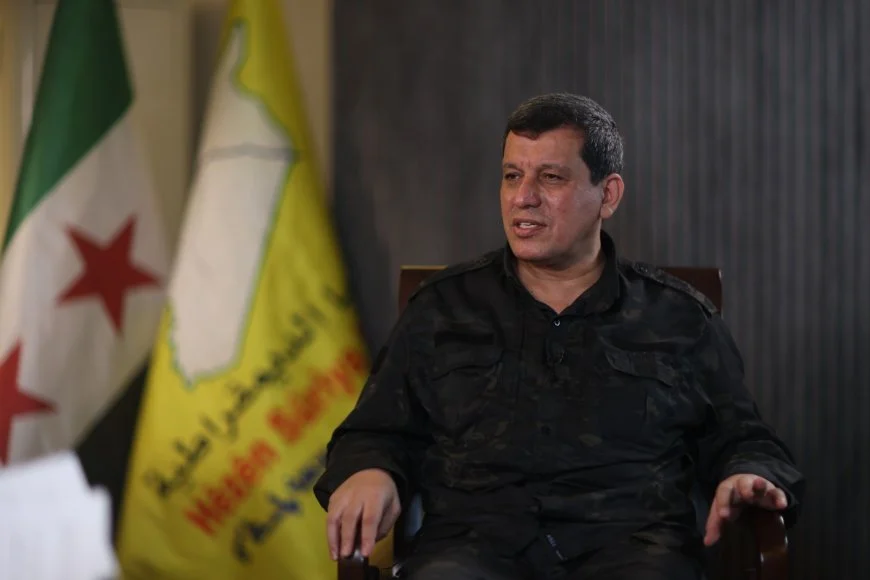
The Commander-in-Chief of the Syrian Democratic Forces (SDF), Mazloum Abdi, has called on the public to allow for a period of calm to facilitate ongoing understandings with the government regarding the judicial file and the issue of the identification signage at the Justice Palace in Hasakah. He confirmed that promises have been made to re-include the Kurdish language in the coming phase, emphasizing that maintaining the path of integration requires avoiding the disruption of other files linked to the judicial institution.
In an interview with the Kurdish Hawar News Agency (ANHA), Abdi discussed the reasons behind the deadlock in the judicial file, the understandings reached with the Interim Government, and recent developments concerning the removal of the Kurdish language from the Justice Palace signage in Hasakah—and how this aligns with the spirit of the recent agreement and Presidential Decree No. 13.
Abdi stated that “some problems emerged in this file approximately two weeks ago, which were a direct cause for stalling the integration process for a period of time.” He noted that the dispute began due to the absence of a clear mechanism for judges of the Autonomous Administration to join the government within the integration framework, accompanied by concerns regarding the protection of their rights and the specific nature of the region.
He explained that “the reaction from the judges and the judicial administration in the region was justified, represented by a rejection of exclusion, which contradicts the essence of integration based on consensus rather than marginalization.” He pointed out that the lack of a consensual agreement from the start led to the failure of this file and the halting of the integration path, which in turn impacted public opinion.
Abdi added that several meetings were held in Damascus and in North and East Syria at various levels following this deadlock. He noted that he personally held a meeting with those concerned with the judicial file to overcome the crisis and prevent it from becoming an obstacle to a comprehensive agreement.
According to Abdi, understandings reached with the government include the acceptance of integrating Autonomous Administration judges without exclusion. Furthermore, it was agreed that certain individuals from the previous era (“the Ba’ath era”) would continue their work to “ensure the continuity of citizens’ legal files and the smooth running of operations” through joint work between Autonomous Administration judges and previously employed judges.
Abdi indicated that lists of the names of Autonomous Administration judges—who constitute the majority—have been submitted in preparation for their enrollment in government judicial courses and their permanent appointment in courts. He stressed that both parties agreed to expedite the resolution of this file and the opening of judicial centers in the region, given that many official services are linked to them.
He emphasized that the continued disruption of the Justice Palace file affects various issues, including elections, passport procedures, the real estate registry, and other transactions requiring documents issued by the judiciary. “Solving the Justice Palace problem is a gateway to solving many other files,” he added.
Regarding the removal of the Kurdish language from the identification signage at the Justice Palace in Hasakah, Abdi said the government justified this by stating that the Justice Palace is a “sovereign institution within the governorate and the sign must be in Arabic only.” He added that regional representatives did not want this dispute to become a new reason for stalling the integration process.
Abdi clarified that the agreement with the government includes adopting bilingual signs (Arabic and Kurdish) in majority-Kurdish cities such as Kobani, Qamishlo, Derik, Amuda, and Darbasiyah. He noted that the current signage in Hasakah was accepted “for a limited period of time,” provided it is reconsidered later under new understandings.
He added that the popular reactions rejecting the exclusion of the Kurdish language were justified and strong, particularly among the youth, stemming from the community’s sensitivity toward the preservation of the Kurdish language. Based on these developments, and taking into account the civil protests and the sensitivity of the judicial institution, the issue was revisited.
Abdi stated that the matter was raised again in ongoing communications with government representatives. It was agreed that the issue of language and naming at the Hasakah Justice Palace must be addressed in the next phase, in line with the practices in other Kurdish cities. He confirmed that the other party provided “pledges” to solve the problem and restore the bilingual sign, but at a later stage rather than immediately.
Abdi called on the public, especially the youth, to grant an opportunity for de-escalation to allow these understandings to be translated into reality on the ground, and to avoid disrupting the integration path or delaying other files associated with the institution.
In conclusion, the SDF Commander-in-Chief expressed his appreciation for the people’s high sensitivity toward preserving the Kurdish language, describing it as a “source of pride,” while stressing the need for continued efforts to ensure the Kurdish language is enshrined in the future Syrian constitution.
The judicial file is considered one of the most prominent issues to face obstacles in implementing the terms of the January 29 agreement signed between the SDF and the Interim Government in Syria over the past weeks. This coincide with ongoing popular protests in front of the Justice Palace in Hasakah, rejecting the marginalization of the Kurdish language on the building’s signage and demanding a resolution to the governorate’s judicial file.
Source: ANHA
Note: This text is translated from the original Arabic version… Read the Arabic version: Click here