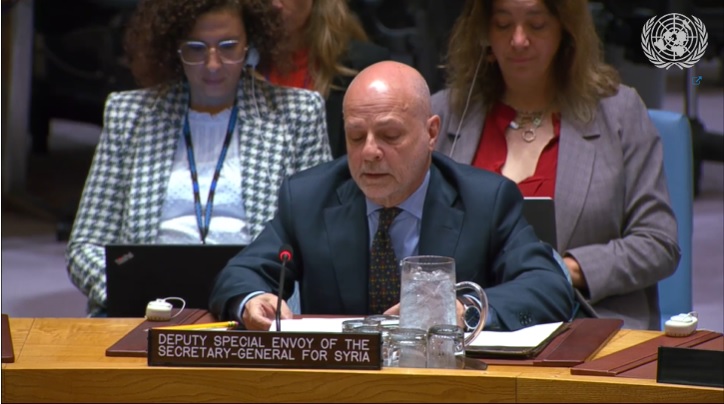
The Deputy Special Envoy of the United Nations for Syria, Claudio Cordone, stated that the country’s political transition process is passing through a “critical juncture characterized by the coexistence of opportunity and fragility,” adding that the organization is focusing its efforts on supporting the authorities and the people in facing existing challenges and pushing toward a “sovereign, stable, peaceful, and inclusive future for all.”
This came during a UN Security Council meeting on Monday, where Cordone emphasized the need to move forward with the political transition process in Syria through the formation of the legislative authority, the consolidation of state institutions, and the establishment of the rule of law. He noted that the engagement between the Syrian authorities and the United Nations regarding the political transition is progressing “tangibly and constructively,” yet there is more to be done.
He pointed out that the continued delay in forming the transitional People’s Assembly raises concern, asserting that women and the various components of Syrian society must be genuinely and effectively represented in this assembly and in all aspects of public life. He also stressed the importance of achieving transitional justice swiftly and fairly, and that all perpetrators of atrocities and heinous crimes must be held accountable, “not only those associated with the Assad regime,” and that issues of conflict-related sexual violence must be addressed.
He referred to what was included in the Secretary-General’s 2025 report on conflict-related sexual violence, including violations against women from the Alawite community during the violence witnessed in the coastal region last March at the hands of armed elements “and some members of the government security forces.” He urged the government to ensure that “these crimes are addressed through transitional justice mechanisms and that appropriate measures for accountability, protection, and assistance to survivors, as well as prevention, are taken.”
Security Situation
Regarding the situation in northeast Syria, the Special Envoy reported that the implementation of the agreement concluded between the government and the Syrian Democratic Forces (SDF) continues to progress, including the integration of four SDF brigades, whose members are now receiving their salaries through national structures. However, he noted that there are significant issues that need to be addressed, encouraging continued constructive engagement to advance the implementation of the agreement in a manner that enhances inclusivity and national unity.
Regarding the situation in Suwayda, he stated that no progress has been made on the roadmap for confidence-building and reintegration, adding that mistrust persists between Damascus and actors within Suwayda, while separatist calls within the governorate threaten to undermine the country’s unity and territorial integrity. He added that incidents of kidnapping and internal rivalry among Druze factions continue to affect the governorate, and no solution has been reached regarding Suwayda students taking national exams.
Further complicating the security situation is the continuation of Israeli military activity in southern Syria, including maintaining a military presence in the disengagement zone and conducting “near-daily incursions,” as well as establishing temporary checkpoints and conducting searches and arrests of civilians. Cordone said: “We reiterate our strong call to Israel to abide by the 1974 Disengagement Agreement, release those unlawfully detained, and respect Syria’s sovereignty and territorial integrity.”
Policy of Distancing
Cordone welcomed the efforts made by the Syrian authorities to distance the country from regional conflicts. He pointed to reports indicating that Syrian security forces foiled attempts to transfer missiles from Syria to Lebanon and carried out additional operations targeting cross-border smuggling networks. He said that Syria also confirmed its position of non-interference in Lebanon’s affairs and support for its stability, which President Al-Sharaa reaffirmed yesterday.
He said: “We hope that the recent memorandum of understanding between the United States and the Islamic Republic of Iran will be implemented, and that greater regional stability will allow for a renewed focus on the stability of Syria – and its economy.”
Humanitarian Situation
For his part, Indrika Ratwatte, the Acting Assistant Secretary-General for Humanitarian Affairs, stressed that Syria does not need “narrow thinking that separates humanitarian response from recovery, or recovery from long-term stability,” adding that these three elements are essential to ensure the sustainability of the transition process in the country.
He noted that humanitarian needs remain acute, displacement continues, “and the conditions conducive to sustainable return remain uneven across the country.”
He said that humanitarian workers are working to meet needs, but resources remain insufficient. He added: “If more support is provided, much can be achieved.”
Ratwatte pointed to recent flooding that affected more than 17,600 people along the Euphrates River, damaging agricultural lands and disrupting critical infrastructure.
He said the humanitarian response to the floods constituted “an important test for Syria’s evolving humanitarian coordination structure” and demonstrated the value of strengthening coordination at sub-national levels, more effective local partnerships, and streamlining procedures that “allow the United Nations, humanitarian partners, and relevant authorities to move quickly and in harmony.”
He added: “This is the model we need to build on: responding to immediate needs while helping communities strengthen their resilience against future shocks.”
The UN official pointed out that the humanitarian appeal for Syria—which requires $2.92 billion—has only received 20% funding, calling for more predictable and flexible funding.
He also called on the Council to support the government’s vision based on the principle of “no tents and no camps,” a vision that requires investment in conditions that “make solutions possible,” including protection, social integration, mine clearance, basic services, livelihoods, and environmental recovery.
Source: UN
Note: This text is translated from the original Arabic version… Read the Arabic version:Click here