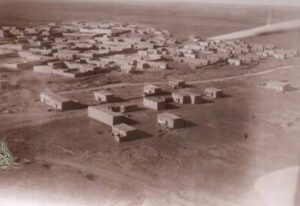
The emergence of Kurdish cities was linked to a combination of natural and human factors that contributed to the transition of human settlements from the stage of small agricultural villages to the stage of advanced urban centers. Kurdistan has been characterized by its mountainous nature, abundance of water resources, and its location on the transportation and trade routes connecting Mesopotamia, Iran, Anatolia, and the Levant. This made it a suitable environment for the emergence of human settlement since the earliest times.
The initial nucleus of many Kurdish cities began as agricultural villages that settled near water sources and fertile lands. These villages relied primarily on agriculture and livestock breeding. With the increase in population and the expansion of economic activity, they began to acquire new functions that transcended the boundaries of agricultural production. The growth of commercial exchanges between villages and neighboring regions led to the emergence of local markets, which became gathering centers for populations, craftsmen, and traders.
At later stages, citadels and fortresses played a pivotal role in the urbanization process. Due to Kurdistan’s mountainous nature and the abundance of political and military conflicts, the population tended to build citadels on high elevations to provide protection and security. Over time, these citadels became centers of administration and governance, and the headquarters of local princes and rulers. This led to the settlement of the population in their vicinity and the emergence of residential neighborhoods, markets, and service facilities around them; thus, the citadel transformed into an urban nucleus that attracted various economic and human activities.
The Kurdish emirates that emerged during the Islamic eras also contributed to enhancing the status of many cities. Local rulers took an interest in constructing mosques, schools, khans, baths, and markets, as well as fortifying cities and developing their public facilities. This led to the growth of the administrative, religious, and commercial functions of the city, transforming it into a center that attracted populations from neighboring rural areas.
The political factor alone was not responsible for the emergence of Kurdish cities; the geographical location also contributed to enhancing the role of certain urban centers. Cities located on main trade routes—such as Erbil, Duhok, Zakho, Amadiya, Kirkuk, Kermanshah, Urmia, Bitlis, Amid, and Van—benefited from the movement of trade and passing caravans through the region, which led to the prosperity of their markets, an increase in their population, and the expansion of their urban architecture.
With the development of economic and social life, Kurdish cities began to acquire clear urban characteristics, manifested in the existence of specialized markets, residential neighborhoods, and religious and administrative institutions, as well as the diversity of professional and craft activities. Thus, these centers gradually transitioned from being villages or fortified human settlements around citadels into cities performing multiple political, economic, cultural, and religious functions.
Accordingly, the emergence of Kurdish cities was not a sudden event, but rather a long, complex historical process resulting from the interaction of intertwined geographical, economic, military, and political factors. The agricultural village and the military citadel formed the primary foundation for the emergence of many cities, before they developed over time into urban, administrative, and political centers that played an important role in the history and civilization of Kurdistan.
The historical experience of the Kurdish emirates shows that many Kurdish cities emerged and developed around citadels, fortresses, and local centers of governance, and then gradually transformed into urban centers with political, economic, cultural, and social functions.
The Kurdish emirates in the Islamic eras—some of which took the title of a state or a kingdom by the consensus of many primary Islamic sources, and which exceeded fifty in number—are considered among the most prominent political entities that contributed to shaping the historical and cultural structure of Kurdistan. They were characterized by their multiplicity, the diversity of their regions, and their temporal span that encompassed various stages of ancient, medieval, and modern history. A number of them settled outside the motherland of Kurdistan, such as the Ayyubid state in the heart of the current Middle East, the Zand dynasty across most of the Iranian plateau, and the Zafranlu and Shadanlu emirates in Khorasan in eastern Iran on the borders of Turkmenistan and Afghanistan. These emirates can be arranged chronologically to reflect the development of Kurdish political authority and its geographical distribution.
In the early Islamic phase, the Hasanwayhid emirate (10th–11th century AD) emerged in the Zagros Mountains region, taking the regions of Lorestan and Hamadan as its center, and was known for its military strength and local influence. Around the same period, the Annazid emirate appeared, extending from eastern Kurdistan to the Shahrizor regions and its outskirts, in addition to the Hadhabani emirate, which played an important role in the Erbil region and its surroundings, contributing to the consolidation of political stability across most of southern and western Kurdistan.
Also in the tenth and eleventh centuries AD, the Shaddadid emirate emerged, taking Arran (= the Caucasus and Azerbaijan) and Armenia as its center, distinguished by its ability to manage vast, multi-ethnic regions. This was in addition to the Rawadid emirate, which controlled large parts of Azerbaijan. In Hasankeyf, the Dustakid emirate also appeared under the leadership of Bad ibn Dustak, the self-made, brave prince who exhausted the Buyid state and controlled Mosul. Furthermore, the Marwanid emirate (990–1085 AD), which took Mayyafariqin as its center, extended its influence to vast areas of northern Kurdistan and was characterized by its architectural and scientific prosperity, political stability, and balanced diplomatic relations with the Abbasid, Fatimid, Byzantine, and Buyid states. It minted its own currency, as if it were a state standing on its own (= confederal rule).
As for the late Islamic eras (= the Ottoman era), Kurdish political entities continued within a more organized framework. Around 30 Kurdish emirates emerged following the agreement between Maulana Idris al-Bidlisi and Sultan Selim in the year 1515 AD after the Battle of Chaldiran in 1514 AD according to one account, or after the issuance of the decree of Sultan Suleiman the Magnificent in 1534 AD according to another account. Among the most prominent of these was the Bahdinan emirate (13th–19th century), which took Amedi (Amadiya) as its capital and was distinguished by its numerous schools and mosques, particularly its famous minaret that has stood for more than 500 years, and the Qubahan School (the Al-Azhar of the Kurds). To its west, the Bohtan emirate emerged, with Jezireh Bohtan as its capital, and its golden age was during the rule of Bedr Khan Pasha. There was also the fortified Hakkari emirate, which took the city of Julamerg—surrounded by towering mountains—as its capital, serving as an impenetrable shield against the attacks of the Oghuz and Mongols on the Kurdish homeland. Nor can one undervalue the Soran emirate, which flourished scientifically and militarily in Rawanduz during the eighteenth and nineteenth centuries, in addition to the Baban emirate, which took Sulaymaniyah as its capital since its founding in 1784 AD, playing an important role in political, cultural, and economic life in southern Kurdistan. Nor can one forget the Ardalan emirate, whose capital was the beautiful city of Sanandaj; it ruled for a long period and was the last Kurdish emirate to fall by the seventh decade of the nineteenth century.
Collectively, these emirates indicate that the Kurdish political system was not a fixed, centralized system, due to many reasons, including geographical location and regional and international conflicts over Kurdistan. Rather, it was based on overlapping regional units linked administratively (= federation), meaning the transition from the scope of the tribe and clan to administrative unions of an urban nature linked to geographical location and military and economic conditions. This contributed to the emergence of urban centers that later transformed into important Kurdish cities that still exist today.
Among the most prominent of these living models up to the present time is the city of Erbil (Hewler), another model of the historical Kurdish city, as it formed around its famous citadel, which is considered one of the oldest continuously inhabited sites in the world. Its strategic location on the trade routes between Mesopotamia, Iran, and Anatolia contributed to its economic prosperity and its transformation into an important urban center throughout various eras, until it became one of the most beautiful cities in the Middle East in terms of urban and economic development, being the capital of the Kurdistan Region of Iraq.
The Zakho region, due to the city’s location on the banks of the Khabur River and its proximity to international trade routes, also represents a model of gradual growth from a small population settlement into a prominent commercial and administrative center, especially during the era of the Bahdinan emirate. The prosperity of commercial activity led to the expansion of its markets and residential neighborhoods.
As for the city of Sulaymaniyah, it represents a relatively different example, as it was established in the late eighteenth century by the Kurdish prince Ibrahim Pasha Baban around the year 1784 AD, to be a new capital for the Baban emirate. It was created according to a clear political and administrative vision, and within a short period, it transformed into an important cultural and commercial center in southern Kurdistan.
Another model is the city of Rawanduz, which flourished during the era of the Soran emirate in the nineteenth century, benefiting from its strategic mountainous location and its military and administrative role, which made it an influential political and economic center in the region. The city of Aqrah (Akre) also emerged as an urban center linked to trade routes and the administrative role it played within the spheres of influence of various Kurdish emirates.
These models illustrate that the emergence of Kurdish cities was often linked to three main elements:
The citadel as a center for defense and governance.
The market as a center for economic activity.
The geographical location that provided the conditions for stability and commercial communication.
Through the interaction of these elements, villages, citadels, and small human settlements developed into urban cities that played prominent political, economic, and cultural roles in the modern and contemporary history of Kurdistan.
Source: Rudaw
Note: This text is translated from the original Arabic version… Read the Arabic version:Click here