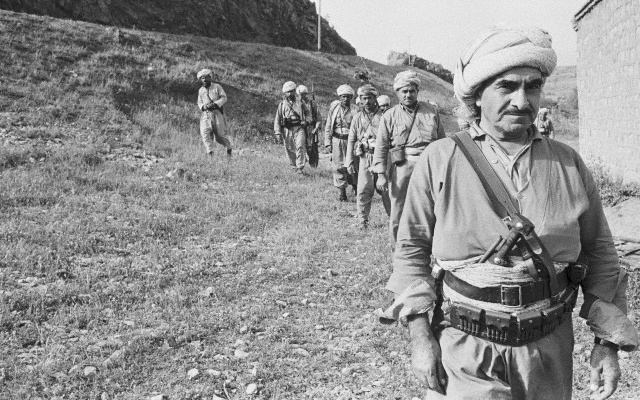
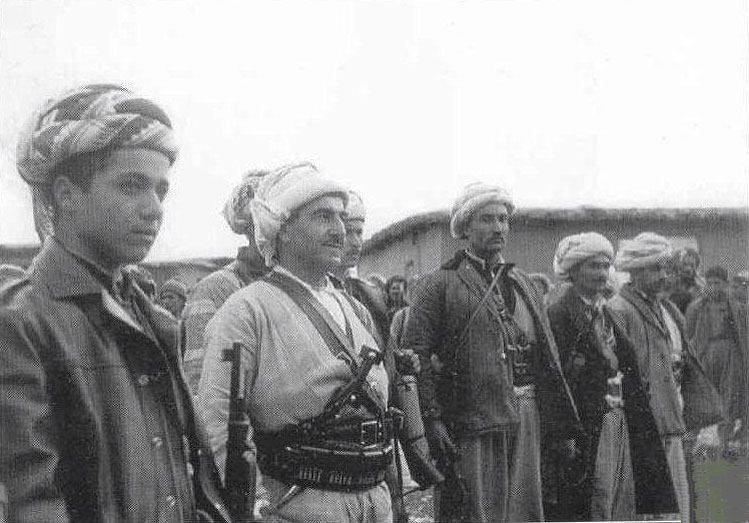
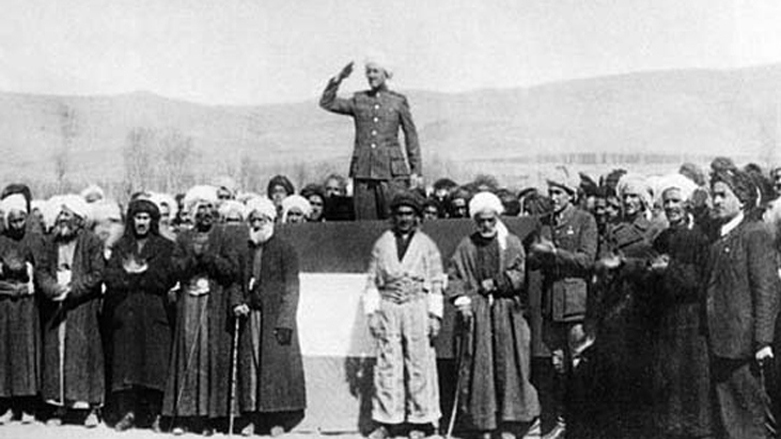
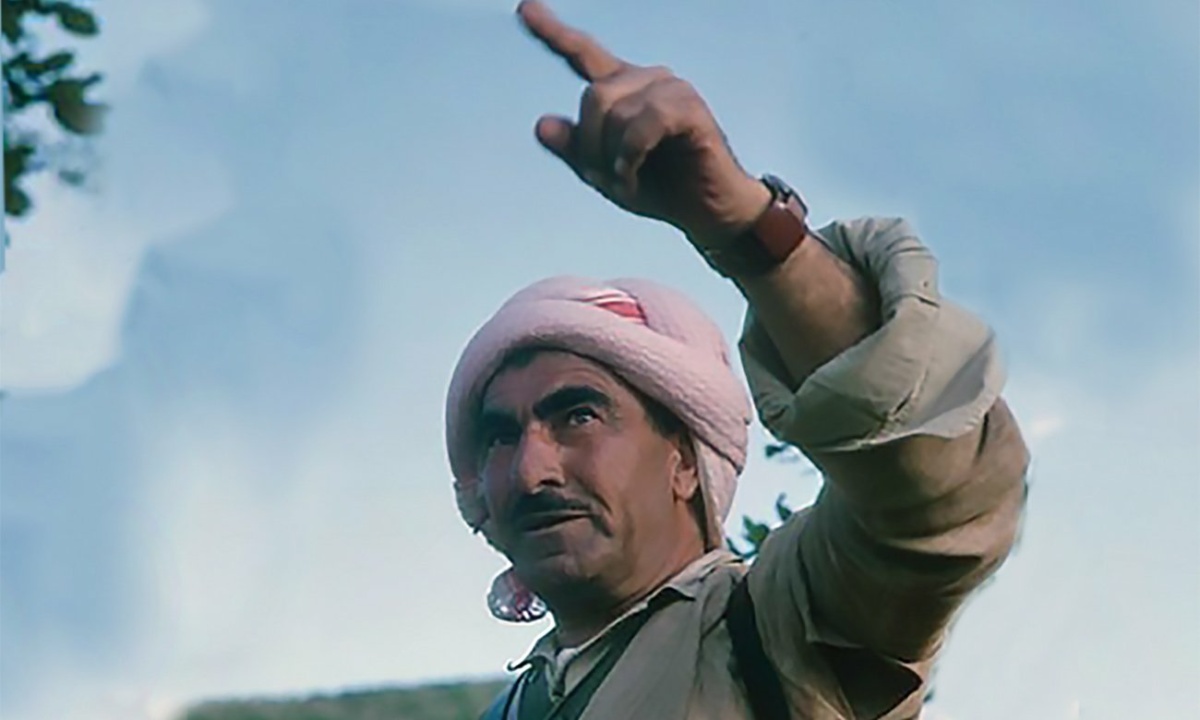
The history of the Kurdish liberation movement, from the early twentieth century to the present day, has been closely linked to the Barzani family. Mustafa Barzani became a beacon for the Kurds throughout his life of struggle; his name became synonymous with the Kurdish people, and he played a historic role in introducing Kurdish national identity to the world.
Mustafa Barzani was born on March 14, 1903, in the mountainous village of Barzan near the Greater Zab River, which became the capital of the Barzanis and included the Baruji, Mazuri, Shirwani, and Herki tribes. Barzan never submitted to the ruling authorities. The Barzani family enjoyed a special status in the region, where the Naqshbandi sheikhs Taj al-Din and Abd al-Salam (grandfather of Mulla Mustafa) managed and settled the affairs of the area.
The Barzani family was subjected to displacement and oppression by the Ottoman authorities following the execution of Sheikh Muhammad, Mustafa’s father, shortly before his birth, for leading an uprising against the Turkish ruling authorities. His eldest son, Abd al-Salam, assumed leadership of Barzan and is considered the first to adopt the idea of agrarian reform in Kurdistan and the Middle East, when he enacted a law to distribute land equally among the peasants of the region. Mustafa was not yet three years old when the Turks imprisoned him along with his mother and the family of Sheikh Abd al-Salam after the failure of the uprising he had declared in 1905. In 1916, he witnessed with his own eyes how the authorities executed his brother in Mosul. Following the Young Turk movement of 1908–1909, Sheikh Abd al-Salam rose again against the Ottoman Turks, raising the banner of Kurdish liberation struggle. He invited Kurdish leaders to a meeting in the village of Bervikan and sent to Istanbul demanding Kurdish rights, the most important of which were granting the Kurds autonomy, recognizing Kurdish as an official language in the region, and allocating taxes for the development of the Kurdish area.
In 1914, Sheikh Abd al-Salam led a new uprising supported by many Kurdish national tribes, but he failed to achieve his goals due to the complexity of the regional and international situation, which was unfavorable to the Kurdish liberation movement. He sought refuge in the Russian sphere of influence in Urmia, where he met Tsar Nicholas II in 1914 (For History, p. 23). From there he moved to the Nakhchivan province and later returned, but he was arrested in mid-September 1914 in the border strip adjacent to Iran, and on December 14, 1914, he was executed in the square of Mosul city. Leadership of the tribe then passed to Sheikh Ahmad, who revolted in 1919 demanding Kurdish rights following World War I, as the Kurds aspired to establish their national state in accordance with Wilson’s Fourteen Points and the right of self-determination promoted simultaneously by Moscow and Washington. Under Sheikh Ahmad’s leadership, the Barzanis succeeded in liberating Amadiya from British forces, which had destroyed and bombed the villages and towns of Barzan. Sheikh Ahmad Barzani, besides being a national leader, was also a social reformer through his reform project and his particular views on religious and moral issues and on protecting nature.
Since Barzan was a school of struggle for the Kurds, Mustafa Barzani became involved early in military-political struggle. The prominent Soviet academic, political, and media figure Yevgeny Maksimovich Primakov said: “The life of this man is very fascinating. In 1905 he was arrested with his mother in Mosul prison. He fought in his youth in 1914–1915, as well as in 1931 and then in 1943…”
In 1919, at the age of sixteen, he led an armed unit. Between 1919 and 1922, he met Sheikh Said Piran in Mush in northern Kurdistan. In the late 1920s, he and his brother Sheikh Ahmad established relations with the Khoybun Party, and Mustafa Barzani marched at the head of 500 of his fighters to support the rebels of Ağrı led by General Ihsan Nuri Pasha, but the Turks forced him to retreat after a battle between the two sides in the Oramar area.
Mustafa Barzani was a Kurdistani who believed that the Kurdish issue was indivisible, and he often used Kurdistan’s geographic depth during his confrontations with enemy forces. He became the charismatic leader of the Kurdish national movement. From the beginning, he possessed high political-diplomatic qualities. In 1930, his brother Sheikh Ahmad tasked him with meeting King Faisal to present Kurdish demands. Four Kurdish deputies had already presented demands in 1929 to allocate 20% of the state budget to Kurdistan. Successive governments neglected Kurdistan throughout history and imposed, especially on Barzan, an undeclared economic blockade. The Barzanis, led by Sheikh Ahmad and Mustafa Barzani, launched a major uprising between 1930 and 1932 following the end of the British Mandate and Iraq’s acceptance as an independent state in the League of Nations, while Kurdish national rights were ignored.
Britain participated alongside the Iraqi army, which constituted one-third of the forces attacking Barzan areas. In December 1931, due to British bombardment, Sheikh Ahmad was forced to retreat into rugged mountainous regions. British aircraft destroyed dozens of Kurdish villages in Barzan. Britain did the same in the summer and autumn of 1945 when it supported Nuri al-Said’s forces in suppressing the Barzan uprising. In 1943, Mustafa Barzani led his courageous uprising, which forced the Iraqi government, headed by Nuri al-Said, to recognize Kurdish demands to form a Kurdish region including Kirkuk, Erbil, Sulaymaniyah, Khanaqin, and Duhok, but with British support, the Iraqi government reneged on its promises. The uprisings led by Mustafa Barzani from 1943 to 1945 played a major role in the growth of Kurdish national self-awareness.
Regarding Barzani’s foresight, Soviet intelligence officer Alexander Kiselev wrote in his book “Secret Mission in the Middle East” (p. 23): “In 1941, Mustafa Barzani came to Iran, where British and Russian forces were present, and contacted Ivan Ivanovich Akayants, asking Stalin for military support.”
When the Barzan uprising of 1943–1945 ended, Kurdish leader Mustafa Barzani moved with two thousand of his fighters to eastern Kurdistan on October 11, 1945, via Kelashin–Dalameer, at the tri-border point between Turkey, Iran, and Iraq, to support the establishment of the anticipated Kurdistan Republic. Iraqi and British aircraft did not stop indiscriminate bombardment and pursuit of the Barzanis to the last border point. On January 22, 1946, the first Kurdistan Republic was declared in Mahabad during the Cold War, and Barzani was invited to attend. The burden of defending this young republic fell on the Barzanis. Barzani played a major role in building the Kurdistan Democratic Republic and became Chief of Staff of its army.
Following the Barzan uprising of 1943–1945 and the new international conditions produced by World War II, Barzani realized that southern Kurdistan needed a political organization to carry the burden of Kurdish national struggle under new international conditions. Thus, the first congress was held on August 16, 1946, in Baghdad, where members of the party’s Central Committee were elected, and Mustafa Barzani was elected in absentia as its president, after the congress adopted his recommendations and those of his comrades. In eastern Kurdistan, the last meeting between Mulla Mustafa and Qazi Muhammad took place on December 16, 1946. Qazi Muhammad insisted on sacrificing himself to spare Kurdish bloodshed and was executed at dawn on March 31, 1947, along with Saifi Qazi and Sadr Qazi. On January 29, 1947, the Barzanis left Tehran.
Qazi Muhammad
On April 15, Mustafa Barzani bid farewell to his brother Sheikh Ahmad, who accompanied the women and children to Iraq, while Barzani himself, at the head of 560 armed men, decided to move to the Soviet side to internationalize the Kurdish issue. At that time, on June 19, 1947, four Kurdish officers—Major Izzat Abdul Aziz, Captain Mustafa Khoshnaw, Khairallah Abdul Karim, and Lieutenant Mahmoud Qudsi—were executed.
Barzani’s march was legendary by all standards. On April 20, 1947, this hazardous journey began from the Kudar River area in eastern Kurdistan and ended at the Aras River on the Soviet-Iranian border, about 300 kilometers away. Barzani entered Iraqi territory on April 19, heading to Khwakurk via Nazdari Dagi, dividing his forces into five groups. He reached the Mazuri area on the 25th and stayed in the village of Arkush. Iraqi, Iranian, and Turkish forces coordinated to pursue the Kurdish rebels. On May 6, Barzani gathered his followers in Arkush and informed them of his final historic decision to seek asylum in the Soviet Union, leaving each fighter free to choose whether to return. All preferred death with him over life without him. The force traversed rugged mountain routes according to precise military tactics devised by Barzani, who demonstrated strategic and tactical genius. On May 23, in the village of Dari, Kurdish forces were bombarded by Iraqi forces. The next day they reached Bidaf, the last village on the Iraqi-Turkish border, and left it on May 25 via the difficult mountains covered with dense snow at 3,000 feet elevation. They reached the village of Bai in northern Kurdistan, crossed into Iran, fought Iranian forces in the Battle of Maku between June 9 and 11, captured the Maku bridge, and crossed the Zangi River after inflicting heavy losses. These Iranian forces had come specifically to eliminate Barzani’s force and prevent it from reaching the Soviet state.
The Kurdish force, numbering 504 fighters, crossed the Aras River on July 17–18, 1947, after a historic journey lasting 75 days and covering 400 km across the rugged Kurdistan mountain ranges in harsh winter conditions. Barzani was transferred to Nakhchivan and then to the Azerbaijan Republic, where Kurdish fighters were distributed in various areas. Barzani himself was housed in the city of Shusha. On September 29, 1947, Barzani was transferred to Baku, where a special training camp was established for them.
Because Barzani did not submit to pressure from Azerbaijani ruler Bagirov to make the Kurds part of Azerbaijan, relations between them became strained. Historian Nikolai Fedorovich Bugay, relying on documents from Stalin’s archive preserved in the Ministry of Interior, wrote: “Jafar Bagirov requested Stalin to train the Barzanis near the Caspian Sea and provide 20 Soviet experts to train them.” Due to disagreements, Barzani and his comrades were transferred at Bagirov’s request to the Uzbek Soviet Republic by decree No. 2943-121 issued July 9, 1948. They were placed in Jirjuk camp near Tashkent on August 29. Soviet intelligence general Pavel Sudoplatov also led negotiations with Barzani, presenting himself as Matveev, deputy director of TASS and spokesman of the Soviet government. Sudoplatov later wrote that Barzani left on him “the impression of a very intelligent politician and experienced military commander.” He informed Barzani that the Soviet side agreed to provide special military training to Barzani and some of his officers and assured him that Kurdish settlement in Central Asia would be temporary until conditions allowed their return to Kurdistan. Barzani wrote to Stalin requesting a meeting to discuss the Kurdish issue, but his letters were intercepted and hidden from Stalin.
At the end of 1948, Barzani was received, at his urgent request, by Osman Yusupov, First Secretary of the Uzbek Communist Party, expressing dissatisfaction with his group’s situation and requesting a meeting with Stalin. On March 13, 1949, Barzani was transferred to Jambay near Lake Ural, while others were sent to Samarkand and elsewhere. Kurds were dispersed across collective farms and prevented from communicating. In late 1951, Barzani was given a house near Tashkent, and the situation of his comrades improved.
After Stalin’s death in March 1953, Barzani traveled to Moscow. Primakov wrote in “Secret Backstage of the Middle East” (pp. 324–329), quoting Barzani: “I knocked on the Spassky Gate of the Kremlin. An officer asked what I wanted. I replied: It is not Barzani knocking, but the Kurdish revolution.” He said: “I am Mulla Mustafa Barzani. I came to present the case of an oppressed people to Lenin’s people and his party.” He was received by Malenkov and later met Khrushchev. Khrushchev asked him to recount events from entering Soviet territory to arriving in Moscow. Barzani concluded: “My comrades and I fought seven states before reaching Moscow.” When asked which states, he replied: “The United States, Britain, Iraq, Turkey, Iran, Azerbaijan, and Uzbekistan.” Khrushchev laughed and said: “How did you discover Bagirov’s character?” Barzani replied that their treatment contradicted Lenin’s principles. Khrushchev informed him that his letters had been confiscated by Lavrentiy Beria. Barzani was then transferred to Moscow, where he lived on Novoslobodskaya Street in a special building for political émigrés. He graduated from the Frunze Military Academy and sent dozens of his comrades to Soviet institutes and universities. Primakov noted that Barzani lived under the name Mamedov.
In 1956, Barzani visited Kurds in Armenia and was warmly received. Following his visit, the newspaper “Riya Taze” was reissued, Kurdish writers’ unions were established, Kurdish studies developed, and Kurdish national consciousness revived.
After spending 12 years in the Soviet Union, Barzani returned to Iraq following the July 14 Revolution via Prague, Cairo, Basra, and Baghdad as one of the most prominent leaders of contemporary liberation movements. Iraq’s constitution then affirmed Arab-Kurdish partnership and guaranteed Kurdish national rights within a unified Iraq.
However, the ruling military regime later retreated from these principles. Abdul Karim Qasim launched campaigns against the Kurdish people and the Kurdistan Democratic Party. Barzani left Baghdad for the mountains in late 1960, and the September 11, 1961 revolution erupted under his leadership—the longest Kurdish revolution in modern history. Southern Kurdistan became a center of hope for Kurds everywhere. Primakov quoted Barzani in 1967: “I suffer greatly when a Kurd or Arab is killed, and I will not allow the Kurdish revolution’s nature to be distorted.”
The March 11, 1970 agreement between the Kurdish movement and the Iraqi government was a major achievement, but it proved impossible under Saddam Hussein’s dictatorship. An international conspiracy culminated in the Algiers Agreement of March 6, 1975, ending the revolution tragically.
On May 5, 1970, the Georgian newspaper “Evening Tbilisi” reported academician Vasily Zakharovich Kolshavi’s visit to Barzani, describing him as a brave Peshmerga and optimistic leader who said Kurdistan would build schools, hospitals, and develop agriculture. Barzani emphasized national unity as the key guarantee of Kurdish rights.
Barzani later went to Iran and then to the United States, preparing to return after the Shah’s fall, but he died on March 1, 1979, in New York at the age of 76.
Barzani’s name will remain forever engraved in Kurdish history. He combined rare qualities: diplomatic and military skill, determination, resilience, simplicity, dignity, and devotion to his people and cause. He loved knowledge and despised ignorance. His name and legacy will forever endure throughout Kurdistan.
Sources:
1. Archives of the Central Committee of the Soviet Communist Party.
2. Vasily Mitrokhin Archive.
3. Pavel Sudoplatov memoirs, “Special Mission.”
4. Alexander Kiselev, Secret Mission in the Middle East.
5. Yevgeny Primakov, Secret Backstage of the Middle East.
6. Masoud Barzani, For History.
7. Dr. Ismail Hassaf symposium paper, Salahaddin University, March 13, 2022.