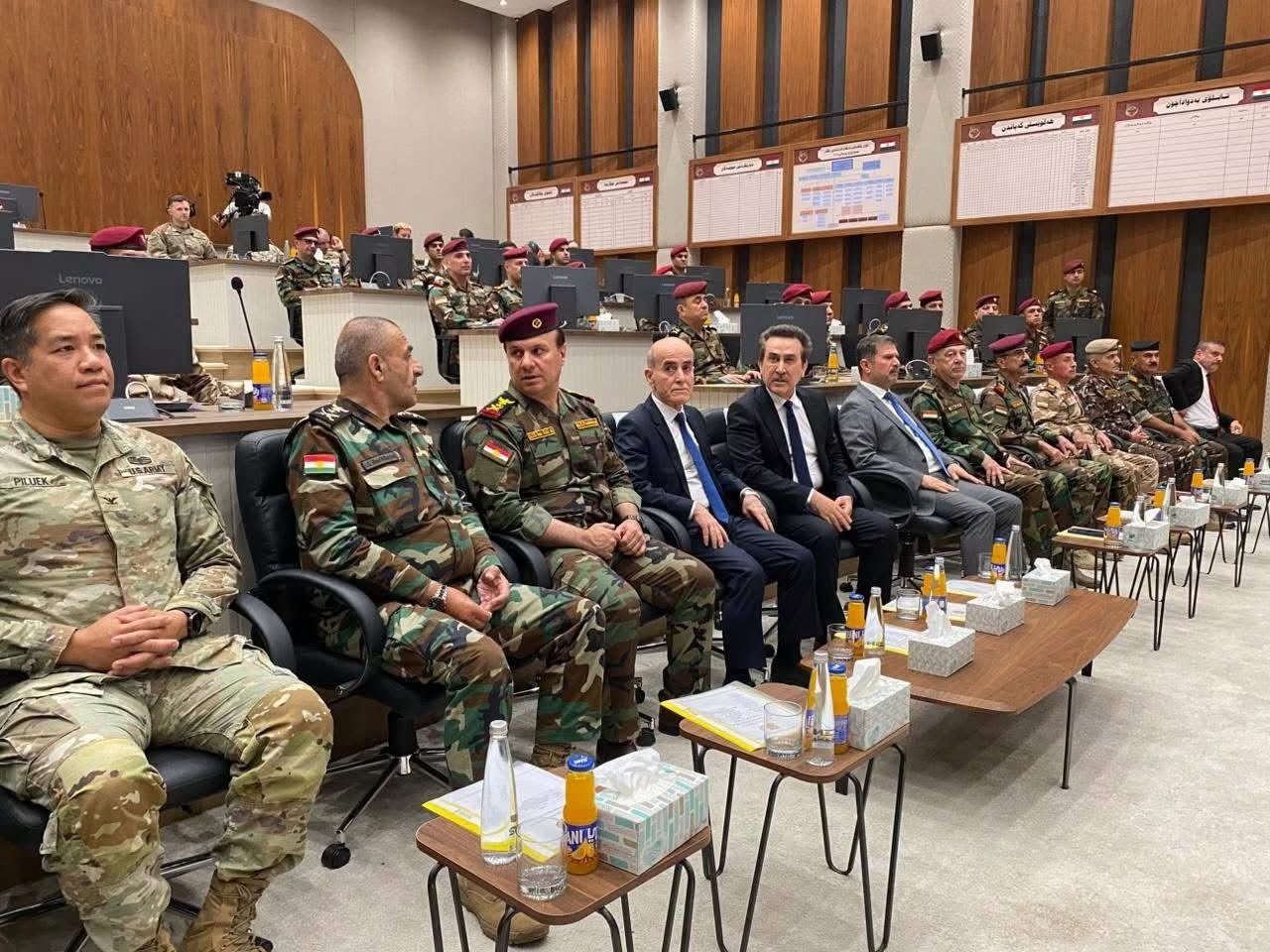
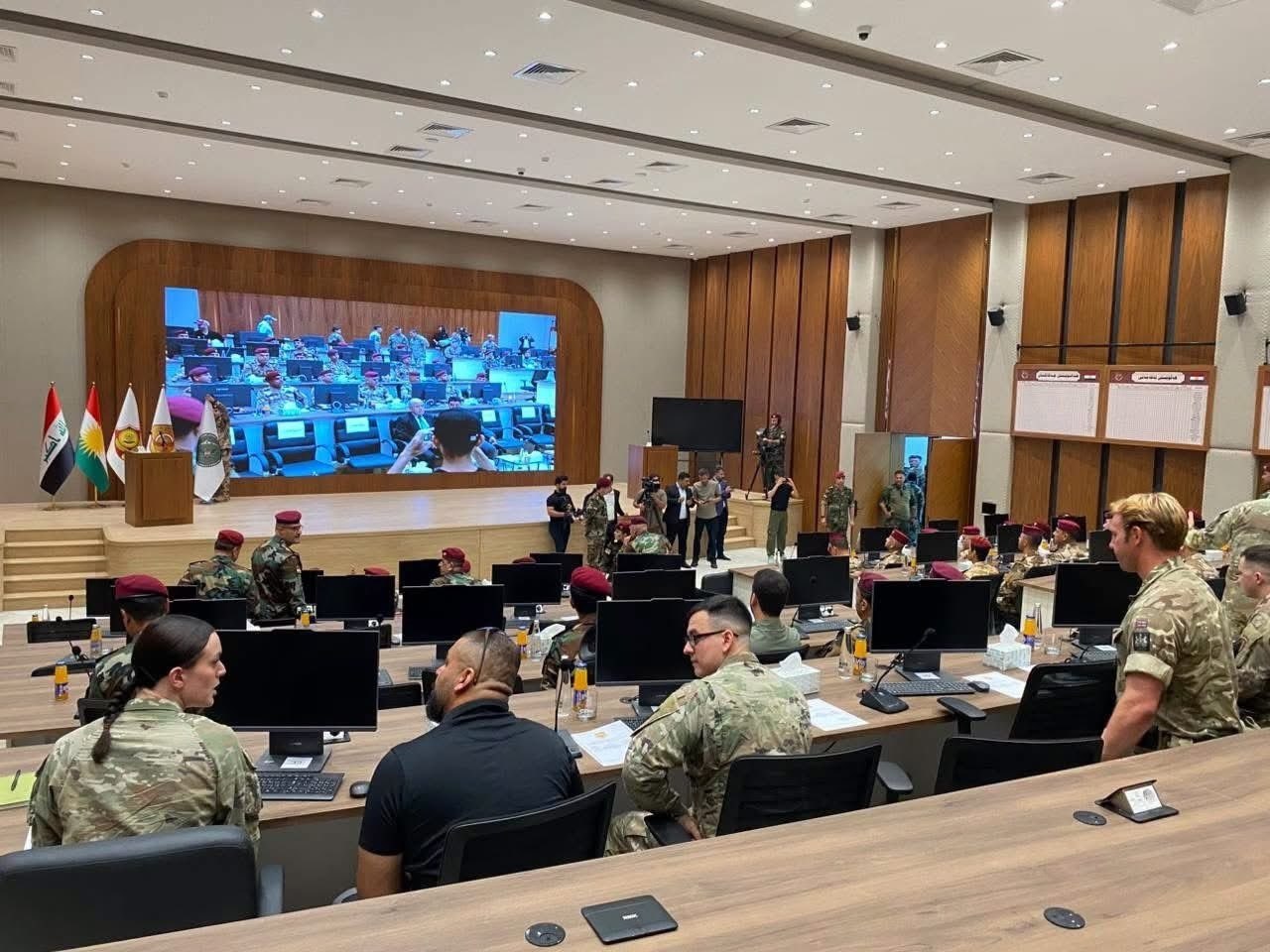
ERBIL — The Ministry of Peshmerga Affairs in the Kurdistan Regional Government (KRG) commenced on Tuesday the implementation of the first phase of the project to unify and reorganize the Peshmerga forces. This step is regarded as one of the most prominent stages of military institutional reform in the region, aimed at merging military formations under the ministry's umbrella and enhancing combat and organizational efficiency, in the presence of representatives from the International Coalition forces.
The practical phase of the project was launched at the headquarters of the First Division Command in the capital, Erbil. KRG Minister of Peshmerga Affairs, Shoresh Ismail, announced the start of the Peshmerga forces' unification process, confirming that all forces will come under the direct supervision and management of the Ministry of Peshmerga, following the resolution of obstacles that had previously hindered the project's implementation.
Speaking at a press conference following the launch ceremony of the first joint training course for Peshmerga forces, Ismail stated that the ministry will handle accommodation, training, logistics, and administrative tasks under a unified system. This comes within the framework of implementing the directives of Kurdistan Region President Nechirvan Barzani, and the plan to integrate forces that were previously outside the ministry's scope.
Regarding cooperation with the International Coalition, Ismail clarified that the financial support agreement concluded with the US Department of Defense (Pentagon) will expire next September, noting that there are currently no indications regarding its extension or the signing of a new agreement. He added that the Ministry of Peshmerga has acquired the capability to manage its affairs independently in terms of training, housing, and administrative system development, emphasizing that while continued International Coalition support would be an additional asset, its cessation would not affect the ministry's ability to meet its forces' needs.
For his part, Lieutenant General Najat Ali emphasized that the project to unify the Peshmerga forces represents a crucial step toward building a unified national military institution, noting that the process enjoys direct support from the Kurdistan Regional Government and the International Coalition forces.
He added that personnel from both commands have commenced joint training under the supervision of International Coalition advisors, aiming to raise readiness and enhance combat efficiency. He stressed that the Peshmerga forces have been and will remain a force for protecting peace and coexistence, and have never posed a threat to any party. However, the evolution of threats, particularly missile and drone attacks, necessitates developing military capabilities and equipping the forces with modern weapons and technologies.
Lieutenant General Najat Ali concluded by reaffirming that the ultimate goal is to achieve the full unity of the Peshmerga forces within a single national institution under the Ministry of Peshmerga Affairs, thereby enhancing the security and stability of the Kurdistan Region and safeguarding its achievements, which were realized through the sacrifices of thousands of martyrs.
An official source within the Ministry of Peshmerga had revealed on Monday that the restructuring process, overseen by the International Coalition, would begin with a training course titled "Decision-Making Process." The source explained that this represents the actual beginning of merging and restructuring the forces formerly known as Units "70" and "80", before they were renamed "First Region" and "Second Region," leading up to their full integration under the direct umbrella of the Ministry of Peshmerga.
This project is part of a reform plan launched by the Kurdistan Regional Government to reorganize the Peshmerga forces, which includes merging Unit 80, affiliated with the Kurdistan Democratic Party (KDP), and Unit 70, affiliated with the Patriotic Union of Kurdistan (PUK), into a unified military
institution.
The legal status of the Peshmerga forces is based on the constitutional powers granted to the Kurdistan Region to manage its security forces and regional guards. However, for years, their organizational structure remained divided between formations directly under the Ministry of Peshmerga and others linked to the two main parties.
Since the emergence of ISIS in 2014, the International Coalition—particularly the United States, the United Kingdom, and Germany—has intensified its support for the Peshmerga forces' reform project through a strategic program aimed at unifying them administratively and militarily, and developing the command, armament, training, and financing systems to enhance their readiness and capability to face security challenges.
Note: This text is translated from the original Arabic version. Read the Arabic version:Click here