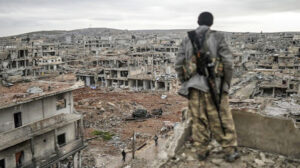
The Kurdistan Region of Iraq, by virtue of its geopolitical location and political orientations, has turned into one of the hottest arenas most affected by the repercussions of the direct confrontation between Iran on one side, and the United States and Israel on the other. According to recent reports monitoring the period between February and May 2026, the region recorded a heavy bloody and material toll, as it was subjected to more than 750 aerial and missile attacks, which left dozens of dead and wounded, and put the stability of the region at stake.
Statistics issued by international and local monitoring teams indicate that the intensity of the attacks peaked in the first forty days of the outbreak of confrontations, where suicide drones were used as a “preferred weapon” at a rate exceeding 78%. The geographical distribution of these strikes was not random; Erbil Governorate captured the lion’s share (about 78.3% of the strikes), followed by Sulaymaniyah and Duhok.
These figures do not merely reflect a military escalation; rather, they reveal a strategy of “continuous exhaustion,” as the targets were distributed among U.S. diplomatic and military facilities, civilian areas, and headquarters of the Peshmerga forces, reaching all the way to refugee camps and the headquarters of Iranian Kurdish opposition parties.
Observers raise a fundamental question: Why is Erbil targeted while Baghdad enjoys relative calm? The answer lies in the “political immunity” enjoyed by the capital, Baghdad, and Tehran’s influence within its institutions, which makes striking it politically costly. As for the Kurdistan Region, with its semi-independent model and balanced relations with the West, it represents a “soft target” for sending missile messages.
The pretext of the “presence of Mossad” is used as a ready-made scapegoat to legitimize these attacks before public opinion, despite the absence of tangible evidence. The truth is that targeting the region aims to pressure the Kurdish decision-maker to align with a specific axis and to break the policy of “rational neutrality” pursued by Erbil. It is a punishment for a successful model that managed to build an infrastructure and urban development that represents a “visual insult” to the areas controlled by factions mired in chaos.
The escalation was not limited to the military dimension; rather, it extended to include a fierce “economic war.” Targeting oil fields in “Khurmala,” “Sarsang,” and “Fishkhabur” aims to undermine the backbone of the region’s economy and scare away foreign investments. This military pressure coincides with political and financial pressure from Baghdad regarding the salary and budget crisis, suggesting an unannounced coordination to bring the region to its knees economically and securely. Striking oil facilities is not just material sabotage; it is a message to international companies that Kurdistan is an “unsafe environment,” thereby threatening the livelihood stability of millions of citizens.
The greatest danger manifests in the region’s defensive exposure. Erbil’s security currently relies almost entirely on the defensive umbrella of the international coalition forces. With the approaching date of the supposed U.S. withdrawal in September 2026, existential questions emerge about the capability of the Peshmerga to protect the region’s skies.
Military reports, including the “Forbes” report, confirm that the Peshmerga forces lack independent air defense systems capable of intercepting drones and ballistic missiles. While Baghdad seeks to develop its arsenal with Korean and Turkish systems, the region remains restricted by political and legal constraints that prevent it from being armed with advanced systems, making it an open arena for regional ambitions.
Today, the Kurdistan Region is not just a party to a conflict; rather, it is a model that is intended to fail so that no comparison arises between a state of institutions and a state of militias. The 751 attacks and the subsequent escalation are not isolated incidents, but rather an attempt to redraw the map of influence in the Middle East.
The Kurdish bet remains placed on resilience, development, and resolving problems with Baghdad, while demanding international guarantees and real air protection. Neutrality in an inflamed environment is not weakness, but rather a costly strategic choice, and its tax is paid with the blood of civilians and the security of facilities, while awaiting a moment of regional balance that may not come anytime soon. Day after day, the Kurdistan Region proves that it prefers building the sidewalk over digging the trench, yet it finds itself forced to face the trenches being dug around it under the cover of darkness.
Note: This text is translated from the original Arabic version… Read the Arabic version:Click here