110 Years Since Sykes-Picot: The Wounds of Partition, Present Transformations, and the Horizon of the Kurdish Dream
The sixteenth of May has passed, bringing with it its one hundred and tenth anniversary; a century and a decade have elapsed since that closed room where two diplomats, the British Mark Sykes and the French François Georges-Picot, gathered to draw, with their geometric pens, the fates of entire peoples and cultures.
What is striking at this significant temporal juncture is the noticeable absence of media attention commensurate with its magnitude, especially from the Kurdish side. The anniversary passed in relative calm and silence, despite representing one of the harshest historical turning points and the primary foundation that contributed directly to shaping the painful Kurdish reality and engineering its enduring wounds.
The Sykes-Picot Agreement (1916) was not merely a secret understanding to share influence between two colonial empires; it was a geopolitical earthquake that shattered the natural geography of the region, leaving behind artificial border lines that, over the decades, turned into political and social minefields that continue to explode to this day.
The Historical Path: From the Secret Stab to the Consolidated Lausanne
The path of the agreement began with a grand deception coinciding with the Bolshevik Revolution in 1917, which exposed the secret papers. Consequently, the peoples who fought for their liberation found themselves under the weight of a new colonialism masked as “Mandates,” which was approved by the San Remo Conference in 1920. Amidst this pragmatic division, the Kurdish people were the greatest victims of this forced engineering.
Although the “Treaty of Sèvres” (1920) was a fleeting glimmer of hope recognizing the Kurdish right to self-determination, the balance of power and the rise of the Turkish Republic led by Mustafa Kemal Atatürk soon dissipated this flash.
The “Treaty of Lausanne” (1923) came as the final nail in the coffin of international promises, consecrating the division of Kurdistan between four newly established and centralized states: Turkey, Iraq, Syria, and Iran. This forced partition did not only shatter the dream of an independent state but also thrust the Kurdish people into a spiral of decades characterized by identity denial, national assimilation, and bloody confrontations to protect their existence and culture.
Kurdish Reactions: A Century of Resistance and the Search for an Entity
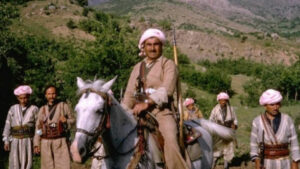
The Kurdish consciousness did not surrender to the reality of fragmentation. Popular rejection was immediately translated into continuous armed and political movements across the four parts. This spanned from the revolutions of Sheikh Mahmoud al-Hafid in Sulaymaniyah and his resistance to the British Mandate, through the Barzan uprisings and revolutions, and the uprisings of Sheikh Said Piran, Ararat, and Dersim in Northern Kurdistan (Turkey), reaching the most prominent historical milestone: the birth of the “Republic of Mahabad” (1946) in Iran, headed by Qazi Muhammad.
Although that republic lived for only eleven months due to regional collusion and Soviet withdrawal, it solidified in the Kurdish collective consciousness the fact that the dream is a viable state, provided that international conditions and internal unity are available.
The Current Reality: Successive Developments and Reshaping the Scene
Today, in light of the turbulent and shifting Middle East, the Sykes-Picot equation is no longer as rigid as it was in the last century. Recent decades have proven that the borders drawn with colonial nails did not succeed in melting authentic identities. In Iraq, after immense sacrifices, the Kurds managed to establish a recognized constitutional entity represented by the “Kurdistan Region” after 2003, which now possesses its own political, economic, and military (Peshmerga) institutions.
In Syria, the crisis ongoing since 2011 has produced a new reality represented by the “Autonomous Administration” of North and East Syria, reflecting the flexibility and ability of the Kurds to manage their regions during times of strategic vacuum for centralized states.
Future Horizons: Is the Kurdish Dream Approaching Embodiment?
In the face of these successive developments, a fundamental question emerges: Can the Kurdish dream of forming an independent state be achieved in the foreseeable future?
The answer to this question vacillates between a reading of political realism and the continuous national will. Achieving the dream of an independent Kurdish state faces a complex equation that requires dismantling three main obstacles and building two essential pillars:
The Shared Regional Veto: Despite the deep differences between the four countries that partitioned Kurdistan, they historically and spontaneously meet at one point: absolute rejection of the establishment of an independent Kurdish state, fearing a domino effect that might threaten the cohesion of their internal borders.
Fluctuating International Interests: Historical experience has proven that major powers (such as the United States and Russia) deal with the Kurdish file as a tactical partner in specific files (such as fighting terrorism) rather than as a strategic ally for self-determination, making international support variable and unguaranteed.
The Need for Internal Cohesion: The internal obstacle remains represented by partisan and regional divisions, and a lack of a unified national strategy that brings together the different parts or even the political forces within a single region.
On the other hand, future horizons depend on structural shifts in the international and regional systems. Whenever central states weaken or fail to provide a fair model of citizenship that accommodates pluralism, the legitimacy and objectivity of the Kurdish independence proposal increase. Furthermore, the growth of Kurdish diplomatic awareness, economic self-reliance, and the building of good governance institutions free from corruption and partisan conflicts are the real tools that can transform Kurdistan from a “liberation cause” into a “fait accompli” that imposes itself on the international map.
The anniversary of Sykes-Picot today is not merely a lamentation over the ruins of history, but a pause to review the path. The Kurdish dream was shattered geographically in 1916, but it is being reformulated politically and institutionally today. A new geography that erases the borders of Lausanne in a single stroke may not loom on the near horizon; however, the Kurdish identity has proven to be stronger than the lines drawn by Mark Sykes and François Georges-Picot, and the train of history—though it may slow down—is moving toward justice for the peoples who refused to die in the depths of oblivion.
Note: This text is translated from the original Arabic version… Read the Arabic version:Click here