By: Dr. Murshid Mashouq al-Khazanawi
On March 27, 2026, the media platform “Syria Now” on YouTube broadcasted a documentary titled “The Story of Syria’s Kurds.” While the media landscape is currently saturated with attempts to re-read history according to divergent agendas—including this documentary, which contained numerous fallacies and distortions of facts regarding the Kurdish cause in general, and the family of the “Sheikh of Martyrs” Mashouq al-Khazanawi in particular—the reliance on figures of significant social weight necessitates a scientific critical pause. This is not for the sake of polemics, but to preserve the historical integrity that belongs to future generations and to safeguard the legacy of symbols who shaped the Syrian and Kurdish consciousness, foremost among them Sheikh Mashouq al-Khazanawi.
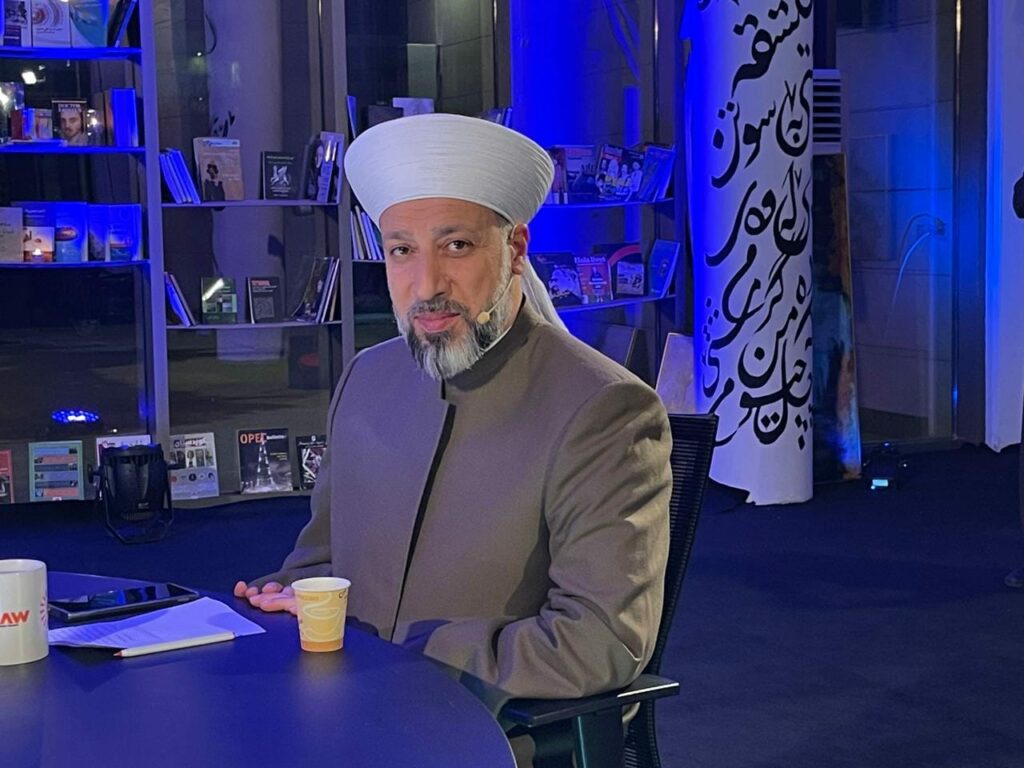
What was shocking was the appearance of Sheikh Abdullah Dershowi in the documentary. His statements were employed as live historical testimony to the “recency” of the Kurdish presence in Rojava (annexed to Syria). Furthermore, Sheikh Abdullah fell into generalization regarding the separation between religion and nationalism.
Based on the principle of “assuming the best of a fellow Muslim”—a principle established by Imam Malik bin Anas, may God have mercy on him—we shall address the remarks made by the honorable Sheikh Abdullah Dershowi in this documentary, considering them a “scholar’s slip” or an oversight in narration.
First: The Fallacy of Timing and Geography (The Al-Khazanawi Family as a Model)
Sheikh Abdullah Dershowi mentioned that the three families representing the Naqshbandi leadership in the “Jazira” region (Al-Haqqi al-Alwani, Al-Khazanawi, and Al-Dershowi) arrived in the region fleeing for their religion following the suppression of Sheikh Said Piran’s revolution in 1925. This generalization serves a narrative that attempts to depict the Kurdish component as a demographic newcomer following the fall of the Ottoman Empire, a claim refuted by the following facts:
While this narrative might apply to the Dershowi family—as Sheikh Abdullah is more knowledgeable than us regarding his own family history—it does not hold up scientifically when applied to the Al-Khazanawi and Al-Haqqi families.
Sheikh Ahmed al-Khazanawi, the founder of the Khazanawi Naqshbandi Order, was born in the village of “Khazna” in 1885, as documented in official Syrian records (attached to this clarification). This was 40 years before the Sheikh Said revolution.

In fact, his father, Mulla Murad, was the Imam of Khazna (affiliated with Tirbespiyê) decades before that date. How is it historically sound to claim the family’s arrival resulted from an event in 1925, while their roots and births are documented on Syrian Kurdish land half a century prior?
Furthermore, the Khazanawi Institute for Sharia and Arabic Sciences was established in 1920 in Khazna, the same year that witnessed the birth of Sheikh Ahmed’s third son, Sheikh Izz al-Din.
How can a person be born in Khazna (Tirbespiyê/Qamishlo) and then have Sheikh Abdullah claim that the arrival of the three families occurred after 1925?
I am also certain that the Al-Haqqi al-Alwani family was in the region before that time, making the link between the existence of Kurdish religious leaderships and the aftermath of the Piran revolution a connection lacking in chronological and documentary accuracy.
Perhaps Sheikh Abdullah Dershowi said this in error without knowledge, but the documentary utilized it as evidence of the late arrival of Kurds to Rojava.
Second: The Totality of National Rejection (Refuting Generalization via Historical Models)
Sheikh Abdullah Dershowi erred when he asserted that Kurdish Sheikhs rejected nationalistic claims. He stated that Kurdish Sheikhs remained committed to their religion—which is true—and that neighboring peoples like Turks, Arabs, and Persians are brothers in religion—which is also true, may God reward him. However, his claim that Kurdish Sheikhs said “we do not accept these nationalistic claims” is incorrect.
It would have been better if Sheikh Abdullah had not spoken in generalities and instead said that “some” or even “many” Kurdish Sheikhs rejected nationalism. His generalization contradicts the reality where the “religious mantle” and the “national banner” merged in the journeys of the great Sheikhs who led the Kurds, including:
Sheikh Ubeydullah Nehri (1880): Considered the spiritual father of the modern Kurdish national movement. He was a Naqshbandi Sheikh of vast influence who led a revolution against the Ottoman and Qajar states. He clearly told the British Consul: “The Kurdish nation is a separate nation… we want our affairs to be in our own hands,” viewing national independence as a legitimate right.
Documentation: Cited by British historian W. R. Hay in Two Years in Kurdistan; documented by Kurdish historian Muhammad Amin Zaki; and found in Ottoman State Archives.
Sheikh Said Piran (1925): Although his revolution took on a religious character in its slogans to confront “Kemalist secularism,” the primary driver was par excellence nationalist. Documentation proves Sheikh Said was the head of the “Azadi” (Freedom) Party, a Kurdish nationalist organization. British and Turkish reports at the time confirmed the goal was the establishment of an “Independent Kurdistan.”
Documentation: Robert Olson in The Emergence of Kurdish Nationalism; Muhammad Ali Awni in The Revolution of Sheikh Said; and Turkish Military Court archives.
Sheikh Mahmoud al-Hafid (Barzanji): The Sheikh of the Qadiri Order in Sulaymaniyah, who declared himself King of Kurdistan and led several revolutions against the British Mandate in Iraq (1919–1932). Al-Hafid did not demand religious rights, but rather an internationally recognized “Kurdish Government,” raising the first flag of Kurdistan.
Documentation: David McDowall in A Modern History of the Kurds; British Colonial Office archives.
Sheikh Ahmed al-Khazanawi: References document his involvement and support for the “Xoybûn” (Independence) Association established in 1927, which was the most important political and national umbrella for Kurds at that time.
Documentation: His name appears in Xoybûn: Founding Documents; and is mentioned by researcher Jamal Nebez.
Mulla Mustafa Barzani: The Naqshbandi descendant who led the greatest Kurdish national revolution (the September Revolution). His chief Sharia judge was the scholar Mulla Abdullah al-Gharzi.
Sheikh Abd al-Salam Barzani: (Brother of Mulla Mustafa), a Naqshbandi religious scholar and national leader, executed in 1914 by the Ottomans due to his national political activity.
Documentation: McDowall and Edmonds; Ottoman State Archives.
This lineage extends to the Sheikh Martyr Mashouq al-Khazanawi, who proved in the modern era that demanding national rights is not a departure from religion, but rather at the heart of establishing justice and removing oppression.
Conclusion
In clarifying these points, we do not aim to undermine Sheikh Abdullah Dershowi. Rather, we remind him that reading the past must not be subject to the selective extraction of facts to prove political hypotheses. It would have been more appropriate for the Sheikh to speak of his “personal position” or “some” Sheikhs, without a generalization that diminishes the struggle and history of a people.
Read the Arabic version: Click here