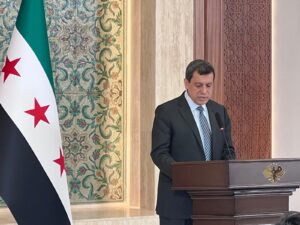
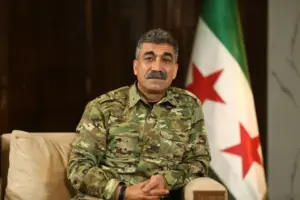
The Commander-in-Chief of the Syrian Democratic Forces (SDF), Mazloum Abdi, affirmed that he rejected all proposals related to his future and potential positions, choosing instead to remain alongside his people and work with them to unify the Kurdish stance. He stressed that the current phase requires unity of ranks and the assumption of collective responsibility. He said: “I will remain among my people and work with them to unite the Kurdish ranks. We have much work to do to achieve unity of Kurdish opinion.”
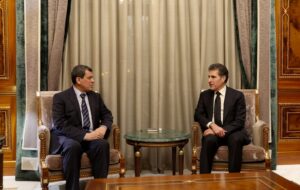
These remarks were made during a special program broadcast by Ronahi TV, in which Abdi revealed details of the agreement announced following a meeting held on 27 January with the head of Syria’s interim authority, Ahmad al-Sharaa. This was followed by a phone call that resulted in an agreement aimed at stopping the war and preventing what he described as a broad plan of extermination against the Kurdish people, amid the absence of effective international action.
Abdi explained that the most important aspect of the agreement is the ceasefire, emphasizing that military forces affiliated with the interim government will not enter any Kurdish village or city, and that responsibility for maintaining security and stability will remain with the Internal Security Forces (Asayish). He added: “Military forces will not enter any Kurdish village or city. Let our people be reassured.”
He noted that it was agreed to allow limited public security forces to enter specific security squares in Qamishli and al-Hasakah, with purely administrative tasks to oversee the process of integrating the Internal Security Forces. He stressed that the agreement enshrines the administrative, military, security, and political particularity of the Kurdish regions.
Abdi confirmed that the Syrian Democratic Forces will remain organized in the form of brigades in the Jazira and Kobani regions and will be part of the Syrian army, while preserving the specific character of the Kurdish areas. He also emphasized that the institutions built by the people over the years of the revolution will not change, and that the administration of the Kurdish regions will remain in the hands of their inhabitants, both in security and administrative terms.
The SDF commander-in-chief stated that implementation of the agreement will begin on 2 February, including the lifting of the siege on Kobani, the withdrawal of military forces affiliated with the Syrian Ministry of Defense from the cities they entered in Jazira and Kobani, as well as the withdrawal of the parties from the lines of engagement.
He added that what was agreed upon regarding the Kurdish regions will also apply to Afrin and Sere Kaniye (Ras al-Ayn), considering them Kurdish areas. He affirmed that Afrin has a Kurdish majority and that the situation in these regions must be organized in accordance with the agreement.
Regarding international guarantees, Abdi revealed that the French president informed him that he would act as the political guarantor of the agreement, noting ongoing supportive international contacts to ensure its implementation.
Mazloum Abdi also confirmed that an understanding was reached with the interim government regarding the issue of abductees, detainees, and the missing, stipulating the return of all detainees to their families. He described this as a fundamental humanitarian dimension aimed at ending the suffering of families and building trust.
Abdi expressed pride in the stance of the Kurdish and Kurdistani people, praising their support and solidarity with his forces, and affirming that this position brought about a shift in public opinion and contributed to reaching the agreement.
He called on the displaced to return to their homes, particularly the residents of al-Hasakah, saying: “I appeal to our people to return to their homes. Today, we move into a new phase of struggle.”