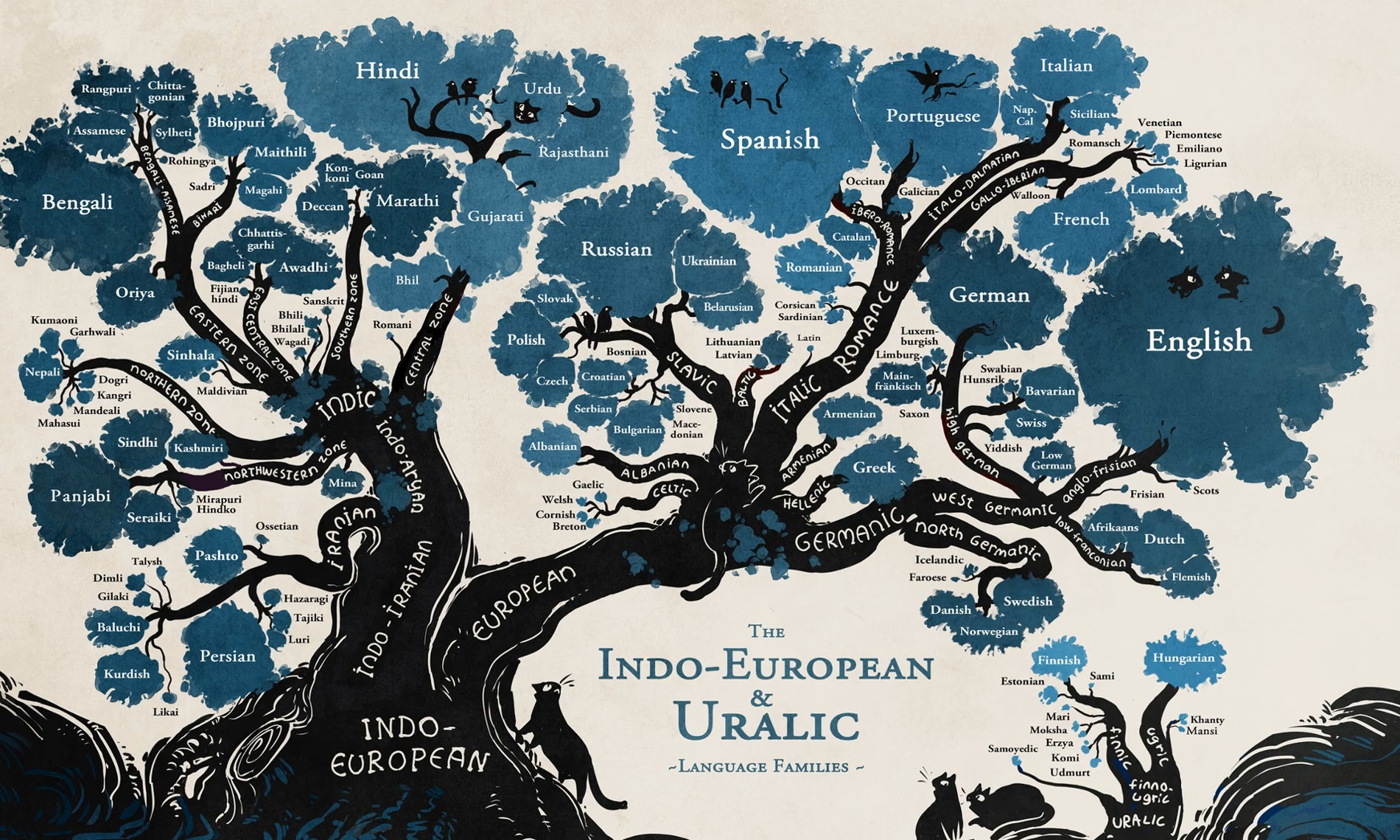
The Kurdish language and the Slavic languages are two groups of languages belonging to the Indo-European language family, which is one of the largest and most widely spoken language families in the world. The Indo-European family consists of several branches, such as Indo-Iranian, Celtic, Germanic, Romance, Baltic, Albanian, Armenian, Greek, and others.
Kurdish is a language belonging to the Indo-Iranian branch of the Indo-European language family and is closely related to Persian and Pashto. It is spoken by more than 30 million people in various regions of northwestern Iran, northeastern Syria, northeastern Iraq, and southeastern Turkey, which is known as Kurdistan. The Kurdish language is divided into three main dialects: Kurmanji (or Kurdi), Sorani (or Soran), and Zaza (or Dimili), in addition to some sub-branches.
The Slavic languages belong to the Slavic branch of the Indo-European family and are closely related to one another. They are spoken by approximately 300 million people in various regions of Eastern Europe, Central Europe, and North Asia. The Slavic languages are divided into three main groups: East Slavic (such as Russian, Ukrainian, and Belarusian), West Slavic (such as Polish, Czech, and Slovak), and South Slavic (such as Bulgarian, Serbian, and Croatian), in addition to some other groups.
The linguistic relationship between Kurdish and the Slavic languages is based on their common origins within the Indo-European family. This means these languages share certain words, sounds, grammar, and linguistic structures that can be traced back to their Indo-European ancestors. However, this similarity does not mean these languages are identical or very close, as they also differ in aspects and characteristics acquired through their historical, geographical, and cultural evolution.
It is possible to classify the linguistic relationship between Kurdish and the Slavic languages into three levels: the lexical level, the phonetic level, and the grammatical level.
The Lexical Level
The lexical level refers to the vocabulary or words used by these languages. There are many shared or identical words between Kurdish and the Slavic languages, either because they share the same Indo-European origin or because they were borrowed from one language to another. Some of these words are:
Father: In Kurdish, it is (باڤ – Bav); in Slavic languages, it is Batko (Bulgarian), Baba (Serbian), Batyushka (Russian), etc.
Mother: In Kurdish, it is (دايك – Dayik); in Slavic languages, it is Maika (Bulgarian), Majka (Serbian), Matyushka (Russian), etc.
Brother: In Kurdish, it is (برا – Bra); in Slavic languages, it is Brat (Bulgarian), Brat (Serbian), Brat (Russian), etc.
Stone: In Kurdish, it is pronounced (کڤر – Kivr); in Slavic languages, it is pronounced Kamak (Bulgarian), Kamen (Serbian), and Kamen (Russian).
Five: In Kurdish, it is pronounced (پێنج – Pênj); in Slavic languages, it is pronounced Pet (Bulgarian and Serbian) and Pyat (Russian).
These are some examples of shared vocabulary between Kurdish and the Slavic languages. However, these words do not constitute a large portion of each language’s total lexicon.
The Phonetic Level
The phonetic level refers to the sounds or letters used by these languages. There are some shared sounds between Kurdish and the Slavic languages, either due to a common origin or because they developed in a similar manner. Some of these sounds are:
The letter /k/: In Kurdish, this letter is pronounced as it is, such as in the word Kur (son). In some Slavic languages, this letter shifts to /ts/ or /tʃ/ before the letters /e/ or /i/, such as in the word цвет (flower) in Bulgarian or книга (book) in Russian.
The letter /g/: In Kurdish, this letter is pronounced as it is, such as in the word Gor (grave). In some Slavic languages, this letter shifts to /ʒ/ or /dʒ/ before the letters /e/ or /i/, such as in the word жена (wife) in Bulgarian or гений (genius) in Russian.
The letter /h/: In Kurdish, this letter is pronounced as it is, such as in the word Hôl (hall/garden). In some Slavic languages, this letter shifts to /x/ or disappears entirely, such as in the word хора (hour/people) in Bulgarian or сон (sleep) in Russian.
The Grammatical Level
The grammatical level refers to the rules and sentence structures of these languages. There are some shared principles and phenomena between Kurdish and the Slavic languages, either because they share the same source or because they arose from mutual influences. Some of these principles and phenomena are:
Inflection: In both Kurdish and Slavic languages, verbs, nouns, pronouns, adjectives, and adverbs are inflected according to different tenses, persons, genders, numbers, and cases.
Case: In Kurdish and Slavic languages, the forms of nouns, pronouns, adjectives, and adverbs change according to their function in the sentence. For example, in both language groups, nouns take different cases such as nominative, accusative, genitive, possessive, relative, and vocative. These cases affect the word ending or require specific prepositions. For example, the noun “book” takes different cases based on this principle:
In Kurdish: کتێب (kitêb), کتێبەکە (kitêbeka), کتێبەکان (kitêbekan), کتێبە (kitêba).
In Russian: книга (kniga), книги (knigi), книге (knige), книгата (knigata), книгах (knigakh).
In conclusion, it can be noted that the linguistic relationship between Kurdish and the Slavic languages is a historical, cultural, and geographical relationship that reflects the interactions and mutual influences between these peoples and civilizations. This relationship appears at different levels of language, such as vocabulary, sounds, and grammar, which carry some shared and distinct aspects. This relationship indicates that these languages have common origins in the Indo-European family, but they also evolved in different ways due to history, geography, and culture.
Note: This article is an excerpt from an ongoing study.
Sources:
Encyclopædia Britannica: Kurds | History, Culture, and Language.
Wikipedia: Kurdish Languages.
The Kurdish Project: Learn about the Kurdish Language.
American University in Cairo Website: Slavic Languages.
Book: “The Slavonic Languages: A Historical and Comparative Introduction” – Bernard Comrie.
Book: “The Slavic Languages: An Introduction to Their Study” – Paul Garvin.
Source: Madarat Kurd
August 2023
Note: This text is translated from the original Arabic version… Read the Arabic version:Click here