Managing Editor of Al-Ahram Newspaper and Egyptian Film Critic
When turning the pages of history in search of the human and military bonds that wove the relationship between Egypt and the Kurds, the mind automatically turns to Sultan Al-Nasir Saladin Al-Ayyubi and his family, until it became established in the public consciousness that the Kurdish presence in the Nile Valley only began with the establishment of the Ayyubid state.
However, ancient historical sources and verified documents reveal a deeper truth: Cairo was never a home for foreigners, but rather a nurturing host that absorbed the talents of the East early on. The Kurdish element was present in the vital organs of the state and army centuries before the era of Saladin, embodying a unique case of a knight coming from the mountains of Kurdistan, yet fighting with the creed and spirit of the Nile’s capital, which became the center of the Islamic world during the Fatimid era. Among those models immortalized in the depths of books, the name of the knight and commander Ahmad ibn Dahhak Al-Kurdi stands out as an early witness to that uninterrupted historical convergence.
The history of battles records the name of this man of Kurdish roots as Abu Al-Hajar Ahmad ibn Al-Dahhak Al-Salil (known in Byzantine sources as Bar Kifa or Clanzon), a Kurdish knight and military commander who lived in the fourth century AH (tenth century AD) and served in the ranks of the Fatimid army in the Levant and Egypt.
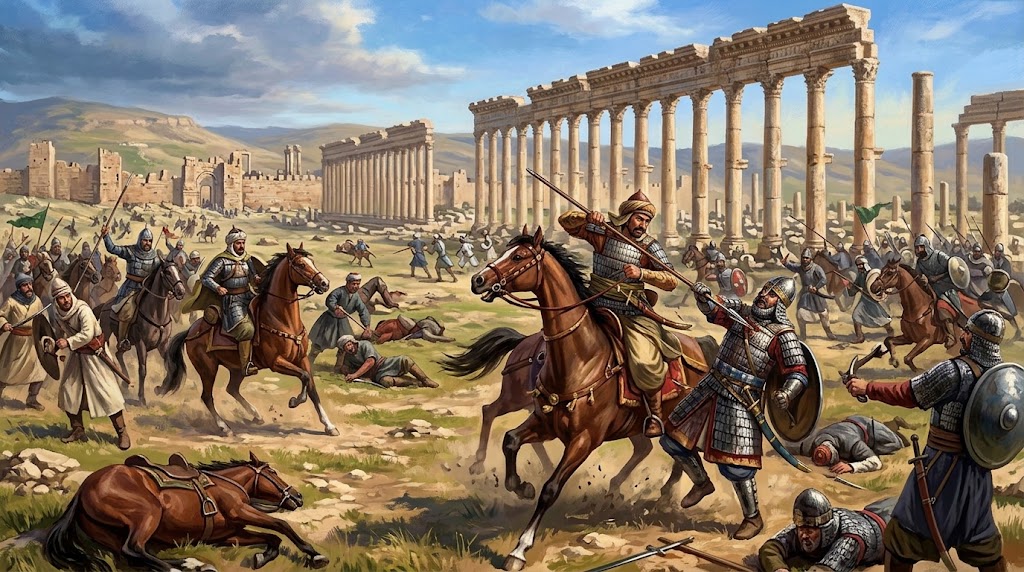
Ahmad ibn Dahhak did not gain his fame from high political positions or intellectual works; rather, history preserved his name through a single pivotal moment that shifted the balance of power in the Levant. In the year 387 AH (998 AD), the Battle of Apamea took place near the Orontes River in the Levant between the Fatimid army—sent by order of Cairo to protect the borders of Islamic influence—and the Byzantine Imperial forces.
This clash was one of the fiercest rounds of the struggle for dominance in the Levant, where defeat almost befell the Fatimid forces were it not for the bravery of a Kurdish knight who rushed forward with a self-sacrificing spirit to turn the tide of battle, becoming a decisive military hero in the history of that era.
The story of this knight rests on authentic classical sources that are fundamentally consistent, rather than modern interpretations or imagined myths. Imam Shams al-Din al-Dhahabi explicitly mentions him in his famous book Siyar A’lam al-Nubala within the biography of the Fatimid commander Jaysh ibn Muhammad, describing him as “Ahmad ibn Dahhak Al-Kurdi.” Al-Dhahabi relates that the engagement began harshly for the Muslims, and the Byzantine crowds tilted the field toward victory, until the commander Bishara al-Ikhshidi held firm with five hundred knights. Then came the moment when Al-Dahhak’s star shone brightly, as he spotted the Byzantine commander on a hill observing the battle, advanced toward him fearlessly, and managed to slay him.
The picture becomes even more vivid and detailed with the historian Ibn al-Qalanisi in his book History of Damascus; he offers the reader a precise field description of the battleground, noting that the Fatimid army comprised about ten thousand fighters and one thousand knights from Bani Kilab. Ibn al-Qalanisi recounts how the Byzantines were initially able to break the center and left wing of the army and dominate, seizing the camps and weapons, and besieging the fortress whose occupants were calling for help. At the peak of those dramatic moments, Ahmad ibn Al-Dahhak enters the scene wearing his armor and helmet, riding his horse; Ibn al-Qalanisi names him “a Kurd known as Abu Al-Hajar Ahmad ibn Al-Dahhak Al-Salil.”
The commander of the Byzantine army, Duke Damian Dalassenos (referred to in Arabic sources as “Al-Dhufs”), was standing on an elevation witnessing the defeat of the Muslims, surrounded by his two sons and his personal guard. When Ibn Al-Dahhak advanced toward him with confident steps, the Byzantine commander thought the approaching knight was seeking quarter or surrendering, so he did not take precaution. Al-Dahhak caught him off guard with a penetrating spear strike that struck a fatal spot in his armor, causing him to fall dead immediately. Shouts rang out across the field announcing the death of the Byzantine tyrant, shattering Byzantine morale and bringing about their defeat. The Fatimid-Egyptian forces turned to pursue their remnants in the mountain passes, the commander’s two sons were captured, and the spoils and prisoners returned to Cairo to raise the banners of victory in the capital of Al-Mu’izz.
This agreement between Al-Dahhak’s account in Al-Dhahabi and Ibn al-Qalanisi provides the incident of Ahmad ibn Dahhak with historical backing beyond doubt. Although numerical details regarding the dead and captured in ancient sources may be subject to the expressive exaggerations prevalent at the time, the essence of the event remains firm: a Kurdish knight in the ranks of the Fatimid army took responsibility for defending the Egyptian camp and saved the army from certain defeat through a precise and decisive military action.
Here, the deeper dimension of Ahmad ibn Dahhak’s character shines through; he was not merely a transient fighter in a regional battle, but an early embodiment of the Kurdish fighter whose loyalty merged into the project of the state centered in Egypt. His association with the Fatimid army meant he was part of a military institution managed centrally from Cairo, and the armies dispatched to the Levant represented the military arm of Egypt in protecting its vital sphere. In this sense, Ahmad ibn Dahhak was Kurdish by origin and mountainous in courage, but Egyptian in devotion, banner, and mission—defending a single cause that united the sons of the Nile and the sons of the mountains under a common flag against the Byzantine threat.
Modern historical studies have addressed this dimension with further research and analysis. Studies concerned with the Kurdish presence in the Levant classify Ibn Al-Dahhak’s participation as one of the oldest documented references to Kurdish engagement in the Fatimid Islamic armies and their integration into the social and military fabric of the region. Furthermore, the researcher Dr. Muhammad Ali Al-Soweirki, in his book on the Kurds in the Egyptian lands, included the name of Ahmad ibn Al-Dahhak among the early pioneers who served in Egypt and the Levant during the Fatimid era, with some researchers viewing his rank as one of military emirship.
Nevertheless, methodological honesty and a rigorous scientific reading of history require us to place the man in his realistic context: Kurdish identity in the fourth century AH did not represent a national project or an independent political movement, nor did the term “Emir” necessarily mean a political ruler of a region; rather, it was applied to commanders of military units and detachments. Therefore, the most accurate description of Ahmad ibn Dahhak is that he was a “professional Kurdish knight and commander in the Fatimid army managed from Egypt.” This clarification does not diminish his standing, but rather restores him to his brilliant truth: a brave soldier who understood the meaning of duty and rushed to resolve a major battle whose fall would have threatened the first defense lines of Egypt.
The return of the prisoners and the heads of the enemy commanders to Cairo after the Battle of Apamea, as stated in the accounts, confirms that the victory was dedicated to the heart of the state in Egypt, and that this Kurdish knight wrote a chapter of the Fatimid capital’s glory with his blood and valor. The importance of this incident lies in revealing the nature of Egyptian society and the Fatimid state as an inclusive entity that allowed military talents of various ethnicities—whether Kurds, Daylamites, Maghrebis, or Turks—to occupy their deserved positions without racial discrimination, as long as loyalty and devotion were given to the state and its causes.
The course of history reveals that the relationship between the Kurds and Egypt was neither a coincidence nor did it begin abruptly with the arrival of Asad al-Din Shirkuh and his nephew Saladin Al-Ayyubi in the sixth century AH. That Ayyubid phase was the culmination of a cumulative trajectory spanning two centuries, in which Ahmad ibn Dahhak Al-Kurdi was at the forefront of the pioneers who paved the way with their horsemanship and steadfastness. Al-Dahhak was a model for the spirit of the Kurdish fighter who carries the toughness of the mountains, yet absorbs the spirit of the land he fights to defend, rendering the sword Kurdish and the heartbeat purely Egyptian.
What is fascinating to reflect upon in this hero’s biography is that we do not know much about his private life, his family details, or his final days, as the sources remained silent on those matters. Nevertheless, he attained exceptional immortality in classical books thanks to a single stance in which all meanings of courage, sacrifice, and tactical judgment were manifested. He charged through the dust of battle at Apamea to turn defeat into victory, recording his name in letters of light as one of the makers of Fatimid history.
Evoking the biography of Ahmad ibn Dahhak today does not aim to create a fictional myth, but rather seeks justice for shared history and putting matters into perspective. It is a bright page in the record of brotherhood and convergence between the Kurdish and Egyptian peoples—a knight who arrived from the East to be at the heart of defending Cairo’s banner, confirming that the roots of loyalty and bravery are older than transient states, and that the blood of heroes on the soil of the Levant stands as an eternal witness that Al-Dahhak was Kurdish in his nobility and horsemanship, and Egyptian in his soul and military destiny.
Source: Kurdistan 24
Note: This text is translated from the original Arabic version… Read the Arabic version:Click here