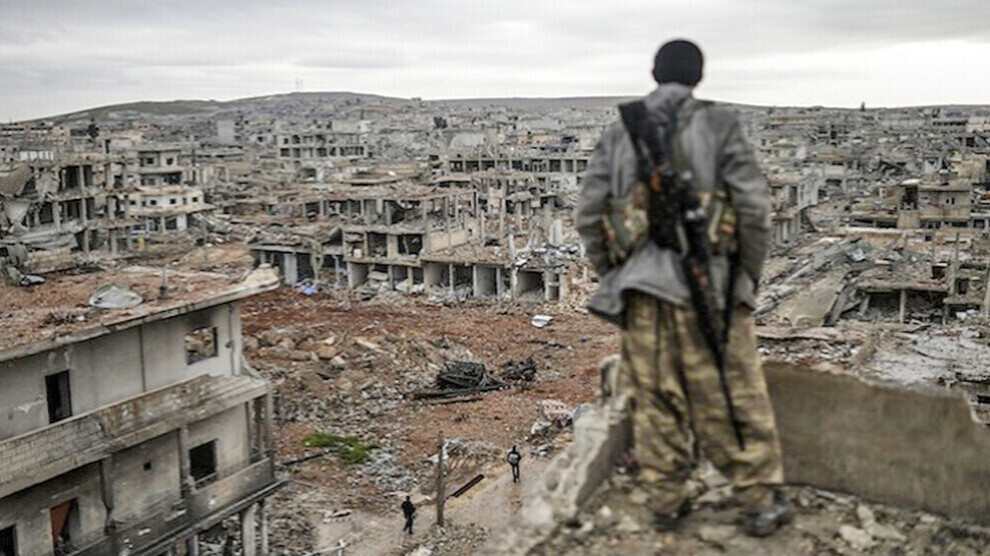
On September 15, the twelfth anniversary of the major ISIS attack on Kobani in 2014 takes place. On that day, the organization’s convoys surged from three directions, heavily armed with tanks, artillery, and heavy weapons seized in Iraq and Syria. Dozens of villages fell one after another, and tens of thousands of rural residents were displaced, before the organization’s fighters reached inside the city itself. At that time, Kobani turned into one of the most bloody and symbolic battlefields in the war against ISIS, not only for the Kurds but for the entire world. Today, on the eve of that anniversary, scenes have returned to the city that its people believed they had paid enough in blood to never see again: armed men coming from outside the city, shouts of “Allahu Akbar,” racist and inflammatory chants, gunfire aimed at the people of Kobani, arrests, beatings, insults, and then charred Kurdish bodies inside prison cells. The banners, names, and military uniforms have changed, but Kobani’s memory does not require much effort to recognize the scene.
The tragedy began this time with the Kurdish fighter Sipan Hizni. Sipan was one of the Syrian Democratic Forces (SDF) fighters who, following the integration agreements between the SDF and the government in Damascus, joined the formations of the Syrian Army. Under this new arrangement, the man was no longer a fighter in a military force independent of the Syrian state; rather, he became a member of the Syrian Army itself. Despite this, an Arab group kidnapped him from Deir ez-Zor, took him there, filmed him as a captive, and then slaughtered him and published the clip on social media. For the Kurds, it was impossible to view the crime as merely a passing murder. The method of kidnapping, filming, slaughtering, and publishing the scene immediately brought back to mind the visual and political language of ISIS, which was not content with merely killing its victims, but turned the killing into a public message directed at the society to which the victim belonged. What is even more bitter is that Sipan had done exactly what Damascus and Ankara had demanded throughout the past years: he left the independent Kurdish military formation and integrated into the Syrian Army. Nevertheless, neither his new status, nor the institution he became a part of, protected him from being kidnapped and slaughtered in this manner.
The crime caused a massive shock in the Kurdish street in Rojava, and demonstrations erupted in the cities of Jazira and Kobani. However, understanding what happened next requires that we do not start the history from the moment of Sipan’s murder, because Kobani was already living in an escalating state of political and national tension. Over the past months, the authorities reverted to using the name “Ain al-Arab” in official documents and correspondence, as if the name Kobani, under which the city’s people fought and its sons died, could be erased by an administrative decision. Then came the issue of education, when the Ministry of Education decided to limit the teaching of the Kurdish language to three classes per week, instead of recognizing the right of Kobani’s children to learn in their mother tongue in a city where Kurds constitute the overwhelming majority of the population. Alongside that remained the issue of displaced Kurds from Tal Abyad, Raqqa, and other areas, with many prevented from returning to their homes, in addition to repeated frictions, provocations, and a growing feeling that the post-dissolution phase of the SDF is not moving toward recognizing the Kurds and their specificity. Instead, it is moving toward dismantling everything they had built over the past years and returning them as individuals, stripped of tools of protection and power, to a central authority that has not yet provided them with political and constitutional guarantees equivalent to what they were asked to give up.
This is why the crime of Sipan’s slaughter was the spark, but it was not all the fuel. When the people went out in Kobani, they were protesting a brutal crime against a Kurdish fighter, but they also carried with them the fear for their language, the name of their city, their rights, their future, and the fear that “integration” would turn into a new name for the return of old policies. At their inception, the demonstrations did not witness sectarian or racist slogans, and the chanting was for the martyrs and for Kurdish dignity. The matter could have ended there, had there been a will to contain the people’s anger and respect the specificity of a city that came out to protest the slaughter of one of its sons. But what happened was the exact opposite, and here begins the direct responsibility of the security elements that were sent to the city and the way they decided to deal with its people.
According to information I obtained directly from local security officials in Kobani who had direct knowledge of the course of events, the escalation began at around 12:00 PM, when a man named Shaheen, a road security official, entered Kobani with eight security groups—three from road security and five from the special task forces. Shaheen is not from Kobani, nor does he have any social or local connection to the city; he comes from Sarmada in the Idlib governorate. Yet, he came to impose his security authority on a highly sensitive city at a moment of unprecedented national and political tension. He stated that his entry came upon instructions from Abu Omar, and that his mission was to deploy in anticipation of any emergency. The groups deployed to a number of points inside the city, and then Shaheen was later informed that he had instructions to stay until 10:00 PM. At around 6:00 PM, he insisted on moving with three groups to the Free Woman Roundabout, where the residents were gathering, in order to photograph the presence of his forces and send the photos to Abu Omar. Here began the confrontation that could have been completely avoided. Youths and teenagers gathered around the elements, and instead of withdrawing and preventing friction in an angry city, Shaheen insisted on staying and arresting those he considered violators. As the number of protesters increased, some youths began throwing stones at his elements, so the forces drew and loaded their weapons. Two groups withdrew toward the Aleppo checkpoint, while the rest of the elements retreated to the security center inside the city. A section of the youths followed them to the door of the center, and there, Shaheen’s groups fired live ammunition directly at the demonstrators.
The Asayish forces and the local forces present in Kobani intervened to prevent the situation from slipping out of control, protect the center, and push the demonstrators back. After more than an hour, they managed to drive the people back and arrest about seventeen of those who participated in the attack on the forces or in acts of rioting. At this point too, everything could have ended within a limited security framework. But at the same time, convoys belonging to the General Security and the Special Tasks were waiting at the Sarrin and Manbij intersections, and then they began moving toward Kobani. With the local forces preoccupied with calming the situation, those convoys entered the city during the night hours, and deployed in its neighborhoods and streets. Their entry did not resemble a security force that came to calm a local disturbance; rather, to the people of the city, it looked like a storming operation. The vehicles roamed the streets shouting “Allahu Akbar” and inflammatory and racist chants, and the elements began arresting people from the roads, parks, and restaurants, including individuals who had absolutely no connection to what happened at the security center. The detainees were subjected to beatings and insults, and the assaults extended to civilians inside restaurants and in the streets, and the forces deployed at the city entrances and around institutions, while requesting additional reinforcements from Aleppo, Manbij, and Raqqa.
Here, Majd al-Din al-Sheikh, known as “Abu Omar,” the Director of Internal Security in the Kobani region, enters the scene. The man’s significance does not stop at his security position in the city; he is the brother of Jihad Issa al-Sheikh, known as “Abu Ahmed Zakour,” a former leader in Hayat Tahrir al-Sham who became an advisor for tribal affairs to Abu Mohammad al-Jolani. This background is not a marginal detail, because it reveals something of the nature of the networks that have come to manage the Kurdish areas after the integration, and the massive distance between the local community and the individuals who have come to hold direct security authority over it. Following the arrest campaign, Abu Omar arrived and demanded that all the detainees be taken and transferred to Aleppo. When the Asayish elements objected to the way he wanted to impose the decision, he and his escorts drew their weapons in their faces, and it even reached the point of drawing a weapon in the face of one of the local Asayish officials inside the center. Abu Omar and his forces managed by force to take seventeen detainees who had been arrested from the city and transferred them toward Aleppo.
However, other prisoners who were inside the prison objected to the transfer of Kobani’s sons to Aleppo, and a mutiny began inside the cells to prevent the General Security forces from taking more detainees. Tension and chaos escalated inside the prison, and then a fire broke out. In a closed space crowded with prisoners, the fire and smoke quickly turned into a massacre. Nine prisoners were killed and seventeen others were injured, a number of them in critical condition, while four of them were fighting for their lives. Thus ended a night that began with a demonstration protesting the slaughter of a Kurdish fighter, with other charred Kurdish bodies inside a prison in Kobani. It does not matter here how many words like “riot,” “mutiny,” and “outlaws” the official statement will need to hide this simple truth: these people entered the prison alive while in the custody of the security forces, and then nine of them came out as corpses.
Information arriving from the heart of Kobani and from inside the security apparatus also indicates that what happened was not merely a series of spontaneous mistakes piled on top of one another. The presence of convoys outside the city before the situation exploded, the summoning of reinforcements from more than one area, the insistence on deploying forces coming from outside Kobani inside it, and then the attempt to exploit the chaos to impose a broader security presence inside the city—all of this raises a more dangerous question about whether the riot itself was used as a pretext to alter the balance of security control in Kobani. There is information about the presence of individuals within the gatherings who played a role in sabotage, incitement, and pushing events toward confrontation, in a way that would later allow presenting the entry of government forces as a necessity because local security forces were incapable of controlling the city. If this is true, then we are not facing a security misjudgment, but rather an attempt to manufacture chaos and then use the chaos itself as a pretext to impose control.
But reducing what happened in Kobani to the mismanagement of a demonstration or a fire inside a prison would be, in all cases, an escape from the real question. What happened comes only weeks after Mazloum Abdi officially announced the dissolution of the Syrian Democratic Forces and the Autonomous Administration and their integration into the institutions of the Syrian state. The Kurds abandoned a military force that, over eleven years, built one of the most important military and political experiments in Syria, fought ISIS, and lost thousands of its fighters, just as they began dismantling the administrative institutions through which they governed their regions since the beginnings of the war. The presumed logic of the agreement was that this historic concession would lead to a corresponding historic partnership; meaning that Kurdish institutions would enter the state in exchange for the state itself becoming more capable of recognizing the Kurds, their rights, their language, and their political and administrative specificity. However, the behavior of Damascus since then makes another interpretation of the integration more pressing: that the government views the integration as a complete surrender of Kurdish power, not a historic settlement with the Kurdish cause.
For al-Jolani and his government, it seems that the dissolution of the SDF and the dissolution of the Autonomous Administration must also mean the end of the phase in which the Kurds were able to negotiate from a position of strength. After the independent military force was dissolved, it became easier to reinstate the name “Ain al-Arab,” reduce Kurdish from a language of instruction to three weekly classes, and send a security official from Sarmada to the heart of Kobani to decide when and how its people can protest, and to send convoys from Idlib, Manbij, and Raqqa when the people protest, and then transfer the city’s detainees to Aleppo, as if Kobani itself possesses neither a society, nor institutions, nor specificity. The issue is therefore not about an educational decision here, an administrative designation there, or a security error on a night of anger. When these facts are pieced together, they reveal a comprehensive political vision: dismantling the elements of Kurdish strength first, then negotiating with the Kurds later as a society stripped of the ability to refuse.
Here, the crime of Sipan Hizni becomes more than a horrific crime against one person, because it presents a condensed picture of the entire integration dilemma. Sipan was a fighter in the SDF, then he integrated into the Syrian Army as he was asked to; that is, according to the discourse of Damascus, he was no longer a member of a military force outside state institutions. Yet, men from Deir ez-Zor kidnapped him, slaughtered him, filmed his death, and published it to the public. And when the sons of his people came out demanding justice for him, they did not find before them a state that treated him as a slaughtered Syrian soldier; rather, they found forces from outside their city shooting at them, arresting them, and driving some of them toward Aleppo. If this is the possible fate for whoever hands over his rifle and integrates, then what is the message supposed to reach the rest of the Kurds?
Nor can all this be read in isolation from Turkey. Not because every security incident in Kobani requires a direct order issued from Ankara, as this is a simplification that political analysis does not need in the first place, but because Turkish policy toward Syria has never at any time separated the fate of Rojava from the Turkish conflict with the Kurdistan Workers’ Party (PKK). Ankara supported the new authority in Damascus, continuously pressured to dismantle the Kurdish military and administrative structure, and then considered the dissolution of the SDF a development consistent with its project which Turkey calls “terrorism-free.” In contrast, Abdullah Ocalan did not call the process by this name; rather, he placed it within the vision of “peace and a democratic society.” The difference between the two expressions reveals a disagreement deeper than language. Turkey wants to start the process by ending what it considers terrorism and disarming the tools of armed force, while Ocalan links it to a political and democratic transformation that addresses the roots of the Kurdish issue. As long as this gap remains, and as long as the Turkish-Kurdish negotiations have not yet produced a complete political settlement, it cannot be ruled out that Rojava and the Syrian Kurds will be used as an additional arena to pressure the broader Kurdish movement. Nor can it be ruled out that Ankara uses its influence over al-Jolani’s government and the forces originating from Hayat Tahrir al-Sham to make the pressure on the Kurds of Syria a part of managing its Kurdish file inside Turkey itself.
Furthermore, for Turkey and for the forces that emerged from the jihadist environment in northern Syria, Kobani carries double the symbolism. This city did not only defeat ISIS militarily, but it shattered an entire political moment in the region. In the fall of 2014, the world stood watching the female and male fighters of the People’s Protection Units (YPG/YPJ) fighting an organization that had overrun Mosul, Raqqa, and vast areas of Iraq and Syria within months, and the prevailing belief was that the fall of Kobani was only a matter of time. However, the city held out, and then the battle turned into the beginning of the great retreat of ISIS and the starting point for the military partnership between the Kurds and the Global Coalition. From that battle, new military and political equations were later born, culminating in the establishment of the Syrian Democratic Forces, the expansion of the Autonomous Administration, and the territorial defeat of the ISIS caliphate. Therefore, subjugating Kobani after the dissolution of the SDF is not, in the political imagination, like subjugating any other city.
Likewise, the relationship between Hayat Tahrir al-Sham and ISIS does not require, for the people of Kobani, a long theoretical debate about the organizational differences between the two factions. The city’s people know very well that ISIS and al-Nusra emerged from the exact same jihadist environment. And that Abu Mohammad al-Jolani himself came out of Iraq and out of al-Qaeda before founding the al-Nusra Front, then changing the organization’s name more than once, culminating in Hayat Tahrir al-Sham. For those who lived through the ISIS massacres and the attacks of al-Nusra and jihadist groups on the Kurdish regions, the past does not become meaningless just because the leaders of those groups wore formal suits, entered government palaces, and renamed their security formations. Changing the organization’s name does not erase the memory of its victims, and changing its leader’s name does not force his victims to forget who he was.
This is the reason that makes what happened during this night more dangerous than the number of dead and detained, despite the enormity of those figures. The issue is about the message that was sent to an entire city. Men coming from outside Kobani enter it with their forces, treat its people as a security problem, shout “Allahu Akbar” and provocative chants in a city that lost thousands of its sons in the war against jihadists, open fire and arrest people, then a security official attempts to take the city’s detainees by force to Aleppo, before the night ends with charred bodies inside the cells. The new authority can change the names of organizations and institutions, and the men of yesterday can wear security and army uniforms and put state logos on their cars, but no one can demand that the people of Kobani erase their memory so that it matches the new political language in Damascus.
The people of Kobani know ISIS well. They do not know it from news bulletins, nor from academic studies, nor from the images that used to reach Western capitals. They knew it when it stood at the doors of their homes, when it slaughtered their sons, when hundreds of villages were emptied of their inhabitants, and when comrades and relatives were buried one after the other. Therefore, they also know that ISIS was not just a black flag and a three-letter organizational name. ISIS was above all a perception of the other, a way of dealing with the different, and a culture that considers weapons, religious identity, and power as a justification to humiliate those who do not resemble it. And when these practices return to the streets of Kobani, the people of the city are not required to pretend that changing the uniform and the name has erased everything.
Twelve years after September 15, 2014, Kobani finds itself once again facing strange men raising weapons in the faces of its people, detainees being driven out of their city, shouts and chants it knows all too well, and charred Kurdish bodies. The first time, the name of the force that came to the city was the Islamic State organization, and its banner was black. This time, the forces enter under the name of the Syrian State and General Security, and carry a different flag. But for a mother waiting for the corpse of her son, or a father searching for his son among the detainees, or a city that has buried its sons over the course of twelve years, the color of the banner does not change the meaning of the scene much.
The burned body does not ask about the color of the banner, and Kobani does not forget.
ISIS in Kobani again.
Note: This text is translated from the original Arabic version… Read the Arabic version:Click here