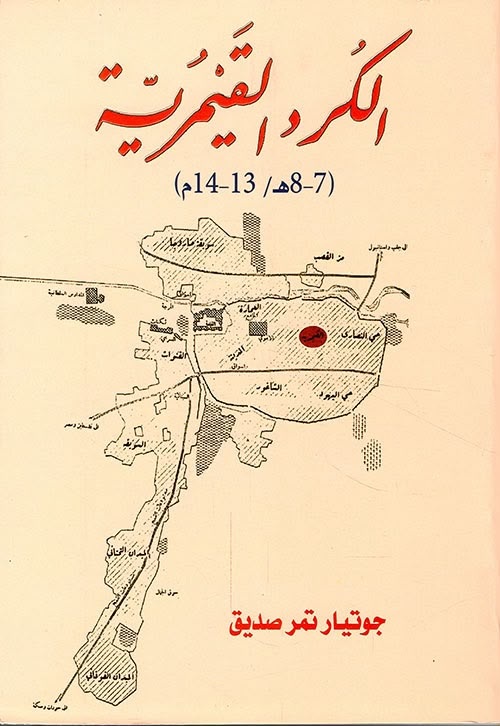
“A reading of the book by Jūtyār Tamr Ṣadīq, ‘The Qaymari Kurds and Their Political and Architectural Role During the 7th–8th Centuries AH / 13th–14th Centuries CE,’ Tammuz Printing, Publishing and Distribution House, Damascus, 1st Edition, 2016.”
Al-Hiwar Magazine – Issue No. 85 – Year 33 – 2026 CE
In the year 648 AH / 1250 CE, Emir Sayf al-Dīn Yūsuf al-Qaymarī arrived in the Levant (al-Shām) from Egypt, carrying with him money that was the dowry (ṣadāq) of his deceased wife, the daughter of Emir ‘Izz al-Dīn ‘Umar ibn Majallī al-Hakkārī. He wanted to return it to her family, but her brother, Nūr al-Dīn ‘Alī al-Hakkārī, returned it to him, saying: “It is not the custom of the Kurds to take a dowry or an inheritance,” as recorded by al-Yūnīnī (p. 187). Thereupon, Sayf al-Dīn said: “This is something I have relinquished, and it shall not return to my possession” (p. 188), and he dedicated all of the money to the construction and endowments (awqāf) of the Qaymari Bimaristan (hospital).
The clearest historical significance of this story encapsulates the transformation of the Qaymaris that the researcher Jūtyār Tamr Ṣadīq traces in his book: from a Kurdish group initially known for chivalry and fighting, to one whose emirs came to possess fiefs (iqṭā‘) and real estate, subsequently directing a portion of their resources toward institutions of education, healthcare, worship, and commerce. Thus, the attestation al-Qaymarī shifted from a distant castle in the Jazira region to the schools, hospital, market, bathhouse, and mausoleums of Damascus, and eventually to a neighborhood inside the city.
The book is organized into an introduction, three chapters, and a conclusion. The first chapter examines the Qaymur Castle, the nomenclature, the initial appearance of the group and its emirate, and its ties with the Ayyubids and the Seljuks of Rum. The second traces its migration to the Levant and Egypt and its military and political roles during the transition from Ayyubid to Mamluk rule, as well as its confrontation with the Mongols and the Crusaders. As for the third chapter, it compiles the structures associated with the Qaymaris and investigates—where the source material permits—their locations, endowments, and administrators.
The author acknowledges from the outset that “we find only a scant amount of historical information regarding their activities and role” (p. 29). Therefore, he reconstructed their history from diverse sources, including Ayyubid and Mamluk histories, biographical and necrological dictionaries, and translated Persian sources. This enabled him to assemble extensive material; however, he finds no decisive answer regarding the origin of the name itself: “Historical sources do not mention any information regarding the origin of the name of the Qaymari Kurds” (p. 37).
The earliest geographical description of the castle came late through Yāqūt al-Ḥamawī, who placed it “in the mountains between Mosul and Khilat” and attributed to it a group of Kurdish notables and emirs (p. 33). This was a loose designation that persisted until later sources placed it closer to Es’erd (Siirt), or confined it to the area between Jazirat Ibn ‘Umar and Es’erd (pp. 33–37). According to the Kurdish historian Dr. Zirar Siddiq Taufiq: “After the growing role of the Qaymari emirs in the events of the Levant and Egypt during the late Ayyubid and early Mamluk periods, and the rise of their status thanks to their notable efforts on both the jihadist and architectural fronts, Qaymur Castle became famous and well-known among Levantine and Egyptian historians, who were knowledgeable and informed about its news. It is located near Es’erd – S’ert – Siirt (2), between it and Jazirat Ibn ‘Umar – Bohtan (3), and it is not Qumri – Qawmri Castle, which is situated between the two villages of Qumri and Harur in the Berwari Bala region – Duhok” (Dr. Zirar Siddiq Taufiq, The Kurdish Qaymari Tribe in the Jazira Region and Its Role in the Levant and Egypt During the Middle Ages, Al-Hiwar Magazine, Issue 70, Summer 2017).
The book also reveals the appearance of the name Qaymur in a Syriac source—Annals of the Patriarchs of the See of the East from Kitāb al-Majdal—within the events of the year 528 CE, as an episcopal see among the bishoprics in the Jazira. This proves the antiquity of the place name, whereas Islamic chronicles did not clearly recognize the group until a later stage (pp. 37–39). As for the emirate, its founding is most likely attributed to Asad al-Dīn Abū al-Fawāris ibn Mūsk, whose rule is estimated between 595 and 620 AH / 1198–1223 CE, and from whose lineage emerged most of the known Qaymari emirs.
The Qaymaris were a tribe that established a hereditary emirate centered in its castle, possessing princely houses, followers, and troops that operated within the existing power structure. In a telling description, it is noted that “the Qaymaris were fundamentally men of the sword, comprising emirs, commanders, and soldiers” (p. 149).
Their initial appearance in written records remains a matter of caution for the author himself. Al-Dawādārī uniquely reports on a Qaymari emir named ‘Izz al-Dīn who fought the Franks alongside Saladin in the year 585 AH / 1189 CE, a claim unsupported by contemporary accounts. A more reliable account details their participation in the defense of Khilat and the capture of the Georgian commander in 606 AH / 1209 CE. References to them then proliferate with the Khwarazmian campaign against the city in 627 AH / 1229 CE, when Ibn al-‘Ibrī (Bar Hebraeus) recounts Emir Ḥusām al-Dīn al-Qaymarī taking refuge in the castle before joining the Ayyubid ruler al-Malik al-Ashraf (pp. 39–42).
Their migration from the Jazira to the Levant and Egypt subsequently passed through three stages, summarized by the author in his conclusion: an individual migration led by Ḥusām al-Dīn alongside his followers; a mass migration that the author links to the year 642 AH / 1244 CE in response to the summons of al-Malik al-Ṣāliḥ Ayyūb, who needed their military strength in his conflict with his rivals within the Ayyubid house; and a third wave following the Mongol takeover of the Jazira and the fall of Qaymur Castle (pp. 219–220). This was not merely a passive movement of displacement, but a transition into a military and political arena where Ayyubid emirs required allies, particularly from among their fellow Kurds, who joined them and formed a core component of their army as soldiers, commanders, judges, and emirs.
The author points out that reading the history of the Kurds in the Middle Ages necessitates examining the conditions and roles of Kurdish tribes and leaderships within their emirates and castles, as well as on the broader Islamic plane, which lived in constant mobilization against the Khwarazmians and the Seljuks of Rum on the one hand, and the Crusaders and the Mongols on the other (p. 219). He posits that had it not been for the establishment of the Ayyubid state, those tribes would not have been able to withstand the massive challenges surrounding them—firstly because they were Kurdish, and secondly because they were originally situated at the very heart of the conflict among internal Islamic powers themselves, as well as between those powers and external forces (p. 219). We consider this perspective to be somewhat dialectical.
The Qaymaris in the Politics and Army of Damascus
“The Qaymaris were fundamentally men of the sword, comprising emirs, commanders, soldiers, and bearers of the banner of jihad” (p. 149). With this phrase, the author summarizes the group’s primary identity, upon which Chapter Two—the chapter on politics and war—is built. Under al-Ṣāliḥ Ayyūb, we witness their role in reclaiming Jerusalem and Damascus and annexing them to his possessions (p. 12). Then, upon the assassination of Tūrānshāh and the rise of the Mamluks, the tribe transformed into the spearhead of Ayyubid legitimacy. The Qaymari emirs in Damascus completely rejected the sultanate of Shajar al-Durr, dispatching to Aleppo Emir Ḍiyā’ al-Dīn al-Qaymarī, his nephew Nāṣir al-Dīn, his son Shihāb al-Dīn, and others, offering al-Malik al-Nāṣir Yūsuf the surrender of Damascus so it might serve as the nucleus from which the glory of the Ayyubid state could be rebuilt. Once reassured by them, he marched and entered the city, receiving a warm welcome as the grandson of Saladin (pp. 95–96). The author presents two explanations for that Qaymari rejection: the roots of the Kurdish-Turkic friction once Mamluk dominance over Egypt became clear, or using the rule of a woman as a pretext for a revolt to avenge the regicides who murdered the Ayyubid sultan (p. 96).
In the events of the Ayyubid-Mamluk conflict, the author notes the cry of the Jāwīsh (herald/marshal) when the Mamluk army broke before the Ayyubid force: “Shābāsh, O Qaymaris!”—meaning “Well done!”—serving as testament to the heavy Qaymari presence in the army (p. 107). He also highlights the image of Emir Sayf al-Dīn al-Qaymarī seated in front of the house housing the family of the defeated King al-Mu‘izz to protect it from looting, refusing to exploit the chaos for revenge or the violation of honor (p. 109).
The author points here to a conflict framed as a Kurdish-Turkic confrontation; for the Ayyubid house was Kurdish, as were prominent commanders, emirs, and soldiers in their army, whereas the new authority in Egypt was based on a Mamluk elite predominantly of Turkic element, and Kurdish emirs suffered from the confiscation of offices and fiefs. However, despite the friction and occasional clashes that materialized at numerous points between the Kurds on one side and the Turkmen or Turkic Mamluks on the other, loyalties were more complex. Ethnic identity was not the sole criterion for alliance or conflict; rather, it intersected with the protection of the emirate, the fief, and the emir’s position within the power network—just as the Qaymaris would later serve the Mamluk sultans themselves. The author also draws attention to an error made by some researchers who considered the Qaymari Kurds to be Mamluks (p. 20).
For this reason, the statement of Nāṣir al-Dīn al-Qaymarī—cited by al-Yūnīnī when he heard a Kurdish emir disparaging the Mamluks—appears far more expressive of the entanglement of allegiances: “Wretched is what you have said! There is no enmity between us; the word of Islam unites us, and we and they are one thing… If the estrangement between the two kings were removed, we and they would become as a single soul” (p. 110). The value of this statement, regardless of its literary phrasing in the source, lies in its placement of ethnic or linguistic kinship within a broader framework of religious and political loyalty, rather than making it the sole explanation for behavior.
As for their fighting against the Crusaders, the earliest account is al-Dawādārī’s report regarding ‘Izz al-Dīn al-Qaymarī in Saladin’s army in 585 AH / 1189 CE, which is a late account unsupported by a contemporary source. However, participation becomes clearer in the next generation: Sayf al-Dīn Yūsuf was renowned for courage and was killed fighting the Crusaders near Nablus in 654 AH / 1256 CE. Subsequently, Nāṣir al-Dīn al-Qaymarī continued military service on the coastal front during the reign of al-Ẓāhir Baybars, leading an assault on the fortress of ‘Atlit in 664 AH / 1266 CE; although the castle did not fall due to its heavy fortifications, his assignment to the mission demonstrates his standing. At ‘Ayn Jālūt, the Qaymaris emerged as a prominent party insisting on fighting the Mongols both before and during the engagement, and their loyalty to the Ayyubids remained intact even after the downfall of their state (pp. 220–221). After the battle, the Mamluks sidelined their role and removed them from their offices and fiefs, until al-Ẓāhir Baybars restored a portion of their status (p. 13): he returned his fiefs to Shihāb al-Dīn al-Qaymarī and rewarded Nāṣir al-Dīn with half of the Red Tower (al-Burj al-Aḥmar) (p. 150).
This capacity for re-integration into a new system explains their survival far better than military force alone; they were successfully re-integrated into the Mamluk state while several of their houses retained wealth and prestige, which later provided the material foundation for their architectural activities. Two emirs stand out in this sphere: Sayf al-Dīn Yūsuf, who combined military leadership with spending on endowments, and Nāṣir al-Dīn Abū al-Ma‘ālī al-Ḥusayni (d. 665 AH / 1267 CE), one of the senior commanders of the Levantine army and a figure of broad influence under al-Nāṣir Yūsuf, before Baybars assigned him to operations along the Levantine coast. His biography, like that of Sayf al-Dīn, reveals that high office was not detached from urban development; the prestige, fiefs, and relationships forged by military service were the very elements that permitted the founding of a school or the funding of a public facility.
In Damascus, the transition from a group of soldiers, emirs, and knights to urban actors reached completion. The Qaymari emirs acquired villages, orchards, shops, mills, and real estate in the city, its suburbs, and along the coast, and they obtained fiefs and funds from the sultans they served (p. 150). It is evident that a significant portion of their wealth went toward establishing public institutions and linking them to charitable endowments (awqāf). In this way, the buildings were not merely marks of prestige, but also a material embodiment of the relationship between military feudalism and the urban economy. The endowment was the link connecting military biography, influence, and wealth to architectural development. Through this mechanism, resources accumulated within the military fief system were transferred to institutions capable of enduring beyond the death of the founder and the turn of sultans. This did not make them an exception to the traditions of the Ayyubid and Mamluk elite; the school (madrasa), hospital (bimaristan), and mausoleum (turba) were standard tools for cultivating legitimacy and prestige for any ruling house during that era.
The Great Qaymari Madrasa
The Great Qaymari Madrasa—also known as al-Juwāniyya—heads this architectural record. It was founded by Emir Nāṣir al-Dīn Abū al-Ma‘ālī al-Ḥusayn ibn Shams al-Dīn ‘Azīz al-Qaymarī, commander of the armies of the Levant during the times of al-Ṣāliḥ Ayyūb and al-Nāṣir Yūsuf. Multiple sources—including al-Ṣafadī, Ibn Kathīr, al-Kutubī, al-Maqrīzī, and al-Nu‘aymī—transmit an imposing image of him: all the Kurds were in his service, “riding when he rode and dismounting when he dismounted,” and his decree was “more binding than the decree of King al-Nāṣir Yūsuf” (pp. 155–158). This depiction indicates that they had become an integral part of the capital’s leadership and its top commanders.
The author considers it likely that the madrasa was built before the year 652 AH / 1254 CE, in a market referred to in closely matching forms across sources—al-Ḥarīmayn, al-Kharīmayn, or al-Muṭarrizīn—near the Fairuz Minaret to the east of the Umayyad Mosque, meaning at the very heart of old Damascus rather than on its periphery (pp. 155–158). The madrasa comprised a prayer hall (muṣallā), an iwān, lecture halls, student rooms, and a library, maintained by a staff of teachers, assistant tutors (mu‘īdūn), and superintendents (nuẓẓār); hence, historians did not merely mention its name, but detailed “the land area designated for the construction of the school” and its internal sections (p. 152).
Nāṣir al-Dīn endowed immense assets for it, adding a feature in which no one had preceded him: clocks over its gate crafted by the ingenious engineer al-Badī‘ al-Sā‘ātī at a cost, according to sources, reaching forty thousand dirhams to regulate class times—though al-Dhahabī mentions clocks over the gate of the bimaristan as well. They malfunctioned after a time and were subsequently repaired in the year 788 AH / 1386 CE (pp. 155–158).
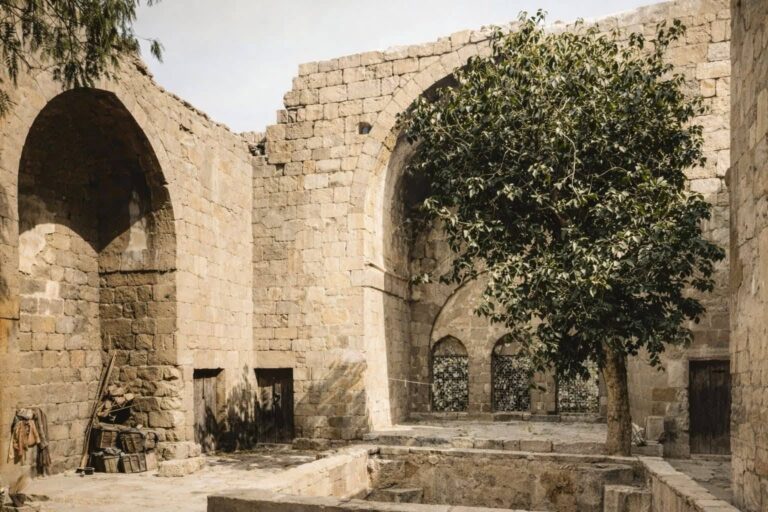
The author adds a field description recorded during his visit to the madrasa in 2009: a courtyard centered around a water basin, flanked by rooms of which eleven remain, a hall featuring a miḥrāb and a high ceiling, spaces for ablution, and a mosque on the southern side bearing traces of recent restoration (pp. 155 et seq.). The book also tracks the madrasa’s teachers, its administration, and the damage it suffered during the Mongol occupation of Damascus in the year 699 AH / 1300 CE (p. 174). Alongside the Great Madrasa, Damascus contained a Lesser Qaymari Madrasa and a third one, while two other madrasas were established in Aleppo and Hebron.
The Qaymari Bimaristan
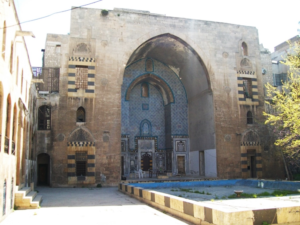
If the madrasa stands as a testament to prestige and scholarship, the Qaymari Bimaristan is the group’s most distinct construction connected to daily life. In the words of researcher Ṣalāḥ al-Dīn al-Munajjid, it is “among the most magnificent monuments of Damascus.” It was established by Sayf al-Dīn Yūsuf (d. 654 AH / 1256 CE) in the year 652 AH / 1254 CE in al-Ṣāliḥiyya on the slopes of Mount Qasioun, west of the Mosque of Muḥyī al-Dīn ibn ‘Arabī, along the alley of schools known as Sūq al-Jum‘a. We mentioned in the introduction to this article the story of its creation funded by the dowry money. The bimaristan was dedicated to serving the poor and was also known as the Ṣāliḥiyya Bimaristan; in later eras, it served as a clinic and a mosque, and its building remains standing to this day.
The book traces the funding sources of the bimaristan, its endowments, its medical and administrative staff, the salaries of its workers, and its treatment divisions (pp. 187–197). Sayf al-Dīn managed its administration personally, and the family’s connection to it endured through his grandson, Emir Shams al-Dīn Muḥammad, until his death in 734 AH / 1333 CE, meaning the presence of the Qaymari house in managing the facility persisted for roughly eight decades (p. 188). In this manner, the endowment preserved two interconnected objectives: the continuation of medical treatment and expenditure, and the sustained presence and social impact of the family in the public sphere.
In addition to the madrasa and the bimaristan, the book enumerates the Qaymari Congregational Mosque and a number of mosques in Damascus—including a mosque attributed to Emir Nāṣir al-Dīn Muḥammad al-Qaymarī—as well as the Qaymari Market, the Qaymari Bathhouse, the Qaymari Mausoleum, and the mausoleums of Qumārī Khātūn and Durra Khātūn. Outside Damascus, it identifies two madrasas in Aleppo and Hebron, a mosque in Aleppo, a congregational mosque, a small market (suwayqa), and a bathhouse in Cairo, as well as a Qaymari Dome in Jerusalem (pp. 201–215).
The attestation al-Qaymarī eventually became the name of a neighborhood in the heart of Damascus. The book links the naming of the neighborhood to the Great Madrasa itself, following the example of other Damascene neighborhoods that took the names of their madrasas, such as al-‘Aṣrūniyya and al-Khuḍayriyya (p. 215).
Following the deaths of the senior emirs and the consolidation of the Mamluk state, their presence as an independent political force receded, yet it was not cut off. The book tracks the transition of some of their descendants into Mamluk administrative positions in Damascus and Aleppo, as well as into Hadith studies, jurisprudence, and literature; similarly, records preserve accounts of women from the house known for endowments and charitable works (pp. 140–146). The attestation “al-Qaymarī” was no longer based solely on blood ties, as it sometimes came to include clients (mawālī) and those affiliated through marriage or service (p. 141).
Their name endured long after the end of their military and jihadist moment. The Qaymari emirs utilized the fiefs they acquired to construct religious, educational, and medical sites, binding them to endowments and administrative bodies. This enabled a Kurdish group of significant standing in its homeland to integrate into the fabric of a relatively distant, ancient city, transforming into a part of its internal and architectural history, and leaving behind a historic neighborhood that carries their name to this day in the heart of historical Damascus.
Note: This text is translated from the original Arabic version… Read the Arabic version:Click here