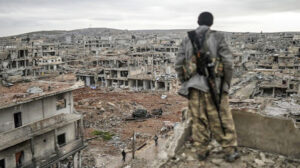
The problem in Iraq is not that the American is leaving, nor that the International Coalition is changing the nature of its presence, nor that the map of regional influence shifts from time to time. The real problem is that some political minds do not see in the absence of foreign power an opportunity to build a state with independent decision-making; rather, they see it as an occasion to bring old projects out from the warehouses of illusions—projects that found no path to implementation throughout past decades, only to return today in new clothes, using the same language, and with an appetite even more open to dominance.
No sooner do signs appear on the horizon indicating the end of a phase of American military and Coalition forces’ presence in Iraq and the Kurdistan Region, than certain Iraqi political and media voices—especially among some Arab analysts and actors—begin speaking about ending the federal system, abolishing the Kurdistan Region, and tightening military and security control over all joints of the state and its borders. In fact, some statements go beyond the limits of political critique to wave the logic of force, as if Iraq has not learned from its long history that when weapons turn into a language of governance, they do not build a state; instead, they open new doors for conflict.
One of them says—in a sense repeated by this discourse—that the Syrian experience can be replicated in Iraq from north to south “because we are the majority and we possess weapons.” Another says, “the time has come to take control of all the military and security joints of the state.”
Here, we have the right to ask—not with the anger of the defeated, but with the coolness of one reviewing the record of history: What kind of state do you want to build? The state of the citizen, or the state of the victor? The state of the constitution, or the state of the rifle? The state of partnership, or the state of the majority when it puts on a military helmet?
If the majority alone confers the right to control, what remains of the constitution? If weapons are the way to reshape the political system, by what logic do we demand that people resort to institutions? And does the state become strong when all its components submit to a single central will, or when everyone feels that their rights do not depend on the balances of power?
The most dangerous aspect of this discourse is not the words spoken in a moment of political passion, but rather the mindset behind them: a mindset that views diversity as a problem, federalism as a revokable concession, and national rights as a temporary privilege granted by the dominant force whenever it wishes, and stripped away whenever circumstances change.
The paradox is that the proponents of this discourse speak of restoring the prestige of the state, while they do not seem to ask themselves about the means that would make the state worthy of prestige in the eyes of its citizens.
Before you hold the Region accountable… hold the history of the state accountable.
Since the founding of the modern Iraqi state, Iraq has passed through successive stages of coups, despotism, wars, repression, foreign interventions, and internal conflicts. Crises accumulated until the Iraqi citizen often became a seeker of a state that protects them, more than a state governed by its official slogan.
Iraqis—Arabs, Kurds, Turkmen, Christians, Yazidis, and all other components—have paid heavy prices as a result of policies of exclusion, violence, and the monopoly on power. The Kurdistan Region was not responsible for all those collapses, nor does its existence alone explain the failures of the Iraqi state in the economy, services, security, and administration.
So what have you done for Iraq, you who are enthusiastic about abolishing the Region, to the point that the Kurds suddenly became the origin of every problem, and the borders of the Region became the last obstacle preventing the rise of the great state?
Was electricity stable before the Kurds demanded their rights? Were state institutions free of corruption? Had political sectarian quota-sharing disappeared from Baghdad, only to reappear because of the Region’s parliament? Were the Iraqi borders completely fortified, only for the Kurdistan Region to come and disrupt the project of full sovereignty?
Turning the Region into a ready scapegoat for every failure is like a doctor who fails to diagnose a disease and decides the problem lies in the mirror exposing its symptoms. Perhaps some politicians prefer a permanent adversary over an honest mirror, because an adversary can be accused, whereas a mirror cannot be arrested on charges of defamation!
Iraq does not need a new discourse seeking an internal enemy; rather, it needs a courageous review of the history of the state and the reasons for its faltering. States are not built by hiding their failures behind a national cause, nor by conjuring the past whenever authority needs a new pretext to expand its influence.
The Kurds are part of Iraq… but they are not a surplus in the power equation.
The Kurds in Iraq are not guests in their homeland, nor a political group waiting for permission to remain, nor a party whose rights can be reduced to the mood of the Center or shifting balances of power.
The 2005 Iraqi Constitution recognized the federal system, recognized the Kurdistan Region and its existing authorities, and regulated the relationship between the federal government and the regions according to its provisions. This is not a passing political favor, but a constitutional framework within whose legal scope disputes ought to be resolved.
The Kurds, as an authentic part of Iraq, do not need to prove their “Iraqi identity” every time they demand their rights. Recognition of national, cultural, and political specificity does not necessarily mean the dismantling of the state, nor does federalism mean the abolition of Iraq or turning it into a group of warring entities.
The problem is not that the Kurds have a region; the problem is that some political minds remain incapable of imagining a state spacious enough for more than one identity, more than one memory, and more than one center of influence.
National unity that requires the abolition of the rights of an authentic component is not a solid unity; it is an anxious unity that fears difference. As for a state that trusts its constitution and institutions, it does not need to turn every demand for rights into a separatist conspiracy.
The question that must be posed to the proponents of domination projects is: Do you want a united Iraq because its citizens are convinced of co-existence, or a united Iraq because no one dares to object?
The difference between the two is not linguistic; it is the difference between a state that enjoys legitimacy and a state that enforces obedience.
The Syrian experience is not a ready-made instruction manual for Iraq.
Politicians and analysts have the right to discuss the Syrian experience, study its power shifts, and examine the future of local forces, security arrangements, and sovereignty. However, turning the Syrian experience into a ready-made template for reshaping Iraq ignores the differences in history, constitutions, and the nature of conflicts in the two countries.
The Kurdistan Region in Iraq enjoys a constitutional status different from the arrangements that arose in northeastern regions of Syria during the war years. Therefore, cloning an experience from one context to another is not necessarily political analysis; at times, it may be an attempt to cherry-pick what serves a prior desire.
Furthermore, a state is not measured merely by its ability to gather weapons under a single command, but by its ability to manage diversity, protect rights, enforce the law, and find political solutions to conflicts that cannot be settled by force alone.
And whoever believes that military control over all joints is sufficient to build stability should remember that the history of the region is full of regimes that possessed vast security apparatuses, yet were unable to plant trust in the hearts of their citizens.
Security built on fear may impose silence, but it does not necessarily create loyalty. A state that needs to threaten its components to prove its strength only reveals fragile notions of its own legitimacy.
But what has the Kurdish leadership done to protect the Region from within?
Here begins a responsibility that should not frighten us, nor should we evade it under the pretext that adversaries are lurking around the Region.
If we reject having Baghdad turn into a center that forces its will upon the Kurds by power, we must also ask: Has the Kurdish political leadership offered an institutional model that consolidates the trust of its people and makes the defense of the Region a defense of citizen rights and interests, rather than merely a defense of partisan arrangements and centers of influence?
The Region is not immune to criticism simply because there are those who threaten its existence. In fact, external threats make internal reform more urgent, not less.
Partisan disputes, power struggles, salary crises, weak coordination among institutions, administrative and transparency issues, and the sometimes strained relationship with Baghdad—these are all files deserving serious handling. No political leadership can ask citizens to sacrifice and remain steadfast endlessly without offering them institutions in return that they feel work for them.
The Kurdish citizen does not only need a discourse that defends their rights before the Center; they also need a good school, a respectable hospital, a regular salary, a law that does not shift according to influence, a fair employment opportunity, and an administration that does not make party affiliation a necessary gateway to the future.
If the Kurdish leadership wants to retain the trust of its people, it must realize that legitimacy is not inherited forever from past sacrifices, nor is it guaranteed merely by raising the flag or invoking the names of historical leaders. Legitimacy is renewed every day through performance, justice, transparency, and respect for the citizen.
It is unwise to demand that Baghdad abandon the mindset of dominance while turning a blind eye to every practice within the Region under the pretext that the political moment does not permit criticism.
Defending the Region does not mean defending every mistake of its governments, just as criticizing the Region’s governments does not mean abandoning the rights of the Kurds.
This equation, despite its simplicity, sometimes seems harder than managing an entire political crisis! Between a Center that wants dominance and a Region that needs reform.
Iraq stands before a question larger than a mere dispute between Baghdad and Erbil: Can it transform from a state where centers of influence coexist into a state governed by institutions?
Iraq’s problems cannot be solved by abolishing the specificity of the Kurdistan Region, nor can the Region’s problems be solved by shifting all its responsibilities onto the federal government.
Baghdad is required to respect the constitution, move away from the language of threats, and settle disputes over powers, resources, and security through law and institutional dialogue. Erbil, in turn, is required to reform its institutions, enhance transparency, strengthen the relationship between authority and citizens, and address internal disputes that weaken its ability to defend its rights in a unified manner.
A federal state does not mean the Center abandons its responsibilities, nor does it mean the Region becomes a space beyond accountability. It is a formula requiring clear rules, effective institutions, and a political will that respects partnership.
As for one party demanding the subjugation of the other in the name of the state, while the opposing party demands protection for every practice in the name of the national cause—that will lead to nothing but reproducing the crisis under new names.
Weapons do not build a homeland… just as slogans do not build a region.
There are two illusions that Iraqis and Kurds must stop falling prey to:
The first illusion is that weapons can solve all political problems, and that the majority can turn its will into law simply by possessing power.
The second illusion is that raising national slogans is sufficient to protect the Region, even if its institutions continue to suffer from administrative crises, weak trust, and political division.
Iraq needs a state that protects diversity, and the Region needs institutions that enjoy the trust of its people. There is no contradiction between the two except in the mind of someone who wants to use differences as an excuse for dominance, or someone who wants to use grand causes as a cover to postpone reform.
National unity is not measured by the authority’s ability to silence those who differ, but by its ability to make difference possible without turning into an existential threat. True strength lies not in the citizen fearing the state, but in trusting that the state will not turn into their adversary.
So, who owns Iraq? The citizen, or the one who holds the weapon?
Iraq is not political spoils, nor is the Kurdistan Region a historical mistake waiting to be corrected by a military decision. Iraq is a diverse homeland, and the Kurdistan Region is part of this homeland within its constitutional framework; the rights of its citizens are not a gift that can be reclaimed when the balance of power shifts.
If some politicians believe that the absence of foreign forces opens the door to imposing total centralization, they should remember that the constitution does not change simply because a foreign soldier leaves, and that the state does not restore its prestige by weakening trust among its components.
Conversely, the Kurdish leadership must realize that protecting the Region does not happen through continuous complaining about Baghdad, nor by postponing internal reform, nor by considering every critique a conspiracy against the national cause. The people who made sacrifices deserve a leadership that respects those sacrifices by building just institutions—not by merely invoking memories of pain on every occasion.
It is time for Iraq to emerge from politics that turn every crisis into an opportunity to accuse the other, every difference into a prelude to threats, and every demand for rights into a project to dismantle the state.
Let the proponents of the project to control all of Iraq step forward—before drawing maps of dominance from north to south—and tell us: What have you done to build a state that makes the citizen trust it without needing a rifle to protect them from it?
And let those in power in the Kurdistan Region step forward in turn and answer the same question from another angle: What have you done so that the citizen feels the Region represents their institutions, rights, and future, rather than just a political title that parties compete to own?
As for Iraq—this homeland exhausted by grand projects and small promises—it needs no more leaders who believe that possessing weapons gives them the right to write history, nor leaderships that imagine past sacrifices exempt them from the responsibility of the present.
A homeland is not built on the logic of “we are the majority and we have weapons,” nor on the logic of “we are the owners of the cause and cannot be questioned.” A homeland is built when the law becomes stronger than the weapon, the citizen more important than the party, and dignity broader than the borders of influence.
Note: This text is translated from the original Arabic version… Read the Arabic version:Click here