In the previous article, I discussed the rise of the Median Empire, the origin of its population, its demographics, its governance system, its kings, the wars it fought, and the political and military alliances it forged, in addition to its geography and subsequent decline and disappearance. In this article, I examine Median civilization and culture, focusing in particular on the Median language (Avestan) and drawing upon reliable historical sources to confirm the Kurdish identity of Zoroaster. I also turn to the vocabulary of the Median language (the language of the Avesta, the sacred book of the Zoroastrians) to prove that the contemporary Kurdish language is an extension of the Median language. Furthermore, in the current article, I focus on the Zoroastrian religion, which was one of the most advanced and civilized religions of its time.
Family, Medicine, and Agriculture
Zoroaster called for noble morals and established the foundations of the family upon strong ethical principles, considering family ties through marriage to be part of religion, and holding that worldly happiness reaches its peak in the marital home: “A happy home is one that shelters a virtuous wife, where children play, and where piety increases.” Zoroaster adds that a happy home is one where livestock multiplies, animal food abounds, and the dog is content.
Zoroaster was a physician who cared for physical medicine. His laws stipulate the requirements that a physical physician must meet: knowing the anatomy of body organs, practicing treatment only after a complete understanding of various medicines and the names of different herbs and their properties, and being barred from practicing medicine if he causes the death of three people during treatment. This caused medicine to develop and progress in Media, making the School of Gundeshapur one of the most important pre-Islamic medical schools, remaining so into the early Islamic centuries.
Zoroaster considered agricultural labor to be the primary factor for a nation’s renaissance, as it provides the nation with sustenance and protects it during years of drought and famine, given that famine incites the urge for conquest in the soul and encourages war. Agriculture was one of the most important aspects that Zoroaster urged his followers to advance, stating that when Zoroaster asked his Lord about the best ways to elevate the word of the religion of Mazda, He answered: “It is the cultivation of wheat; whoever cultivates wheat cultivates righteousness and aids the religion of Mazda.” For “when wheat grains are sown, the demons are terrified… when they sprout, they become distressed and fall ill… when their stalks are seen, they weep… and when their ears are seen, they turn their backs.”
Arts
Art was advanced during the Median rule, with the use of drawings, decorations, and inscriptions on tablets, walls, tombs, stones, iron, and textiles. They were also skilled in tailoring, spinning, weaving, wood and iron engraving, and statue-making, especially for gods and notable figures. Excavations at Tepe Hesar revealed the magnificent art of the Medes, and an advanced type of art was discovered in two caves. The first is the Cave of Sharazur (located in the Sulaymaniyah Governorate in the South Kurdistan Region), which contains the tomb of King Cyaxares and numerous drawings of him in various aspects of political life. A four-winged statue of a figure carved on stone was also found, bearing the image of the planet Venus—denoting the goddess Anahita—the moon denoting the goddess Mithra, and the sun denoting the god of good, Ahura Mazda, in Zoroastrianism, alongside the image of a Magi priest in front of a fire altar. The second cave is located in the Dukan region, where the tomb of Median king Astyages was found, along with drawings of nature and decorative shapes on plates and cups. The Medes also practiced agriculture and animal husbandry, particularly domesticating the horse.
Guerrilla Warfare
The Medes’ skillful use of militias or guerrilla fighters had a major impact on expanding their empire and defending it and themselves. These militias were called “Kara,” as evidenced by the inscriptions at Behistun in the East Kurdistan Region. This is considered the earliest historical record of this type of warfare, which has since become the preferred form of defending Kurdistan to this day.
The Median Language
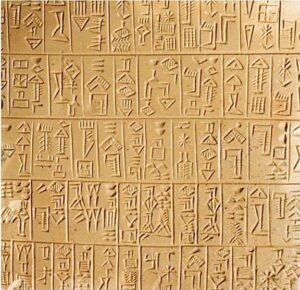
The Median language is Kurdish, as the Mokriyans in the East Kurdistan Region still speak it. From this, we see that the Median language transformed over time from a language that united the Medes around it into merely a dialect among Kurdish dialects. The Medes used cuneiform script in writing, and sometimes hieroglyphics, which changed relatively in shape after Zoroastrianism became the official religion of the country, as characters similar to cuneiform were used to write the “Avesta,” which was called the “Avestan language and script.” The language in which the “Avesta” was written had existed since ancient times in Kurdistan and present-day Iran; when they wrote the “Avesta” in that language, they called it the language of the “Avesta,” which was the official language during the Sasanian era. The present-day East Kurdistan Region was the cradle of the Zoroastrian religion and consequently the homeland of the Avestan language. Most of the words claimed to be purely Pahlavi—such as sara, sardar, suya, farman, sarahang, sartip, etc.—are words that still survive in the Kurdish language. This language and script later transformed into the Pahlavi language and script, which continued to be used by Kurds and Persians until the Islamic conquest reached the region.
Literacy and Writing
Tnk Gllu, nicknamed Shakllu, of Kurdish origin, was a scholar and man of letters in Al-Jazira and the northern regions of Mosul seven hundred years before Christ, with numerous books in Kurdish on religious and astronomical subjects. Ariyata was a famous scholar and physician who wrote books in Kurdish on the arts of medicine, using the Kurdish alphabet of that time. Zoroaster had two books: the “Avesta” and the “Wien,” with the latter written on the hides of 12,000 buffaloes. Azarbord Marsuyand created the Pahlavi script alphabet, consisting of 42 signs that preserve all sounds (fathah, kasrah, dammah), which are the letters in which the “Avesta” was written. The “Wien” is the oldest Kurdish book in the Avestan language. Members of the dynastic line of the Median Empire read petitions in trials. Furthermore, the physician of King Ardashir’s court wrote a historical book about the royal court calendar. The Torah speaks of law and education (literacy) in the Median Empire, confirming the existence of literacy, publishing, law, and courts in Kurdistan since ancient times.
The books “Avesta” and “Wien” were written as poetry and were read aloud and beautifully. In the court of the Sasanian Empire, Barbad would recite poetry and then perform it vocally and melodically with his samutur. The Persians adopted from the Medes their language and 36-letter alphabet, replacing clay tablets with writing, parchment, and pens; they also adopted their moral code inspiring thrift and good management, their religion (Zoroastrianism), and their family system, while of their literature and art, only a few letters remained.
Pre-Islamic Kurdish Books
Before Islam, numerous books were written in the Kurdish language; however, when Muslims invaded Kurdistan, they threw many letters, scrolls, and manuscripts into rivers under the pretext that they were Magian and Zoroastrian. Some were retrieved and fell into two categories. The first category of books and manuscripts dealt with religious matters such as the “Avesta,” “Zand,” “Wien,” and other topics concerning Zoroastrianism. The second category contained subjects on politics, customs, health, education, literature, history, myths, stories, state administration affairs, chess rules, equestrian arts, archery, industry, agriculture, forestry, earth sciences, astronomy, and philosophy. Among the Kurdish books authored before the emergence of Islam in the region were the “Avesta,” “Wien,” “Bundahisn,” “Dadestan-i Denig,” “Artari,” “Virafnamag,” “Karnama-i Ardashir-i Papakan,” “Zriran,” “Dadestan-i Rodik,” “Khosrow ud Madayan-i Rōdak,” “Ushtrenknama,” “Khwaday-Namag,” “Khwaway-Namag,” “Rustamnameh,” etc.
The book “Khwaday-Namag” was known as Sir al-Muluk (The Book of Kings) and “Khwaway-Namag” as the Shahnameh, both translated from Pahlavi into Persian and Arabic. The book Kalila wa Dimna was authored in India and entered Kurdistan during the era of the Kurdish judge and ruler Ardashir, where it was translated into Pahlavi, and after the rise of Islam, from Pahlavi into Persian. As for the Shahnameh, it was a historical book written in Pahlavi before Islam and later translated into Persian.
Alexander the Great’s attempt to destroy the “Avesta” around 331 BC was a major catastrophe and a painful blow to the Zoroastrian religion. After eliminating the Achaemenid Empire, he seized the Shahanshah library where all parts of the “Avesta” were preserved and burned it along with all other written documents. Ultimately, only a few parts of the “Avesta”—amounting to 8,300,000 words—survived the fire; the other parts were preserved in the memories of the Mobeds and Herbeds generation after generation until the end of the Seleucid era, when the editing of its parts resumed around 147 BC. Afterwards, efforts to rewrite it continued into the late Parthian era ending in 226 AD, and through the Sasanian era until the reign of Khosrow Parviz (590–628 AD). Following him, Islam arrived, halting these efforts and closing the chapter of Aryan culture for a time.
Belief and Religion
Before the establishment of the Median Empire, the tenets of Anahita were the most widespread in the region, representing the planet Venus, followed by the beliefs of Mithra representing the moon, after which both blended with the Zoroastrian religion, which grants the sun respect and sanctity, gives fire a prominent place, and exalts light over darkness. It is worth noting that Lady Nefertiti (meaning in Kurdish Neferti-ti, i.e., “the beautiful woman who has come”), who was the wife of the Egyptian Pharaoh Akhenaten, was the daughter of the king of the Mitanni Empire, whose capital was Washukani (Sere Kaniye, i.e., Ras al-Ayn near Qamishli, located in the West Kurdistan Region). Her religious origins trace back to Anahita and Mithra; therefore, when she married the Egyptian Pharaoh, she made him change his religious beliefs—in which he considered himself the living god on earth while another god, Amun, was in heaven, meaning he believed in a dual god—so that he returned to believing in a single god in heaven named Aten, meaning the sun. The word Aten is still used in the Kurdish language to mean “extreme heat,” which formerly meant the sun.
During the reign of Azhi Dahak, angel worship had a major influence on the emerging Zoroastrian religion, resulting in the introduction of the priestly office known as the “Magi” into that religion. The Zoroastrian Achaemenid kings who succeeded the Medes tried to reverse this influence, but achieved little in reinstating original Zoroastrianism as set forth in the Gatha, which is the oldest and purest part of the Zoroastrian sacred book, the Avesta. During that period, a demonic trait was added to the royal honorific title “Azhi Dahak” by the Zoroastrians, thus cementing Iranian national mythology and epic literature in that religion. “Azhi Dahak” is still revered as “Sultan Sahak”—a more corrupted form of the original name—by the adherents of the Kurdish Yarsani religion (Ahl-e Haqq or KakaiIS).
Zoroastrian beliefs were very close to monotheism; indeed, even after Ahriman and spirits were introduced into it, it retained as much monotheism as Christianity with its demons and angels. The reflection of Zoroastrian dualism in Christianity and the extent of its influence can be readily observed. Zoroastrian ideas about God caught the attention of meticulous thinkers such as Matthew Arnold. “Ahura Mazda” represented the forces of the world working for truth and virtuous morals. The idea of dualism explains and justifies to man the contradiction and opposition he sees in the world. Zoroastrian clerics sometimes say that evil does not truly exist; in reality, they present people with a religion capable of representing the moral problems a person encounters in life in a way that brings them close to the mind and imprints them upon it. They promised their followers that the final chapter of this drama would have a happy ending for the righteous man because the forces of evil will be defeated by the forces of good after the world passes through four epochs, each 3,000 years long, ruled successively by Ahura Mazda and Ahriman. Then truth triumphs everywhere, evil vanishes and ceases to exist thereafter. The righteous then join Ahura Mazda in paradise, while the fate of the wicked is in darkness, where they feed on deadly poison for eternity.
Zoroaster Was a Kurdish Prophet, Not a Persian
Zoroaster was born in northwestern present-day Iran (in the region of “Ray” (ancient Ragha) in Kurdistan) and grew up there. He then migrated from there to the eastern part of present-day Iran, settled in the city of Khorasan, wrote his holy book the Avesta there, and began spreading his new religion from there around the 7th century BC. Zoroaster’s birth and upbringing in Kurdistan are evidence that Zoroaster was a Kurdish citizen and that he wrote his holy book the Avesta in the Median language, which is the Kurdish language. Zoroaster was forced to leave his country because of his call for people to renounce unjust customs in certain aspects of life, making him a traveling preacher and caller. It is impossible that he would have stopped his mission for a long period after migrating to Khorasan in order to learn the Persian language to preach his message in it. Even assuming he had done so, it would have been impossible for him, as a stranger to the Persian language, to attain the high rhetorical level in that foreign language—by the standards of that time—that we see in the Avestan language.
To further prove that the language of the Avesta is closer to Kurdish than Modern Persian is to Old Persian, Professor Massoud Mohammad mentions additional evidence supporting this claim regarding morphological significances that build bridges between Kurdish and Avestan. The suffix “-tat” in the Avestan language is a tool for turning a material noun into an abstract noun and has no counterpart in Persian, yet it has a counterpart in Kurdish that is close in form and equal in function: the suffix “-ati, -e-ti, -ti,” which has three forms depending on the morphological structure of the word it attaches to. The Avestan word Ameretat is transformed in Kurdish into nemrayeti or nemreti, which means “immortality.” The open hamza in the first word, which is for negation, corresponds to ne in the second, which is also for negation, and mer means “death” in both cases, making both amer and nemer mean “immortal.” The suffix “-tat” in the first and the suffix “-e-ti, -ati” in the second serve for abstraction, so the meaning becomes “immortality” or “deathlessness.” Furthermore, it is very likely that the open negative hamza in Avestan passed from the Medes into English, as it is also negative in English (such as social / asocial, and sexual / asexual). It is also likely that the Arabs took this tool for negation from the Kurds, given that the elision hamza in the af’ala measure of Arabic verbs used for negation—such as the verbs aflasa (to become bankrupt) and a’thara (to strip of excuses)—is taken from the Avestan language.
If we proceed to compare Avestan and Kurdish words, we find a great similarity between them. To name just a few similar words between these two languages touched upon by the Kurdish thinker Massoud Mohammad—demonstrating conclusively that the Avestan language is Kurdish and not Persian, as there is no similarity between the Avestan words indicated here and their corresponding Persian vocabulary, unlike Kurdish, where one notices strong links uniting Avestan and Kurdish vocabulary:
The Avestan word Pouroush, meaning “old/elderly,” transformed in Kurdish and Persian into Pir. This word also had another meaning: a mixed color of black and white, corresponding in Arabic to al-adham if black predominates and al-ashhab if white predominates. This Median word still survives in Kurdish as Bor.
The word Pareto, denoting “passage,” is none other than the Kurdish word Par with the suffix Te, becoming Tepar.
The Median word Ameretat corresponds to the Kurdish word nemrayeti, meaning “immortality.”
The word uPas, meaning “sheep,” corresponds in Kurdish with the same meaning to Pas.
The Avestan word Haurva, meaning “complete or full,” is found in Kurdish transformed into Iro. Dropping the letter h at the beginning of Kurdish words and replacing it with hamza is common in Kurdish, and the letter shifted according to another phonetic rule in Kurdish, thus transforming this 3,000-year-old Median word into Iro.
The word Vizim corresponds in Kurdish to Khizim, meaning “relative” (derived from kinship).
Azan, meaning “sun,” became in Kurdish Gizing, meaning “sunbeam.”
The word Shapik, meaning “vest,” is used in Kurdish in the same form and meaning.
The Avestan word Dughdu transformed into the word Deot, which still exists in the Luri Kurdish dialect spoken by the Feyli Kurds; this word was adopted from Avestan by Indo-European-speaking peoples such as English, Swedish, Persian, and others.
The word Rapitvina means “midday/noon” in Avestan and transformed into Firavin in Kurdish, meaning “lunch/midday meal.”
The Avestan word Zrayah corresponds in Kurdish to Zarya, meaning “sea.”
matarza transformed into Zawa in Kurdish, meaning “groom.”
The word Asu transformed into Ask in Kurdish, meaning “gazelle.”
The Avestan word Misyah corresponds in Kurdish to Masi, meaning “fish.”
The Median word Thri, meaning “three,” transformed in Kurdish into Se, while the English and Swedish adopted this word from the Medes, transforming it in English to Three and in Swedish to Tre, as it passed into several other Indo-European languages.
There are also other Median words that still survive in Kurdish, such as Arta (oven), Asp (horse), Ary (related to the sun), Nan (bread), and Tigr (tir, meaning “arrow”). The Tigris River derived its name from this designation because it flows like an arrow and was called Tiglat at the time. The word Shir denoted a Zoroastrian religious rank and is still used among the Yazidis. The word Mirta or Marta means “brave, rebellious, insurgent,” a designation given by Avestan writers to Media. Other words include Zir (gold) and Nowruz, which is the name of the month of March and means “new day.”
The holy book Avesta written by Zoroaster includes four parts:
The first part is the Gatha, which contains the laws of the god Ahura Mazda, Zoroaster’s dialogue with God, and Zoroaster’s teachings.
The second part, the Yasna, is a complementary part to the Gatha and contains laws, rules, and Zoroaster’s dialogue with God.
The third part of the Avesta is the Yasht, which includes Zoroaster’s behests to his disciples and believers, as well as matters related to purity and impurity.
The fourth and final part, called the Visperad of the Avesta, consists of hymns, supplications, and chants composed by Zoroaster in praise of the god Ahura Mazda.
Moral Philosophy in the Zoroastrian Religion
Early in his life, Zoroaster was occupied with searching for the truth of creation and the Creator. Once he believed he had found the Creator in the person of the god Ahura Mazda, he began pondering creation, existence, life, and death, searching for an optimal way by which man could combat evil within himself and work for the supremacy of good, truth, justice, honesty, freedom, universal cosmic love, and brotherhood among all human beings without distinction of gender, race, language, or color—unifying their existence in a pure unity melting into the absolute essence of being. No trace of slavery can be seen in his philosophy, as neither Zoroaster nor his gods interfere in this choice, even when it concerns God’s laws, in order to preserve human freedom. Furthermore, Zoroaster did not use physical violence, moral coercion, anger, or wrath in spreading his religion. Zoroaster believed in women’s rights and freedom before Socrates and Plato, considering her equal to man in rights and duties. He was the first to conceive of the rules of opposites: good and evil, light and darkness, truth and falsehood, freedom and slavery, science and charlatanism, knowledge and ignorance—considering the first set to be elements of the will to live, and the second to be elements of the will to die and perish.
Zoroaster brought a new doctrine previously unknown to Indo-European and Aryan peoples. This doctrine rejected polytheism, proclaimed the independence of the forces of good and evil as a struggling and opposing dualism, and coined the word Daeva—which later changed to Dew—for Satan, whereas before that the word meant “god.” Zoroaster named the sole Lord Mazda. The word Mazda is always mentioned with the word Ahura as an epithet, saying Mazda Ahura, which means “the Knowing Lord.”
The Zoroastrians’ portrayal of the world as an arena where good and evil contend introduced a strong incentive into the popular imagination, springing from a power beyond human forces, urging and guarding virtuous morals. They represented the human soul, just as they represented the universe, in the image of a struggle between good and evil spirits. Thus, every human being was a combatant, whether they liked it or not, and had to choose to be in the ranks of God’s army or Satan’s army; every action they performed or neglected tipped the scales for the cause of Ahura Mazda or the cause of Ahriman. It is a philosophy containing moral principles that one admires even more than its religious principles, if we accept that people need a power beyond natural forces to guide them to noble character. It is a philosophy that endows human life with a meaning and dignity that is not bestowed by the view that man is merely a helpless, insignificant insect or a mere moving machine, as is said in today’s world. According to Zoroaster’s teachings, man is not a mere pawn moving without will; rather, he has free will because Ahura Mazda (the god of good or wisdom and creator of the physical world) wants him to be a person enjoying full rights, and he is free to choose the path of light or the path of darkness. Ahriman is the eternal lie, and every liar is his servant.
This doctrine established a detailed yet simple moral code revolving entirely around the rule that “Nature is not good unless it prevents its possessor from doing to others what is evil to oneself.” The Avesta states that man has three duties to perform: “To make the enemy a friend, to make the wicked good, and to make the ignorant wise.” The greatest of virtues in his view is piety, followed by honor and honesty in word and deed. He forbade usury while making the fulfillment of debt an obligation. The capital of all sins (in Zoroastrian law as in Mosaic law) is disbelief. The strict punishments imposed on atheists indicate that atheism existed among the Aryans, and apostates from the religion were punished with death without hesitation. The kindness and mercy commanded by the master were not practically applied to infidels—that is, foreigners—because the latter were a degraded class of people misled by Ahura Mazda.
Since piety was the absolute greatest virtue, the first duty a person must perform in this life is to worship God with purity, sacrifice, and prayer. Zoroastrian Media did not permit the construction of temples or idols; instead, Zoroastrians built sacred altars on mountain peaks, in palaces, or in the heart of cities, igniting fire upon them in honor of Ahura Mazda or minor deities. They took fire itself as a god to be worshipped, calling it Anar and believing it to be the son of the god of light. Every family gathered around its hearth, striving to keep its household fire burning without ever extinguishing it, as this was a prescribed religious ritual. The sun was the fire of the eternal heavens, worshipped as a representation of the god Ahura Mazda or Mithra, much as Akhenaten worshipped it in Egypt. Their holy book states: “The morning sun must be venerated until noon, the midday sun must be venerated until afternoon, and the afternoon sun must be venerated until evening; and those who do not venerate the sun shall not have their good deeds counted for them that day.” They also offered sacrifices to the sun, fire, and Ahura Mazda, consisting of flowers, bread, fruit, perfumes, bulls, sheep, camels, horses, donkeys, and male ibexes. Zoroastrians offered sacrifices as human victims, just like other nations. The gods received nothing from these sacrifices except their aroma, while what was edible remained for the priests and worshippers, because the gods, according to the priests, needed nothing more than the soul of the victim. The ancient Aryan custom of offering the intoxicating juice of “Haoma” as a sacrifice to the gods persisted long after the spread of the Zoroastrian religion, even though Zoroaster himself voiced his displeasure with this custom and did not mention it in the Avesta. The priests drank part of this sacred juice and distributed the remainder to the believers gathered for prayer. If poverty prevented people from offering these sacrifices, they could substitute them by offering supplications and prayers to the gods. Ahura Mazda loved and accepted praise, and thus he set forth for his pious worshippers a magnificent array of his attributes that became favored litanies among the Medes.
If a Median was granted a life of piety and honesty, he could face death without fear. It was established doctrine that the death god Astuad is able to find man wherever he is, and man cannot escape him even if he hides deep within the earth—as Afrasiab the Turk did when he built for himself beneath the layers of soil an iron palace a thousand times the height of a man’s stature, erecting a hundred columns inside it, with the stars, moon, and sun revolving in its sky, bathing it in daylight. In this palace he did whatever he pleased and lived a very happy life, yet he could not escape the king of death, Astuad. Similarly, Dahak dug a vast, circular land extending to the farthest limits and wandered the earth east and west searching for immortality, but could not find it, nor could all of this save him from the grip of the death god. The cunning Astuad comes stealthily and finds every person; he honors no one, accepts no praise or bribery, and destroys people without mercy.
It is the nature of religions to terrify and warn, just as they promise and preach. Despite all this, the Median viewed death with dread, unless he was a soldier defending the cause of Ahura Mazda. After death come Hell, Purgatory, and Paradise. The souls of the dead had to cross a bridge where they are purified; the good souls cross it to reach on the other side “the Abode of Annihilation,” where they are met and welcomed by “a virgin maiden, of strength and splendor, with a full, swelling bosom.” There they live with Ahura Mazda happily, blessed and eternally immortal. The wicked souls cannot cross the bridge and go to hell, the depth of which corresponds to the sins committed by those individuals. Hell is a dark, terrifying abyss where sinful souls are tortured for all eternity. If a person’s good deeds outweigh their bad deeds, they undergo a temporary punishment that purifies them of sins; and if they committed many sins but also did good, they linger in torment for only twelve thousand years, after which they are lifted up to heaven.
Righteous Zoroastrians tell us that the world is approaching its inevitable end: the birth of Zoroaster was the beginning of a 3,000-year world epoch, and after three prophets emerge from his lineage at different intervals to spread his teachings across the world, the Final Judgment day will arrive, the kingdom of Ahura Mazda will be established, and Ahriman and all forces of evil will perish in a destruction from which they can never rise again. On that day, good souls will begin a new life in a world free of evil, darkness, and pain; the dead will be resurrected, life will return to bodies, breath will re-emerge in them, and the material world will be free of aging, death, corruption, and decay forever.
In the Zoroastrian religion, there is the threat of a terrifying Day of Judgment, which likely passed from Zoroastrian philosophy into Jewish philosophy during the days when the Aryans ruled Palestine, or when Jews in captivity under the Babylonians during the spread of the Zoroastrian religion were influenced by Zoroastrian beliefs in the resurrection and the sending forth of the dead. Since one of the aims of religion is to facilitate the duty of subordinating the young by the elders, it compels us to admit that Zoroastrian priests possessed skill in establishing the rules of religion. Looking at this religion as a whole, we find it a wonderful religion—less brutal and warlike, less pagan and superstitious—than contemporary religions.
If Zoroaster were immortal, he would hide in shame upon seeing statues of Anahita-Aphrodite erected in many cities of the Aryan Empire a few centuries after his death, and it would grieve him to find many scrolls dedicated by the Magi to talismans for healing the sick, divination, and magic when the Magi priests eventually overcame Zoroaster’s cause. These Magi priests, through their asceticism, abstinence, limitation to a single wife, observance of hundreds of sacred rituals, purification in accordance with religious commands, abstention from eating meat, and simple attire, soon became famous for wisdom among foreign countries, including the Greeks. These priests also acquired boundless authority over their compatriots, to the extent that Persian kings themselves became their disciples and undertook no major matter without consulting them. Their upper classes were wise men, while the lower classes were diviners and sorcerers who looked at the stars and interpreted dreams. Witness to their influence is the fact that the English word for “magic” is derived from the name of the “Magi.”
Zoroastrian elements in the Aryan religion dwindled over time; while thriving during the Sasanian Empire (226–651 AD), the Islamic conquest of the region and the Tatar invasion eradicated them. No trace of the Zoroastrian religion remains today except among a few clans in Iran and the Indian Parsis. This community still preserves its sacred books, studies them, worships and sanctifies fire, dust, earth, and water, and exposes its dead in “Towers of Silence” to birds of prey so as not to defile the sacred elements by burying them in the ground or burning them in the air. They are a people of sublime morals and refined manners, living witnesses to the virtue of the Zoroastrian religion and its great impact on the refinement, civilization, and culture of humankind. Despite the recession of Zoroastrianism as a religion in the present day, the influence of Zoroastrianism on Jewish, Christian, and Islamic religions is clearly evident.
Zoroaster published his philosophy centuries before Socrates, Plato, Aristotle, and Pythagoras, and some historians consider Pythagoras to have been a student of Zoroaster’s teachings, just as later Platonists, Greek historians Herodotus, Ctesias, Xenophon, and others subsequent to them were acquainted with Zoroaster’s philosophy and religion.
Sources
Zaki, Muhammad Amin (1945). A Brief History of the Kurds and Kurdistan: From the Most Ancient Historical Eras Until Now. Part 1, 2nd Edition. Translated by Muhammad Ali Awny.
Mokriyani, Qيو (1961). Ferhengi Mahabad. First Edition, Erbil, Kurdistan Printing House.
Durant, W. (1954). The Story of Civilization. Vol. 1, part 2. Simon and Schuster, New York.
Izady, Mehrdad (1992). The Kurds: A Concise Handbook. Department of Near Eastern Languages and Civilizations, Harvard University, Taylor and Francis International Publishers, Washington – Philadelphia – London, 268 pp.
2007 / 1 / 21
Note: This text is translated from the original Arabic version… Read the Arabic version:Click here