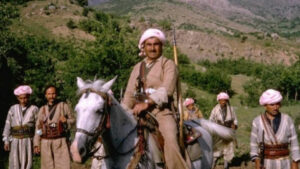
That night in Kurdistan was no ordinary night. Homes were drifting to sleep amidst their simple daily details: a mother cradling her child in silence, a father reviewing his day before rest, and children sleeping with total confidence that their homes were the safest of places. But in a single moment, everything shattered. Stillness turned into shock, safety into an unforgettable fear, and homes into targets invaded by tragedy without warning.
From here begins the story of Al-Anfal—when a human being is targeted at their most secure moment, inside their home and among their family.
The Al-Anfal crime is considered one of the cruelest pages in modern Iraqi history; it was not merely a military campaign, but a project aimed at the very existence of the people of Kurdistan. Its broadest events occurred between February and September 1988, during the final stages of the Iran-Iraq War, within organized operations that spanned vast areas of the Kurdistan Region.
This was not a matter of military confrontation, but a direct targeting of civilians. Estimates indicate that approximately 182,000 people lost their lives without charge, trial, or even the chance to defend themselves—solely because of their national identity.
The tragedy did not stop at killing. Thousands of villages were destroyed, entire families were scattered, and people were forcibly displaced from their homes, alongside widespread arrest campaigns and policies of demographic change in certain areas. Furthermore, chemical weapons were used against civilians in one of the harshest forms of violence during that era.
Among the prominent scenes of that period is what occurred in Halabja on March 16, 1988, when the city was subjected to a chemical attack that claimed the lives of more than five thousand civilians and injured thousands more, remaining a stark witness to the magnitude of the humanitarian catastrophe endured by civilians at the time.
What makes the Al-Anfal crime even more agonizing is not just its scale, but the way it was justified or handled, as if it could occur outside the circle of accountability. In its essence, however, it was a flagrant violation of all human values and all principles of justice.
Therefore, speaking of Al-Anfal cannot remain a mere annual commemoration. It is a cause of rights, first and foremost: the rights of victims who lost their lives, and the rights of families who still live with the effects of loss today. These rights are not symbolic; they are a legal and moral obligation.
The Iraqi state bears a clear responsibility in this file to compensate the victims’ families fairly and comprehensively. This should not be limited to the material aspect but must include an explicit official recognition of what happened, reparations for the harm caused, and true justice for the victims and their families in a manner befitting the magnitude of the tragedy.
Multiple international and human rights reports, in addition to subsequent admissions and decisions by official bodies, confirm that what took place amounts to a crime of genocide under international law.
Nevertheless, it remains clear that no compensation, regardless of its form, can bring back those who were lost or erase the mark of pain. Thus, the most important responsibility remains ensuring that this history is never repeated under any pretext or title.
Today, thirty-eight years after the Al-Anfal crime, its impact remains present in the collective memory of the people of Kurdistan. Three decades and eight years have passed, yet they have not succeeded in closing the wound or lightening the weight of loss. Mass graves still stand as witnesses, families still carry the names of their vanished sons, and memory remains as vivid as if time had never passed. The passage of these long years does not diminish the truth; rather, it entrenches it further, making the demand for justice, compensation, and recognition more urgent than ever.
For this reason, Al-Anfal is not just a memory from the past, but a permanent test of the concept of justice in the present: Can the victims truly be served justice, the crime recognized, and its recurrence prevented—not just in words, but in deeds?