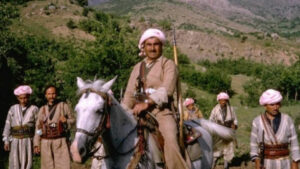
The Kurdish language belongs to the Indo-Iranian language family. It branches into major dialects and smaller sub-dialects distributed across various regions of Kurdistan. Over time, dozens of literary and religious works have been documented in this language. However, Kurdish faced significant competition from Arabic following the advent of Islam, and later from Persian and Turkish in the late Islamic eras after the Safavid and Ottoman Empires partitioned Kurdistan between them.
Kurdish experienced a notable revival after many Arabic and Persian vocabulary words were integrated into it by pioneers of Kurdish poetry, both religious and romantic. Three hundred years ago, the Kurdish poet Ahmad Khani was the first to recognize the necessity of an Arabic-Kurdish dictionary to teach Kurdish children Arabic, viewing it as the language of the Quran and Islam—the faith embraced by the majority of Kurds. Consequently, he authored his small poetic dictionary titled Nûbihara Biçûkan (The New Spring of Children) at the end of the 17th century. He was followed by a poet from Sulaymaniyah, Sheikh Marouf al-Nodehi, who authored a similar dictionary titled Ahmadi.
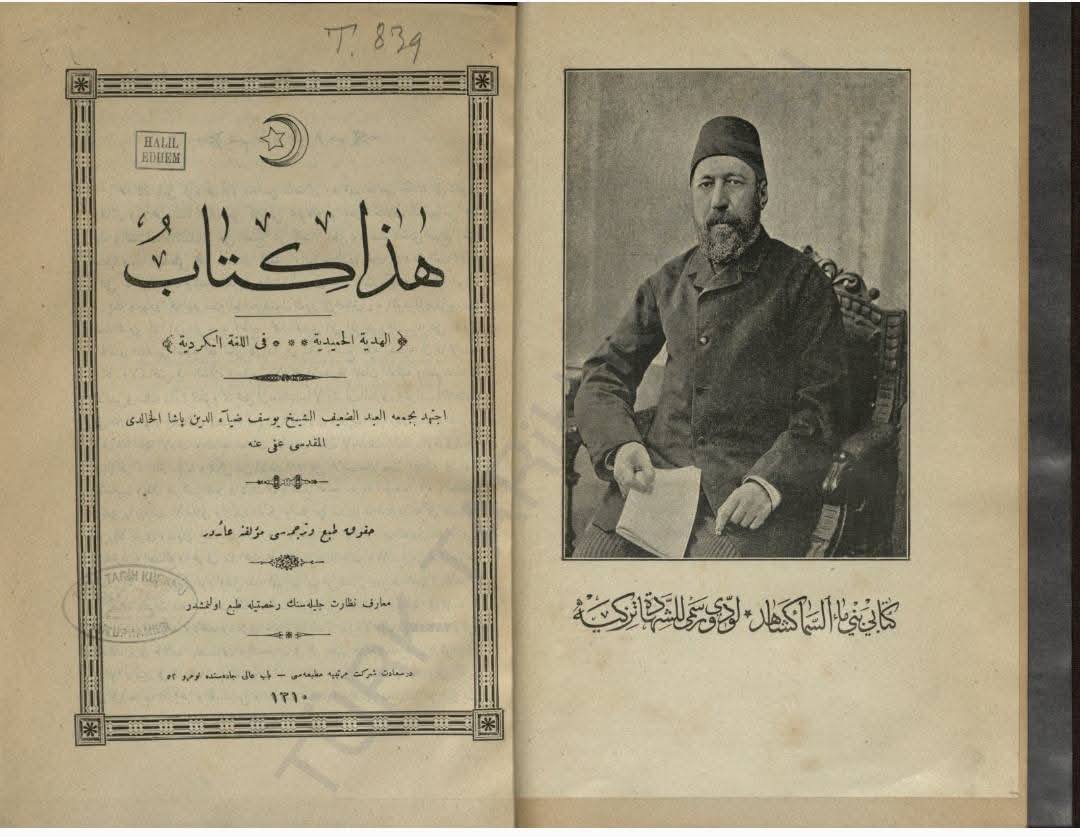
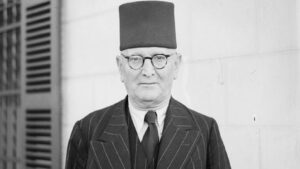
In the 19th century, specifically in 1892 AD (1310 AH), Yusuf Diya al-Din Pasha al-Khalidi al-Maqdisi took the initiative to compile the first Kurdish-Arabic lexicon. He titled it Al-Hadiya al-Hamidiyya fi al-Lugha al-Kurdiyya (The Hamidian Gift in the Kurdish Language) during the reign of the Ottoman Sultan Abdul Hamid II.
Notably, this dictionary resonated within Kurdish cultural circles. Intellectuals wrote poetic eulogies upon the release of its first edition in the Ottoman capital, Istanbul (then known as Al-Astana), indicating its popularity among the elite at the time. Sheikh Abdul Rahman bin Mullah Hussein, the Mufti of the city of Siirt (Is’ard), wrote:
His commendable legacy is now inscribed,
Descended from a master who surpassed the noble.
I mean Diya al-Din Yusuf, by whose arrival,
Difficulties were unraveled and resolved.
A sun whose light was glimpsed in the land of Jerusalem,
Illuminating the regions like blazing torches.
It is our duty to explain the core of his praise,
Every day, at dawn and at dusk.
These verses praising the author appeared in the book Famous Figures of the Kurds and Kurdistan by the historian Muhammad Amin Zaki. In the same book, Zaki attributes other verses to someone he names “Muhammad Amin Zaki Yusuf Diya Effendi bin Sheikh Hassan bin Mustafa, the Mufti of Siirt”—who I believe is the same poet mentioned above. Recording the date of the dictionary’s publication, he says:
The sweetest book of the Kurdish tongues has gathered all,
Exalted in its arrangement and form.
It contains the glorious foundations, leaving nothing behind,
In clarity, whether singular or compound.
When the dictation of ‘Al-Hadiya’ was complete, its date was set:
The son of Al-Khalil, a man of letters, dictated the book.
The second hemistich of the final verse (The son of Al-Khalil, a man of letters, dictated the book) corresponds exactly to the year 1310 AH according to the Abjad (Gematria) numerical system. This is the same year confirmed by Dr. Mohammad Mokri in his introduction to the dictionary, without citing a specific source.
While the Mufti of Siirt praised the author, claiming the dictionary left no word undocumented, the work actually contained many deficiencies. The Maqdisi author placed the letter (ع) (Ayn) before many words of unquestionable Kurdish origin to indicate an Arabic origin, (ت) (T) for Turkish, and (ف) (F) for Persian.
Furthermore, we find that the author labels the Kurds as “savages.” While translating the word Surafik—a type of dye used by Kurdish women to brighten the face—he writes: “Surafik is a medicine used by women on their faces to bring beauty and redness.” He then remarks in surprise: “Even among savages, there is counterfeit civilization!”
It is possible that the author, during his stay in Kurdistan, encountered nomadic Kurdish groups. Bedouins everywhere, as is well known, live far from urban civilization, though this does not mean they lack values or ethics. Perhaps the author’s astonishment stemmed from a general disapproval of women using makeup. This does not mean only nomadic Kurds knew Surafik; the dictionary is a lexicon of the Kurdish language, not just nomadic vocabulary, even if nomadic terms dominate the work. The author repeatedly noted the presence of prominent scholars among the Kurds, some of whom assisted him in compiling his dictionary.
Since the dictionary was written in Arabic script, Yusuf Diya al-Din Pasha al-Khalidi adopted the Arabic alphabet for its organization. Consequently, the reader finds sections (chapters) that are absent in contemporary dictionaries which use the Latin alphabet or a modified Arabic script that excludes purely Arabic letters like Ṣād, Ḍād, Ṭā, Ẓā, ‘Ayn, and Ḥā.
Despite this, the dictionary has preserved authentic Kurdish words that contemporary writers have unfortunately overlooked and failed to use in their writings. The importance of this dictionary lies in the fact that its Maqdisi author was committed to collecting vocabulary and rare terms without adding anything of his own through personal “interpretation” (Ijtihad), as many currently working in Kurdish lexicography do today.
The plague of personal interpretations that has afflicted those tasked with creating dictionaries is a blight that causes great harm to the Kurdish language. These individuals believe they are adding new bricks to the Kurdish linguistic structure, oblivious to the fact that only profound linguists and linguistic academies have the right to innovate linguistic structures or vocabulary to meet society’s needs; such matters should never be left to amateurs.
Finally, it is worth noting that this classic dictionary was first printed in 1975 in Lebanon by Librairie du Liban, a publisher known for dictionaries. It was edited and verified by Dr. Mohammad Mokri, then a professor of French scientific research in Paris. Librairie du Liban reprinted it in 1987. Dr. Mokri wrote an introduction in both English and French, including studies on Kurdish linguistics and the Kurmanji dialect in which the dictionary was written. Regarding the author, Dr. Mokri states: “He is Yusuf Diya al-Din Pasha al-Khalidi al-Maqdisi, from a famous religious family in Palestine. He was a governor in the Motki region of the Kurdish Bitlis province, where he worked on compiling this dictionary.” As Mokri notes, he was proficient in Arabic, Persian, and Turkish, alongside Kurdish.
Note:
The “Media TV” satellite channel broadcast this reading in its Arabic section as part of the program Book Under the Spotlight.
June 2006
Note: This text is translated from the original Arabic version.