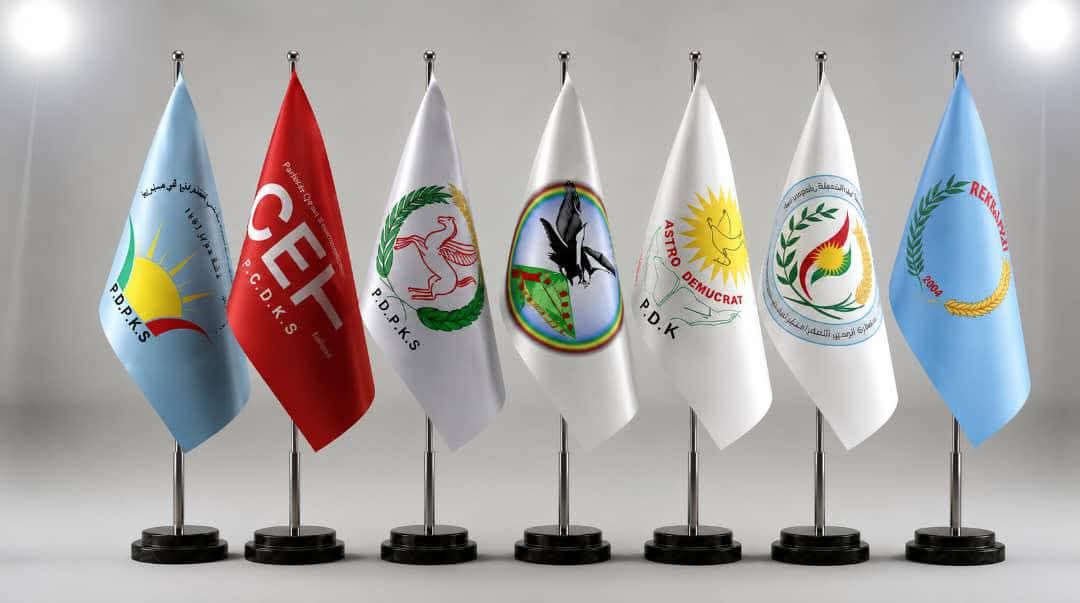
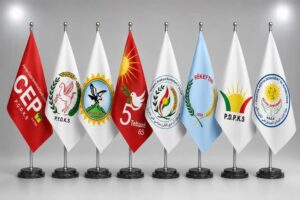
The “Kurdish” Consultative Meeting parties announced that Syria is witnessing “rapid developments” during the transitional phase at both the political and administrative levels. These coincide with procedures and decisions regarding the formation and restructuring of state institutions. The parties noted that the Syrian people are following the nature of these developments and the accompanying policies with concern, as they directly reflect on the future of the country and the principle of national partnership among the various components of the Syrian people.
The statement explained that these measures “did not contribute to improving general conditions” in terms of political, security, economic, service, and living standards. Instead, they “made matters more complex,” which, according to the parties, necessitates a “comprehensive review of the transitional administration’s policies.” This begins with a call for a “comprehensive and inclusive national conference” featuring the participation of all political, national, cultural, and religious components in Syria.
The statement indicated that the proposed conference should result in a committee to draft a “modern constitution” that defines the nature of the country’s governing system. Additionally, it calls for the formation of a transitional government representing various segments of Syrian society, tasked with preparing for and supervising presidential and legislative elections. The new parliament would later take on the responsibility of enacting laws regulating public life “in a spirit of true partnership, away from the mentality of exclusion and marginalization.”
On the Kurdish Issue
Regarding Kurdish affairs, the Consultative Meeting parties noted that despite the January 29 agreement coming into effect, it “continues to face obstacles and problems” in the military and administrative fields. They considered the management of ongoing merger processes in various institutions and administrations to “lack credibility and transparency” and fail to respect the specificity of Kurdish regions. According to the statement, this has contributed to “increased tension and fear for the future among the Kurdish people” and weakened the chances of building a genuine national partnership.
The statement added that the “government’s procrastination regarding the file of prisoners and the lingering delays in their release” has become a priority issue for the Kurdish public and a metric for the government’s seriousness in implementing the agreement.
The parties stressed that the “Kurdish cause cannot be reduced to a post here or an administrative job there.” They considered what they described as the “People’s Council elections” recently held in Al-Hasakah governorate, the Kobani region, and previously in Afrin, to have “lacked all democratic standards.” Furthermore, the principle of seat distribution “did not take into account the demographic proportion of Kurds in Syria or the demographic composition of Al-Hasakah governorate.”
Criticism of Representation and Legitimacy
The parties viewed the process as having been conducted in a “selective manner,” deepening the state of frustration and despair among Kurds due to the “continuation of the policy of marginalization and the denial of their existence as the second-largest nationality in the country.” They emphasized that the results of the Council’s formation “aroused widespread fears among the Kurdish people due to the weakness of their true representation” and the reliance on methods of appointment and selection “far removed from the popular will.”
The statement added that the outcomes of this process are “illegitimate,” and the resulting Council is “illegitimate as it does not represent the will of the Syrian people.”
The parties also considered the participation of some political forces in the electoral process to have “deepened the rift and division within the Kurdish street,” which had pinned high hopes on the outcomes of the April 26, 2025 Conference and the joint Kurdish delegation. They added that the participation of some parties “without consulting the Kurdish parties” contributed to increasing division within Kurdish society.
In a related context, the parties pointed out that the appointment of “one of the sons of the Al-Ghamr villages” to the Council for the Sere Kaniye (Ras al-Ayn) constituency is, according to the statement, “a form of defiance and disregard for the will of the Kurdish people and the inhabitants of the region.” They stated these individuals are “not original inhabitants of the city,” considering this to represent a “continuation of racist policies and the approach of demographic change in Kurdish areas.”
Economic Concerns and National Vision
The parties also criticized what they described as the government’s hiking of fuel prices and the imposition of taxes on goods coming through the Semalka crossing with the Kurdistan Region of Iraq, considering these measures to have “increased the suffering of the governorate’s residents on a living standard level.”
Stemming from their “national and political responsibility,” the Consultative Meeting parties stressed the need to work on strengthening Kurdish dialogue and building a unified political position and a shared vision that expresses the aspirations of the Kurdish people in Syria—free from external interference and narrow partisan calculations. This would contribute to strengthening the Syrian national partnership and building a “decentralized, pluralistic democratic state,” while ensuring the legitimate national rights of the Kurdish people in the country’s constitution and the constitutional recognition of the rights of all Syrian components.
Issued in Qamishlo on May 26, 2026.
Signed by:
Kurdish Democratic Unity Party in Syria (Yekîtî)
Kurdish Democratic Party in Syria (PDK-S)
Kurdish Democratic Left Party in Syria
Kurdistan Azadî Movement in Syria
Syrian Kurdish Democratic Accord Party (Wifaq)
Kurdistan Democratic Peace Party
Kurdish Democratic Progressive Party in Syria
Note: This text is translated from the original Arabic version… Read the Arabic version:Click here