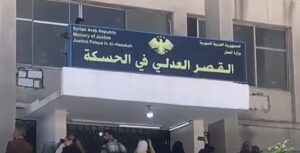
The General Council of the Democratic Union Party (PYD) has asserted that the omission of the Kurdish language from the identification signs of the Judicial Palaces in the cities of Hasakah and Qamishli “is not consistent with the spirit of the agreements” concluded between the Syrian Interim Government and the Syrian Democratic Forces (SDF). The party emphasized that including the Kurdish language in sovereign institutions represents a “genuine reinforcement of Syrian sovereignty.”
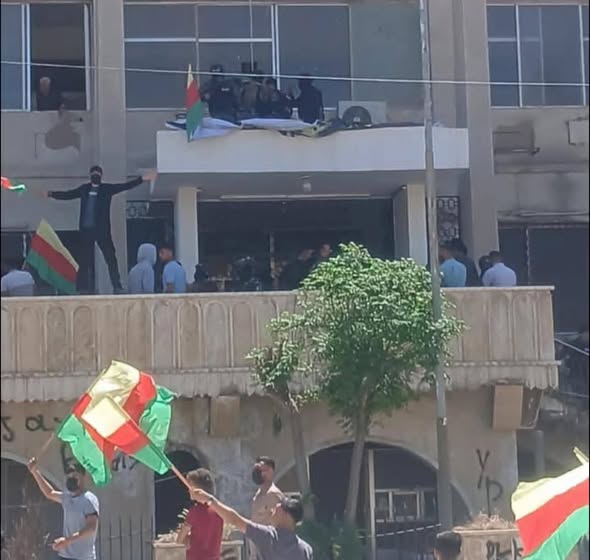
In an official statement, the party noted that it has followed the “positions and reactions” regarding the identification signage displayed at the Judicial Palaces in Hasakah and Qamishli, particularly concerning the exclusion of the Kurdish language from this “important sovereign facility,” not only at the level of Hasakah governorate but across all of Syria.
The statement clarified that the party views the resumption of work in sovereign institutions in Hasakah with “great responsibility and high national evaluation.” It expressed appreciation for the efforts made to facilitate the affairs of Syrian citizens, whether regarding the courts and the Judicial Palace or other institutions that have been activated—or those that will be supported and developed later—”within the framework of previous agreements between the Syrian Interim Government and the Syrian Democratic Forces.”
The statement stressed that the party, “like all Kurdish, Arab, Syriac, and other political forces within the Autonomous Administration,” will not hesitate to support these agreements and work toward their success. It added that the party views Presidential Decree No. 13, pertaining to the Kurdish language and the Nowruz holiday, as an “positive entry point that can be built upon.”
Conversely, the statement pointed out that omitting the Kurdish language from the Judicial Palace identification plaque “is inconsistent with the path of national integration based on a genuine partnership among all Syrians,” in a manner that preserves Syrian sovereignty and the country’s unity.
The statement added that justifying this omission based on the Constitutional Declaration—”despite the positive assessment of some of its articles”—does not negate the need for its “review and the amendment of many of its articles.” It explained that the Declaration “was not given sufficient time and did not express the will of the components of the Syrian people in a balanced and effective manner.” Furthermore, it cited “official statements and positions issued by the Syrian government confirming the necessity of developing and amending it to serve the Syrian national interest.”
The General Council of the PYD affirmed that writing identification signs in the Kurdish language “represents a real reinforcement of Syrian sovereignty and cannot be considered a detraction from it.” It maintained that recognizing Kurdish “as an official Syrian language, and not just a national one,” constitutes a “national step directly linked to strengthening Syrian national sovereignty.”
Additionally, the statement emphasized that the rights of the Kurdish people in Syria must be viewed “as a Syrian national cause,” foremost among them cultural and linguistic rights. It stressed the necessity of establishing and guaranteeing these rights in a “fair and clear” manner within the future Syrian constitution.
The statement concluded by calling upon “all Syrians, not just the government,” to approach the concept of a “national democratic state” based on neutrality toward all national, ethnic, cultural, and religious components in Syria. It urged work toward achieving “supra-constitutional national principles” upon which the foundations of the Syrian social contract and future constitution are built, alongside “criminalizing everything that threatens the unity of Syrian society” and ending the “policies of discrimination and denial” to which Syrians in general, and the Kurdish people in particular, were subjected “at the hands of successive Syrian regimes, especially the defunct regime.”
Note: This text is translated from the original Arabic version… Read the Arabic version:Click here