The agreement signed on January 30, together with the recent clashes in northern and eastern Syria (Rojava), has brought the Kurdish issue back to the forefront of regional and international debate, amid wide controversy over how the developments are characterized—between those who see them as a “setback” and those who view them as a “strategic gain.”
In a comprehensive interview with Nûmedya24, Sipan Hamo, a member of the General Command of the Syrian Democratic Forces, spoke with journalist Dogan Cihan, addressing the background of the agreement, the nature of the previous phase, and the prospects of the coming stage politically and militarily, in addition to military restructuring and the political status of the Kurds in Syria.
Hamo affirmed that the recent war was not a “conventional battlefield confrontation,” but rather “resistance in the face of a comprehensive extermination plan targeting Kurdish existence.” He noted that the agreement enabled, for the first time, recognition of the political and administrative presence of the Kurds in Syria, and represents an indicator of a transition from the phase of military struggle to a political and legal phase.
He explained that the agreement was placed on the agenda on January 18 and signed on January 30, and that work is currently underway to implement its provisions, beginning in Hasakah and continuing in Qamishli. He said, “We see this as an achievement for the Kurdish people,” considering that the plan aimed at eliminating Kurdish gains “was shattered by resistance, popular support, and the signing of this agreement.”
Regarding the characterization of the agreement as either a “surrender” or a “diplomatic success,” Hamo stressed that the Kurdish side has lived through nearly 14 years of intense and continuous war, and that what occurred last month was a “struggle for existence” against a “mentality based on comprehensive extermination.” He added that steadfastness and resistance in areas such as Sheikh Maqsoud, Tishrin Dam, and Hasakah altered the calculations of the attacking forces and produced a new level of balance, despite the persistence of risks.
Commenting on a statement by the Commander-in-Chief of the Syrian Democratic Forces, Mazloum Abdi—who said after the agreement in an interview on Ronahî TV, “This is not the outcome I had dreamed of”—Hamo acknowledged the existence of mistakes, confirming that the Syrian Democratic Forces are conducting a comprehensive assessment of the results of this phase. At the same time, he emphasized that “the Kurds are now living in Syria as citizens with their own identity and distinct existence,” and that “in the Kurdish regions, our people will live with their own selfhood and self-rule, and they will govern themselves.”
He noted that the Kurds will represent themselves in official Syrian institutions within a quota-based system, considering that these outcomes do not mark the end of the struggle, but rather an opportunity to strengthen the path of freedom and democracy.
With regard to the next phase, Hamo explained that the primary objective is “the free existence of the Kurds, the protection of their identity, and their political status,” alongside the demand for democracy and equality for Syria as a whole. He pointed out that the absence of constitutional amendments so far does not negate the adoption of tangible steps, affirming entry into a phase of strengthening legal struggle and drafting a new basic constitution.
Hamo admitted that the Syrian Democratic Forces “did not succeed sufficiently in the Arab regions,” explaining that over ten years the focus was placed on organizing Kurdish society, without exerting the same effort in Arab areas, particularly in Raqqa, where the battle was “social and political” as well as military. He stressed that this necessitates open self-criticism, without placing blame on Arab society.
Regarding criticism directed at the leadership, Hamo said that the Kurdish people have the right to hold the leadership accountable, but without turning this into “political liquidation.” He considered that the Kurdish issue in Syria reaching a central position globally is the result of the sacrifices of thousands of martyrs from all parts of Kurdistan.
He also rejected describing the positions of some Arab tribes as “betrayal,” affirming that shifting interests explain changing positions, and that history will record that the status achieved by the Kurds in Syria came about through the resistance of the fighters.
Concerning the January 30 agreement, Hamo stressed that it “is not the end of the road,” but rather a new beginning, amid ongoing dangers. He considered that the agreement imposed recognition of Kurdish identity and elevated the level of Kurdish national unity, describing these as “sacred” gains.
He noted that the agreement was concluded under the supervision of international and regional powers, but stressed that “the real guarantee is the continuation of our struggle, not reliance on promises,” affirming the transition from a “war of existence” to a “battle to consolidate the political status of the Kurds in Syria and the world.”
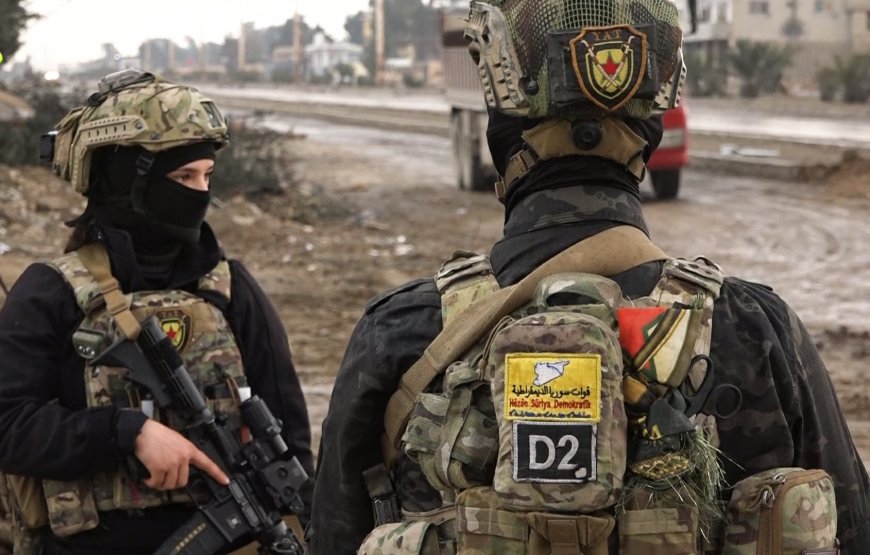
Regarding military and security restructuring, Hamo explained that the agreement has so far addressed only the military and security aspects, stipulating the organization of forces in the Kurdish regions into four brigades in Derik, Qamishli, Hasakah, and Kobani. The three Jazira brigades will be combined into a single division, while the Kobani brigade will be Kurdish-administered and administratively affiliated with Aleppo Governorate. He confirmed that forces will not remain inside city centers, and that 90% of the forces will be Kurdish and 10% Syriac and Arab.
As for internal security (Asayish), he indicated that the Governor of Hasakah will be appointed by the Syrian Democratic Forces, while the Director of Security will be appointed by Damascus, and that district administrators and security centers in Hasakah, Qamishli, and Derik will be appointed by the Syrian Democratic Forces—meaning that internal security in the Kurdish regions will be in their hands.
He also explained that the Deputy Minister of Defense will be appointed by the Syrian Democratic Forces, in addition to appointing a representative in the Ministry of Interior, with the same system to be applied in Kobani, and future efforts to apply this model in Afrin and Sere Kaniye after the return of the displaced.
Hamo concluded by noting that the second phase of the agreement includes official recognition of the Kurdish language and recognition of school and university certificates in Rojava, stressing the need for vigilance in the face of attempts to obstruct implementation, and emphasizing that what has been achieved represents “only the first phase” in a long path of struggle.
Read the Arabic version: Click here