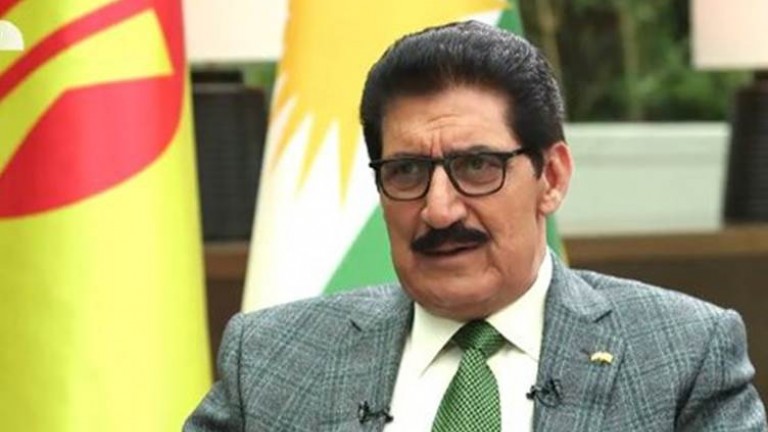
Fazil Mirani | Head of the Executive Body of the Political Bureau of the Kurdistan Democratic Party
No war occurs without outcomes, just as no war occurs without causes. Outcomes are not always comfortable, and the causes of war are not always explicit.
The central axis of every war is interest. Interests are both a constant element and a changing factor that accompanies every matter connected to a particular interest.
Systems rarely adhere to governing laws during war. Factors of power, superiority, and the ambition to achieve objectives may overshadow legal or humanitarian constraints that would otherwise regulate the voice of weapons and the targets of their fire.
Relations between the United States and Iran have been governed by decades of tension since the departure of Mohammad Reza Pahlavi from Tehran in December 1979. The old alliance subsequently turned into a hostility that has rarely been calm, yet it did not reach an official military confrontation until recently. Despite numerous security operations carried out against one another, and their presence in proxy confrontations in both hot and relatively calm regions, the thunder of bombs did not strike until decades later.
Iran, which moved to build defensive positions for itself politically and militarily, was met with counter-planning by its adversaries, through confrontation with its extensions and the establishment of networks around it.
Iran’s influential geographical position is one of the primary sources of suspicion within the international system, driven by the question of who governs it. This is neither a secret nor a biased claim. We have long been, and remain, before equations that materialize and provide competing powers with gains while also imposing losses upon them. In politics and in defining its programs, there is little room for error; if an error occurs, the price is determined according to what the victor imposes.
Even when taking into account the social factors related to the nature of the peoples of the region and understanding their value systems, war ultimately yields outcomes shaped by its tools—military science, security efforts, and the availability of the costs required to support the achievement of objectives.
There is a significant disparity in the perspectives of the two sides of the conflict—this is an accepted fact. Likewise, there is disparity in motivations, explanations, justifications, and even in the mutual descriptions exchanged between the parties to this war. Although factors of difference may, in some circumstances, become factors of rapprochement, in conflict they become essential material for attacking the opponent. Ethnicity, creed, political project, the nature of the system, its goals and history—these are fundamental elements and powerful propaganda material within the equations of conflicts and wars.
Iran is an influential state in the region, and its influence will not easily fade. The United States leads the strongest pole in international decision-making, and Israel as well. One can imagine the implications of these states entering into direct collision, and the immediate and future effects on them and on the region that has become a battlefield. The repercussions will affect every aspect of the lives of the peoples of our region.
The economic and geographic interdependence, as well as the vital and political spheres within a region where two spheres of influence are competing, require extremely precise wisdom in calculating the rates of continuity and safety. Systems are always tested in preserving their structure—formed by their peoples and the interests of their security and economies—and such wisdom rarely appears when it is most needed.
Just as it is essential for the success of any system to present an alternative if its place becomes vacant, it is even more important for every system to understand, objectively, the foundations of its own strength and to understand the strength of its adversary. Above all, it must understand the reasons, the cost, and the consequences of conflict.