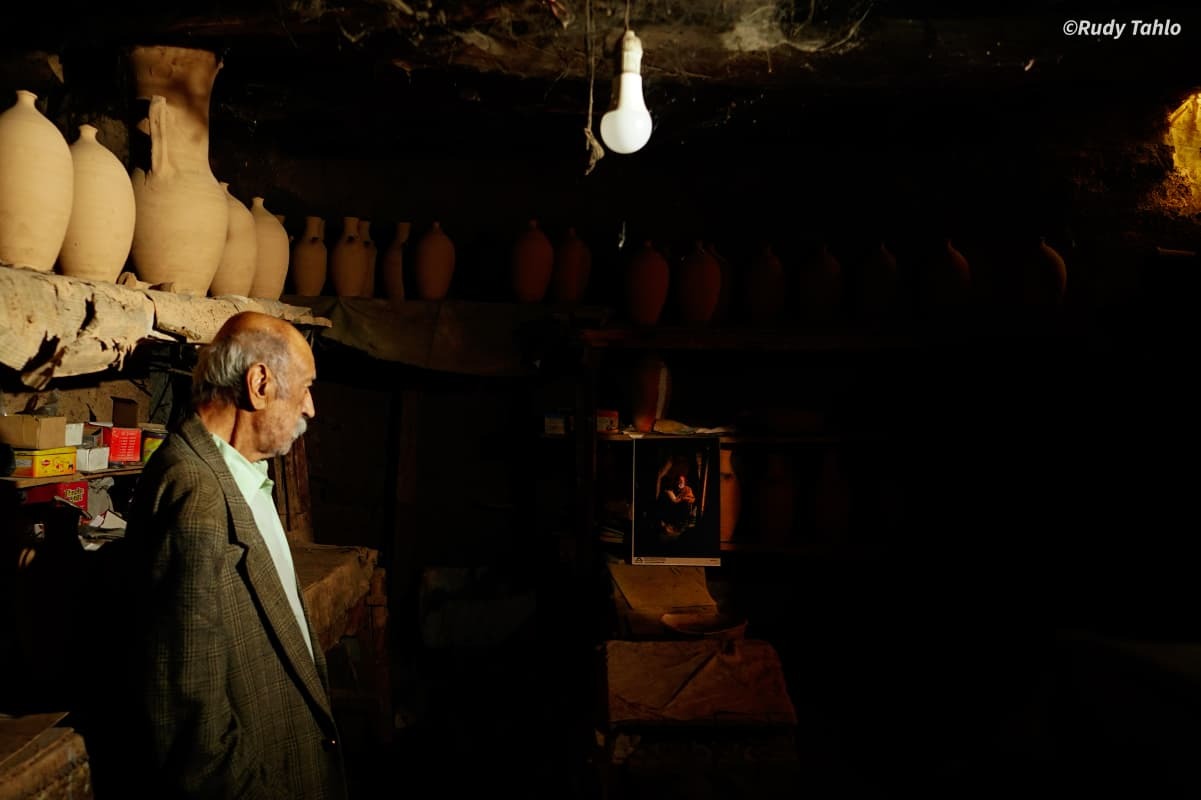
In cities contested by geography and politics, traditional crafts remain more steadfast than the maps themselves. There, in Qamishlo, where languages neighbor one another just as the alleys do, lived a man who was not merely a potter, but a living witness to centuries of memory shaped from clay.
Misak Antranik Bedros, who passed away in May 2026 at the age of 88, was not a craftsman in the traditional sense; rather, he was a walking cultural institution, carrying in his hands a family history spanning nearly 450 years.
A Legacy Not Inherited Through Words
Misak Bedros was born into an Armenian environment that carried the memories of displacement and resettlement. For him, the craft was not so much a professional choice as it was a family destiny. At an early age, he learned how to “listen” to the clay, not just how to shape it. Pottery, as he often repeated, is not a material to be subjugated, but a living being that requires patience and respect.
This legacy extended through generations of his family, where the workshop was not just a place of labor, but a space for daily rituals: kneading the clay, spinning the wheel, and monitoring the fire in the kilns. These were rituals that carried an almost spiritual dimension. In this context, it was not surprising that Bedros spent 67 years of his life in this craft, as if guarding a flame that must never be extinguished.
Qamishlo: A City Formed Like Pottery
In the experience of Misak Antranik Bedros, Qamishlo was not merely a place of residence; it was part of the formation itself. The city, with its ethnic and religious diversity—from Armenians to Kurds, Arabs, and Syriacs—offered him a human material parallel to the clay he kneaded. Every piece of pottery he created indirectly bore this cultural intersection. He used to say that pottery resembles the city: “If you do not handle its components well, it will crack at the first test.” This comparison was not just a metaphor, but the summation of an experience lived in a pluralistic environment, where balance is not a luxury, but an existential necessity.
Between Craft and Archaeology: A Memory Reclaimed
What distinguishes Misak Bedros’s experience from many other craftsmen is his close connection with archaeological missions he worked with across Syria. His role was not only technical but also intellectual. He contributed to interpreting ancient pottery shards, understanding their manufacturing methods, and even reproducing some using traditional techniques.
In this meeting point between craft and archaeology, Bedros transformed into a living bridge between the past and the present. He saw in every artifact a message from an anonymous maker who lived thousands of years ago, and he attempted to “respond” through his own work. This relationship with time turned his workshop into something of a historical laboratory, where it was not just the form being reproduced, but the soul as well.
Pottery as an Act of Resistance
In the context of a region that has undergone profound political and social shifts, Misak Bedros’s journey can be read as an act of silent resistance. Preserving a traditional craft in an era of rapid industrialization is not merely a clinging to the past, but a clear cultural stance.
It was not easy to persevere in this craft amidst declining demand, the absence of institutional support, and the shift in tastes toward industrial products. Nevertheless, he chose to stay. He never compromised on the quality of his work, nor did he attempt to “modernize” the craft in a way that would strip it of its spirit. He believed that the true value of pottery lies in its slowness—in being the antithesis of a world of rapid consumption.
The Human Before the Craftsman
Despite all the above, the human side of Misak Bedros’s personality remains the most impactful. He was not isolated in his workshop but was open to people, teaching anyone who wished to learn, explaining with patience, and welcoming visitors as if they were family. Many of Qamishlo’s youth were introduced to pottery through him, even if they did not pursue it professionally.
He realized that the craft might not continue in the same form, but he was keen on passing down the “idea” rather than just the “technique”: the idea of patience, precision, and deep respect for the material and the work.
The Departure of the Body, the Endurance of the Impact
With the passing of Misak Antranik Bedros, the region loses one of the last witnesses to traditional craftsmanship in its authentic form. However, the real question lies not in his absence, but in what remains. Will this craft continue? Is there someone who will carry the flame with the same faith?
Perhaps the answer is not clear now, but what is certain is that what Misak Bedros left behind is not just pottery vessels, but a living archive of human experience. Every piece he made bears his fingerprint—not just as a maker, but as a human being who lived between clay and history, succeeding in making his work a language that transcends time.
A City of Many Names… and One Memory
In a city that every people calls by the name they love—Qamishlo, Al-Qamishli, or any other designation—the deepest truth remains that memory is indivisible. Misak Antranik Bedros, Armenian by origin, Syrian by belonging, and Qamishlawi in spirit, was a living embodiment of this idea.
He was not concerned with names as much as he was with the stories they carried. Perhaps this is the most important lesson he leaves us: that identity, like pottery, is not made from a single element, but from a delicate balance between multiple components. And if we shape it well, it will endure… even after its maker is gone.
Ronahi Newspaper
Note: This text is translated from the original Arabic version.