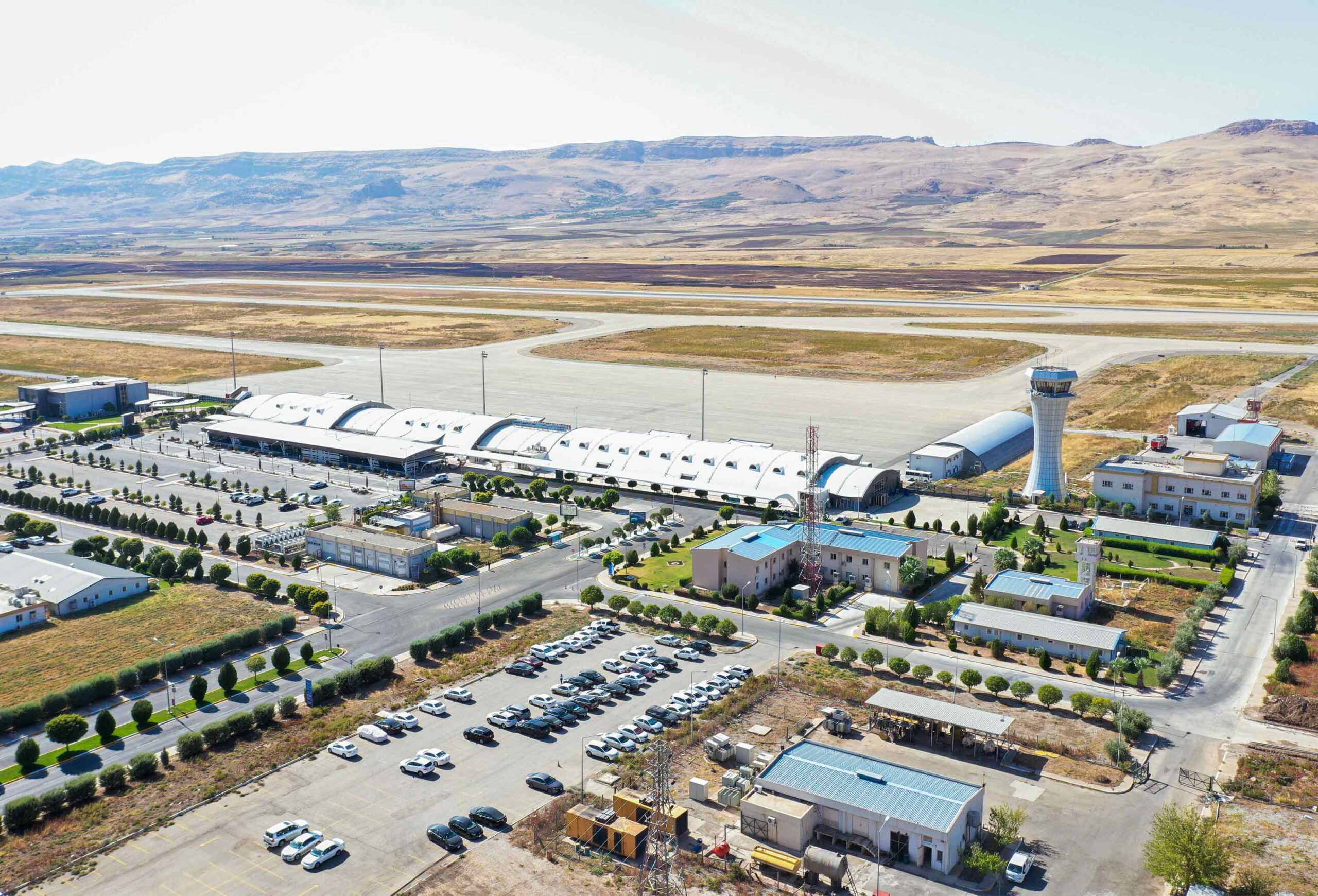
Sulaimaniyah International Airport in the Kurdistan Region suspended two flights to Istanbul and the Jordanian capital, Amman, on Saturday morning. The suspension follows security tensions witnessed in the cities of Sulaimaniyah and Erbil last night. Meanwhile, the remaining scheduled flights at the airport resumed, coinciding with assurances from the Erbil International Airport administration that air traffic continues to operate normally.
An official source at Sulaimaniyah Airport told Shafaq News Agency that the airport management halted two flights scheduled for this morning—the first to Istanbul and the second to Amman—due to the recent security situation in Sulaimaniyah Governorate and the tensions that also affected the city of Erbil. The source added that the remaining scheduled flights resumed later, and air traffic continued normally after the suspension of only those two flights.
Conversely, the Erbil International Airport administration confirmed that flights to and from the airport are continuing without disruption. The airport’s director, Ahmed Hoshyar, told Shafaq News Agency that flights remain open and have not been suspended, following reports circulating about a halt in air traffic due to security developments.
These measures coincided with an announcement by the Forest and Environment Police Directorate in Sulaimaniyah Governorate that three large fires in the areas of Arbat, Qaradagh, and Aghjalar had been brought under control. The directorate confirmed that one of the fires was caused by a missile strike, while the other two resulted from agricultural harvesting activities, causing extensive damage to vegetation and natural forests.
In a statement, the directorate explained that the fires witnessed in the areas of Qaradagh, Zargwezlah, and Aghjalar over the past few days up until today caused significant losses to the environment and biodiversity, and harmed wildlife. The statement noted that the first fire broke out within the boundaries of Zargwez and Zargwezlah villages, which belong to the Arbat sub-district, as a result of a missile strike. This led to the burning of approximately 500 dunams of pastureland and grass, and damaged parts of the natural forests—particularly oak trees—before specialized teams managed to extinguish it completely.
The directorate added that the fire spread toward the boundaries of Qaradagh district across Swara Mountain and within the Gllazard mountain range. Forest and environment police detachments, in cooperation with civil defense and local residents, managed to fully control the fire by 6:00 PM. Preliminary estimates indicate that about 150 dunams of natural forests and pastures were burned in the Qaradagh area, while relevant authorities continue their damage assessment operations.
In the Aghjalar sub-district, two fires broke out within the boundaries of Maylah and Kani Hanjira villages as a result of harvesting activities using a combine harvester. Forest police and civil defense teams managed to control both blazes. Preliminary estimates showed that approximately 120 dunams of pastures, grass, and agricultural crops were burned.
On Friday evening, residents of several neighborhoods in the city of Sulaimaniyah reported hearing a loud explosion, prompts security and specialized authorities to launch investigations to determine its source and circumstances.
These attacks followed renewed U.S. strikes on Iran, which targeted bridges, military and logistical facilities, and sites in the southern part of the country.
On Friday, Sulaimaniyah and Erbil witnessed a series of missile and drone attacks, which included the targeting of a weapons and ammunition depot in Tasluja and the bombardment of sites belonging to the Iranian Kurdish opposition, resulting in the martyrdom of nine Peshmerga forces from the Komala Party.
Note: This text is translated from the original Arabic version… Read the Arabic version:Click here