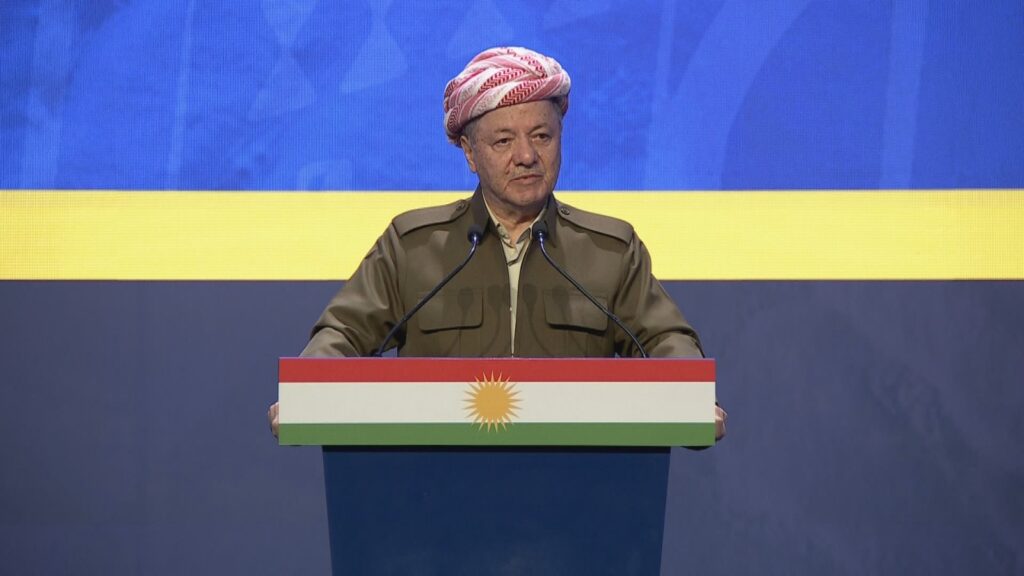
The Peoples’ Equality and Democracy Party shared a new message from Abdullah Öcalan, the leader of the Kurdistan Workers’ Party (PKK), during a press conference held in Ankara. The message was released on the occasion of the first anniversary of the “Peace and Democratic Society” call that he issued on February 27, 2025.
The statement, translated from Firat News Agency (ANF), indicated that Öcalan affirmed in his message that the February 27, 2025 call “is a declaration that weapons lose their meaning wherever democratic politics is practiced.” He described it as “a clear statement of the preference for politics and the continuation of principles,” explaining that the movement “has fundamentally moved beyond the stage of passive uprising,” and that the process has demonstrated its capacity to negotiate and open the way for a transition “from a policy of violence and division to a democratic policy based on integration.”
Öcalan added, according to the statement, that the movement’s decisions to dissolve itself and end the strategy of armed struggle represent “an official and practical rejection of violence” and an internal shift toward the political path, considering that they also constitute “a declaration of intellectual reconciliation with the republic.”
Öcalan also pointed to what he described as the importance of political will in the process, stating: “I see the will of Mr. Recep Tayyip Erdoğan, the call of Mr. Devlet Bahçeli, and the contribution of Mr. Özgür Özel, along with the efforts of all political, social, and civil individuals and institutions that participated positively in the process over the past year as extremely important.”
In his message, he explained that the relationship between Turks and Kurds “has an authentic historical character,” noting that the February 27 call represents an attempt to revive the spirit of unity and demand a democratic republic. Its goal, he said, is “to break the mechanism of bloodshed and conflict” and to open discussion on building a shared life.
Öcalan stressed the necessity of moving “from the negative phase to a phase of positive construction,” considering that the path is now open for a new political strategy aimed at ending violence-based politics and opening a trajectory grounded in democratic society and the rule of law. He called on all components of society to assume responsibility and create opportunities for this transformation.
He also affirmed that democratic integration requires a legal, political, economic, and cultural system, noting that many of the current crises stem from the absence of democratic law. He emphasized the need for “an approach that opens space for democracy and builds strong legal guarantees for it.”
In his message, Öcalan called for a concept of citizenship based on connection to the state rather than ethnic affiliation, stressing the need to guarantee freedom of religion, nationality, and opinion, so that “religion or language should not be imposed, nor should nationality be imposed.”
He also stressed that democracy represents the foundation of any intellectual system in the current era, and that the call seeks to find solutions not only in Turkey but also in the Middle East to the problem of coexistence.
In the conclusion of the message, he pointed to the role of women as “one of the most important leading social forces,” considering that domestic violence and the killing of women represent an extension of a historical assault on women. He added that women constitute “the force most aspiring to freedom and the driving force for democratic integration,” affirming that achieving these goals requires “a shared mind that respects the other.”
Öcalan message translated by the Firat News Agency included the following:
“Our call on February 27, 2025, is a declaration that where democratic politics comes to life, weapons lose their meaning; it is a proclamation that the choice has been clearly made in favor of politics, representing an integrity of principles. We have essentially managed to overcome the negative period of rebellion through unilateral will and practice. The process we have left behind has proven our negotiating capability and our strength to ensure the transition from the politics of violence and polarization to democratic politics and integration. Our calls, conferences, and congresses were directed toward this goal. The organization’s decisions to dissolve and put an end to the armed struggle strategy have demonstrated a purification from violence and a preference for politics not only officially and practically, but also mentally. This was, at the same time, a declaration of making peace with the republic at the level of political consciousness.
Over the past year, I have found the will of Mr. Recep Tayyip Erdoğan, the call of Mr. Devlet Bahçeli, the contribution of Mr. Özgür Özel, and the efforts of all other political, social, and civil individuals and institutions who have made positive contributions to the Process in Türkiye highly valuable. And I once again commemorate our friend Sırrı Süreyya Önder with great respect and longing.
There can be no Turk without a Kurd, and no Kurd without a Turk. The dialectic of this relationship has a historical uniqueness. The foundational texts during the establishment of the Republic expressed the unity of Turks and Kurds. Our February 27 call is an attempt to revive this spirit of unity and a demand for a Democratic Republic. We aimed to break the mechanism that feeds on bloodshed and conflict. Acting according to narrow, short-term political interests, rather than seeing the historical nature of the problem, its gravity, and the risks it may produce, weakens us all. Attempting to perpetuate denial and rebellion is an attempt to make the greatest irregularity the rule. We are removing the obstacles before the brotherhood that has been sought to be reversed over the last two hundred years, and we are fulfilling the requirements of the law of fraternity. We want to discuss how to come together and how to live together.
Now we must transition from the negative phase to the positive phase of construction. The door is opening to a new political era and strategy. We aim to close the era of politics based on violence and to open a process based on a democratic society and the rule of law, and we invite all segments of society to create opportunities and take responsibility in this direction.
Democratic society, democratic consensus, and integration are the building blocks of the mindset of this positive era. The positive phase excludes methods of struggle based on force and violence. In positive construction, the goal is not to seize any institution or structure, but for every individual in society to attain the responsibility to take part in social construction. The aim is to build together with the society and within the society. Oppressed segments, ethnic groups, religious, and cultural groups can claim their own creations through an uninterrupted and organized democratic struggle. It is important for the state to be sensitive to democratic transformation during this process.
Democratic integration is at least as important as the foundation of the Republic. It is a call that contains as much existence and wealth in terms of meaning, future, and power. At its core is the democratic society model. It is the alternative to polarizing or, conversely, assimilationist methods. The transition to democratic integration necessitates laws of peace. The democratic society solution, on the other hand, envisions the establishment of an architecture and a legal framework in political, social, economic, and cultural dimensions.
The cause of many problems and crises experienced today is the absence of a democratic rule of law. We base our approach on a legal solution framed by democratic politics. We need an approach that will allow space for a democratic society, allow space for democracy, and establish strong legal guarantees for this.
The citizenship relationship should be founded not on belonging to a nation, but on the bond with the state. We advocate for free citizenship grounded in being free in one’s religion, nationality, and thought. Just as religion and language cannot be imposed, neither should nationality. A constitutional citizenship relationship, based on democratic boundaries and the integrity of the state, encompasses the right to freely express religious, ideological, the identity, and national existence, and the right to organize.
Today, no system of thought can survive without basing itself on democracy. Fluctuations, tensions, and crises are temporary; democracy is what will eventually be permanent. Our call aims to find a solution to the problem of living together and the state of crisis it produces, not only in Türkiye but in the Middle East. We defend the rights of all those who have suffered injustice to exist and freely express themselves.
Women are at the forefront of the social forces without which no society or state can sustain itself. Today, domestic violence, femicides, and patriarchal oppression are all modern projections of the historical attack that began with the enslavement of women. For this reason, women are the most libertarian component and the driving force of democratic integration.
The language of the era cannot be a dictatorial and authoritarian one. We must fundamentally allow the other party to express themselves correctly, listen to them accurately, and give them the opportunity to express their own truths.
The realization of all these matters requires advanced collective wisdom based on mutual respect.
With my greetings and regards,
Abdullah Öcalan”
Read the Arabic version: Click here