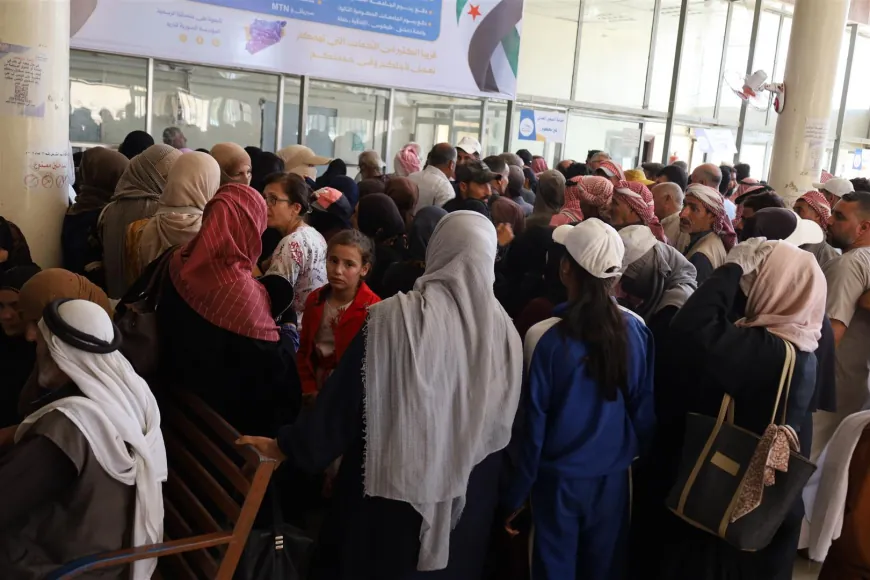
Currency exchange centers in Hasakah Governorate are witnessing increasing congestion as the deadline set by the Central Bank of Syria to replace old Syrian banknotes with the new issuance approaches on July 30, 2026. This comes amid calls to increase the number of exchange centers and extend the deadline to prevent thousands of citizens from being deprived of exchanging their savings.
On July 23, the Central Bank of Syria urged citizens to exchange old currency during the remaining days of the set period and not to delay the process to the last minute, emphasizing that authorized centers continue to receive replacement requests. It also urged citizens to follow information through official channels and not be led by rumors, amid the circulation of unconfirmed reports regarding a potential extension of the deadline. Crowds in Hasakah and a single service center
In the city of Hasakah, dozens of citizens flock daily to the post office—the only center designated for currency exchange in the governorate—resulting in long queues and wait times stretching for hours, alongside complaints about slow procedures and poor organization.
Abdul Masih Assio, a citizen waiting in the exchange lines, told the Kurdish Hawar News Agency: "I came to the exchange center as soon as the decision to exchange currency was issued, and I have been waiting for my turn since yesterday."
He added: "I came today as well to register my name, and the employee informed me that my turn would be after more than a hundred people, but without specifying a time. With the deadline approaching, we do not know how all citizens will be able to exchange their money, which they collected after years of work."
Assio demanded the opening of additional banks and exchange centers, stressing that a single center is not enough to serve the residents of Hasakah and the rest of the Jezireh region, and that slow procedures are hindering the completion of transactions. He also pointed out poor organization in registering names and incomplete data entry, causing confusion among citizens regarding their turns, alongside crowdedness and chaos inside the exchange hall.
He explained that conditions in Hasakah differ from other governorates, as citizens were not given the same timeframe as other regions to exchange currency, calling for an extension of the deadline or an expansion of exchange centers to speed up the process. End of circulation on July 30
The Central Bank of Syria confirmed that the deadline for replacing old banknotes ends on July 30, 2026, noting that the replacement process has achieved an "advanced completion rate."
The bank explained that starting July 31, 2026, old banknotes will lose their legal tender status and will no longer be legally valid for circulation or conducting any financial transactions.
Conversely, it confirmed that banknote replacement will remain available for five years starting July 31, exclusively through the Central Bank of Syria in Damascus, provided that the number of banknotes submitted for replacement is not fewer than 100 notes of a single denomination. Requests involving fewer than this number will not be accepted. Growing rejection of old currency
As the deadline draws near, citizens in several governorates reported an increasing refusal by shopkeepers and transportation operators to accept old banknotes, despite their continued legal validity until the end of the deadline. This has caused growing difficulties in daily transactions.
Nawar Daban, a young man from Hama, said he tried to buy basic supplies using old 5,000-pound banknotes, but three consecutive shops refused to accept them, forcing him to search for someone to exchange them for him.
Bushra Sulaiman also mentioned that she faced refusal from some public transport drivers to accept fares in old banknotes and had to exchange the money with the help of a passerby to continue her trip.
For his part, citizen Ali Sijri called for an additional grace period to withdraw remaining old banknotes, considering that the shortage of small new denominations, particularly the 500 and 1,000-pound notes, increases the difficulty of completing daily transactions, especially low-value purchases. Brokers exploit the crisis
Coinciding with the currency exchange crisis, a new phenomenon has emerged: the activity of brokers exploiting limited exchange options and the refusal of some merchants to deal in old banknotes, imposing high commission fees to exchange them for new banknotes.
This reality has increased pressure on citizens, many of whom find themselves forced to resort to informal means to obtain the new currency amid an ongoing shortage of small monetary denominations and the restriction of the exchange process in some governorates, such as Hasakah, to a single center.
The Central Bank of Syria continues to implement the currency exchange plan, which it stated aims to end the circulation of old banknotes and fully adopt the new issuance in financial transactions within the country. Meanwhile, citizens demand an extension of the circulation deadline for an additional month to ease congestion and ensure the completion of exchange operations without impacting buying and selling activity.
Note: This text is translated from the original Arabic version. Read the Arabic version:Click here