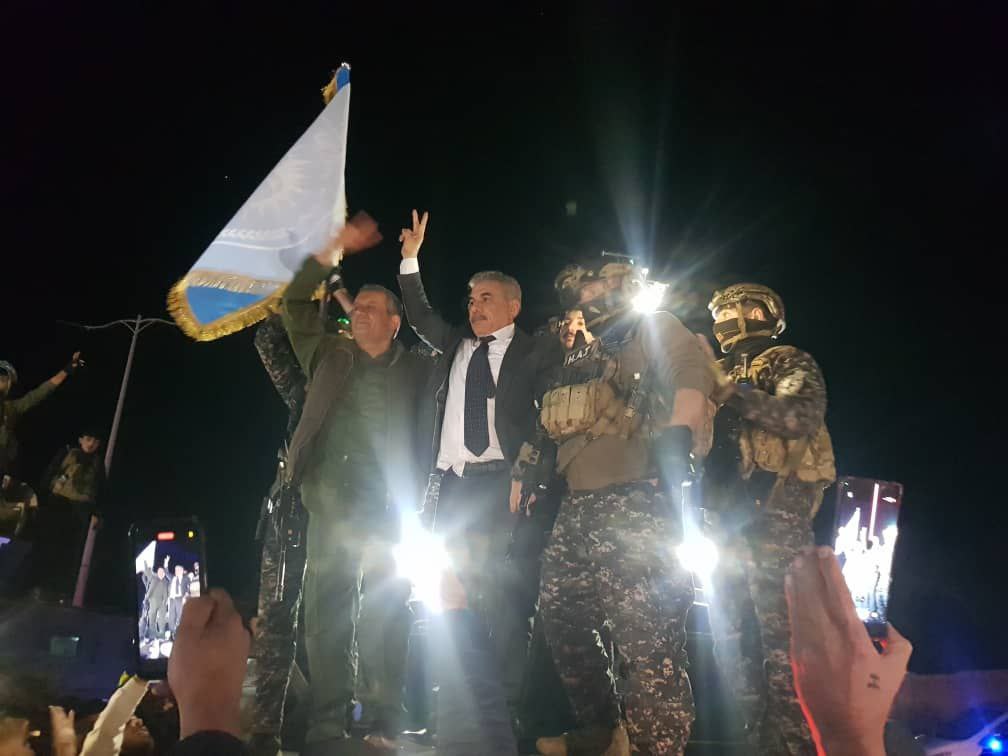
Berlin — Jian Omar, a member of the Berlin State Parliament, announced that the parliamentary group of Alliance 90/The Greens submitted an official and urgent motion late last night during a session of the Berlin State Parliament expressing solidarity with Rojava (Syrian Kurdistan).
According to Omar, the Greens parliamentary group called on the Berlin Senate to urge the German federal government to intervene to protect the Kurdish people and religious minorities in Rojava and across Syria. The motion also calls for the protection of demonstrations and activities organized by these communities in Berlin and Germany, noting that such events have been subjected to attacks by jihadist groups affiliated with the interim authority in Damascus.
The motion further demands granting residency rights in Germany to Kurds, Druze, and Alawites and halting their deportation to Syria, where they face violations, repression, and targeted killings.
Omar stated that all parliamentary groups supported treating the motion as urgent. The draft resolution was published on the official website of the Berlin State Parliament.
Urgent Motion
Submitted by the Parliamentary Group of Alliance 90/The Greens for the Adoption of a Resolution
Solidarity with Rojava (Syrian Kurdistan) – Protection of Minorities and Civilian Population
The Berlin State Parliament resolves as follows:
The Berlin Senate is requested to:
Systematically use the legal powers available to the State of Berlin under residence law in favor of those in need of protection from Rojava, as well as members of religious and ethnic minorities throughout Syria, in particular by granting humanitarian residence permits and refraining from deportation measures during ongoing review procedures.
Work in cooperation with the Berlin Police and security authorities to protect and secure assemblies, demonstrations, and events organized by Kurds, Yazidis, Druze, Alawites, and Syrian opposition members in Berlin, ensuring the constitutional right to freedom of assembly without intimidation or obstruction.
Take firm action against threats, hate crimes, hate-inciting content, and the spread of jihadist ideologies, especially when directed against refugees, minorities, or political activists. Criminal acts must be prosecuted, prevented, and precautionary measures taken where necessary.
Conduct a current security assessment regarding potential espionage, intimidation, or influence activities by official or semi-official Syrian actors, as well as extremist networks in Berlin, and take appropriate protective and preventive measures to counter transnational repression against residents in Berlin.
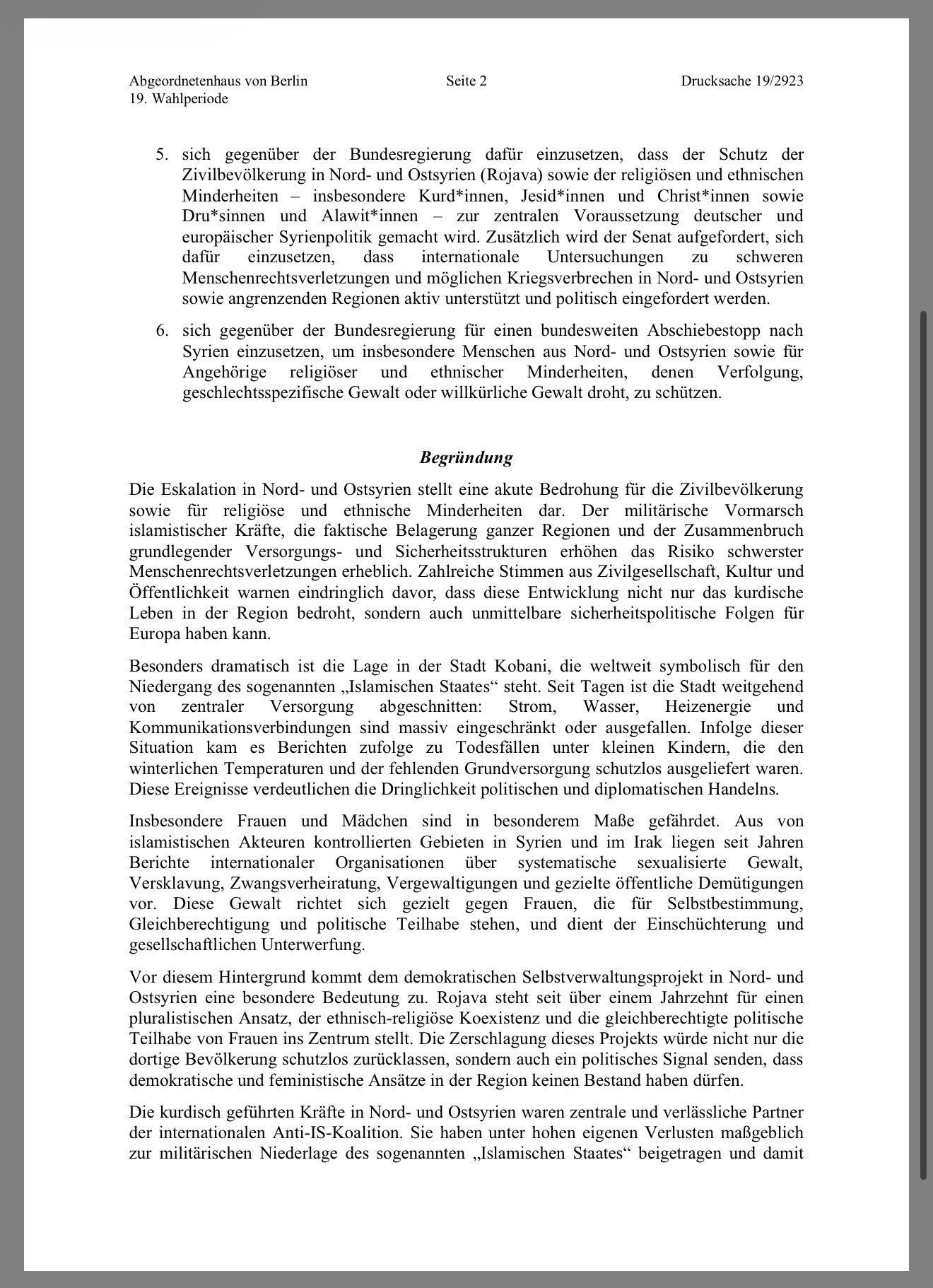
Advocate at the federal government level to make the protection of the civilian population in North and East Syria (Rojava), as well as the protection of religious and ethnic minorities—particularly Kurds, Yazidis, Christians, Druze, and Alawites—a central condition of German and European policy toward Syria. The Berlin Senate is also requested to support and politically demand international investigations into serious human rights violations and potential war crimes in North and East Syria and neighboring areas.
Urge the federal government to impose a comprehensive halt to deportations to Syria, particularly to protect individuals from North and East Syria and members of religious and ethnic minorities who face the risk of persecution, gender-based violence, or arbitrary violence.
Statement of Reasons
The escalation in Rojava (Syrian Kurdistan) in North and East Syria poses an acute threat to the civilian population and to religious and ethnic minorities. Military attacks by Islamist factions, the effective siege of entire Kurdish areas, and the collapse of essential supply and security infrastructures have significantly increased the risk of serious human rights violations. Numerous civil society organizations have urgently warned that these developments not only endanger lives in the region but may also have direct security repercussions for Europe.
The situation in the city of Kobani is described as particularly critical. The city, which became a global symbol of the defeat of the so-called “ISIS,” has in recent days suffered extensive disruptions to essential supplies, including electricity, water, heating, and food, as well as communication networks. Reports have indicated deaths among young children due to winter temperatures and the lack of basic supplies.
Women and girls face especially severe risks. For years, international organizations have documented systematic sexual violence, enslavement, forced marriage, rape, and public humiliation in areas controlled by Islamist actors in Syria and Iraq. This violence particularly targets women advocating for self-determination, equality, and political participation.
The experience of the Democratic Autonomous Administration in North and East Syria is highlighted as particularly significant, having represented for more than a decade a model of pluralism, coexistence among religions and ethnicities, and equal political participation for women. The destruction of this project is described as leaving local populations unprotected and sending a dangerous political signal against democratic and feminist models in the region.
Kurdish-led forces in North and East Syria are described as having been a key and reliable partner of the international coalition against ISIS, contributing decisively to its military defeat at great human cost and thereby making a substantial contribution to Europe’s security.
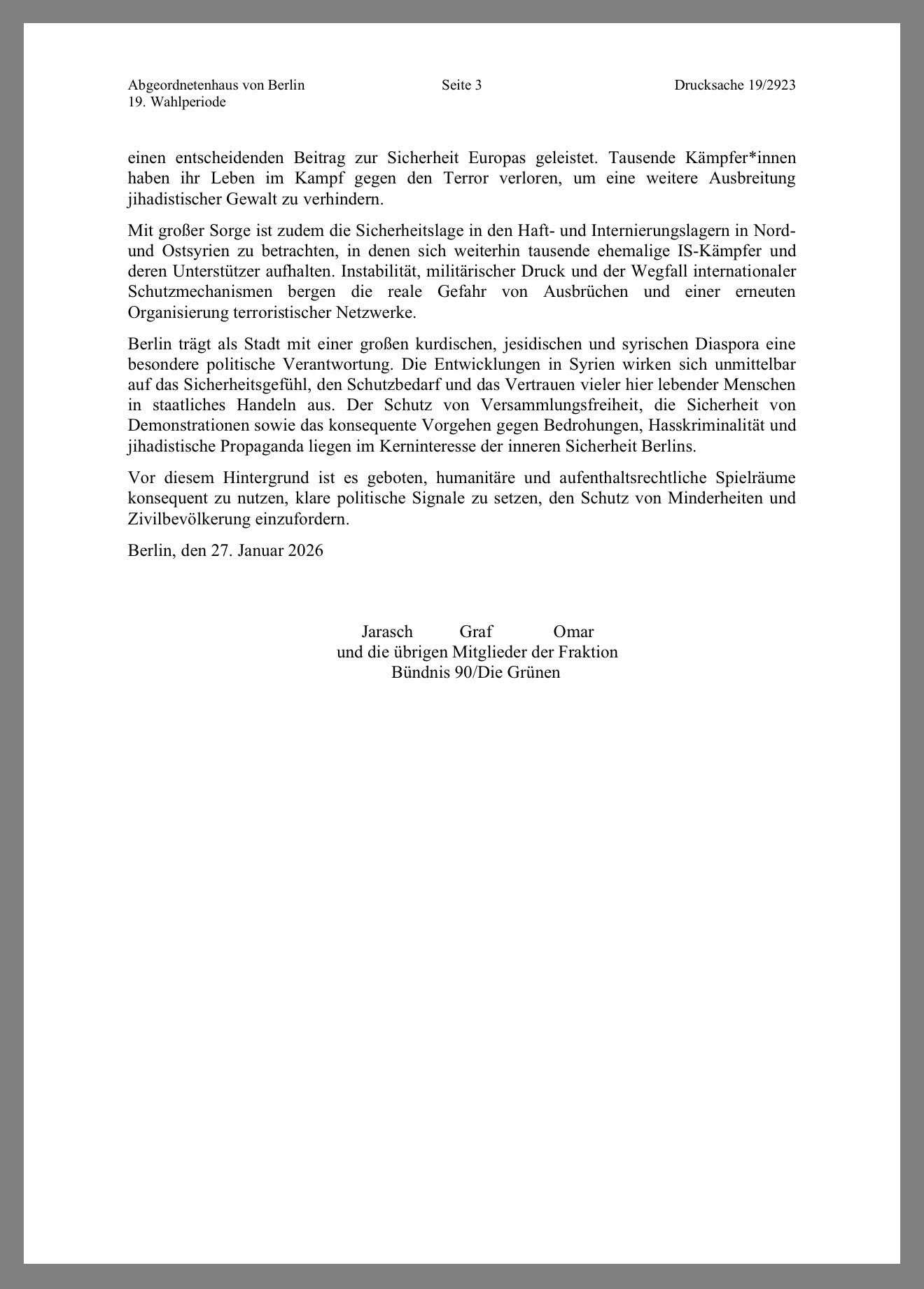
At the same time, the security situation in detention centers and camps in North and East Syria remains a cause for serious concern, as thousands of former ISIS fighters and supporters are still held there. Instability and military pressure raise the risk of escapes and the reorganization of terrorist networks.
The motion notes that Berlin, as a city with large Kurdish, Yazidi, and Syrian communities, bears particular political responsibility. Developments in Syria directly affect the sense of security and trust of many residents in Berlin toward state institutions. Protecting freedom of assembly, securing demonstrations, and firmly countering threats, hate crimes, and jihadist propaganda are described as central to Berlin’s internal security interests.
The motion concludes by emphasizing the necessity of systematically using humanitarian and legal provisions under residence law and sending clear political signals in support of protecting minorities and civilian populations.
Berlin, January 27, 2026
Members of Parliament Bettina Jarasch and Werner Graf (for the leadership of the Greens parliamentary group), MP Jian Omar, and the remaining members of the Alliance 90/The Greens parliamentary group

Read the Arabic version: Click here