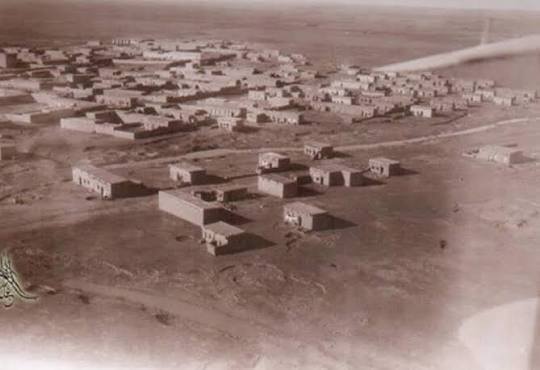
Before it was built, Hasakah was a tell (mound) named “Kri Heski,” upon which stood the tent of a man named Heski—a Kurdish Yezidi name. Over time, it transformed into residential houses that clustered together due to people migrating there, drawn by the waters of the Khabur and Hermas (Jaghjagh) rivers.
It began as a small village around an old Ottoman military barracks established in 1907 during the reign of Sultan Abdul Hamid II. This occurred under the administration of the Kurdish Milli tribe, prior to the era of its leader Ibrahim Pasha al-Milli, and continued through his reign and the reigns of those who succeeded him in leading the tribe until the arrival of the French.
When France occupied what was termed “Syria,” the French army headed toward the Jazira region in May 1922. Colonel “Pigeaud Grandot” deployed his forces in the area, and the city of “Heski” was a small town at that time.
A short period later, the French built the current barracks on the ruins of the Ottoman barracks. After their occupation of “Heski” and the Jazira, they allowed Bedouins to flow in from every direction, and they settled and resided in Hasakah.
The newcomers arrived from the areas of Deir ez-Zor, Al-Bukamal, and Al-Busayrah; some settled in the Guweiran neighborhood, while others built dwellings to the west and north of the Serail (government building), which was constructed during the era of Taj al-Din al-Husayni. In 1933, a large number of Assyrian families were “settled” in the city, specifically on the banks of the Khabur River, against the will of the Kurds and pursuant to a United Nations document. Thus, the demographics of Hasakah were disrupted for a second time. By the time the French departed from the Jazira in mid-1945, and subsequently from all of Syria, the town had grown and become a city. It had acquired a Serail after 1930, when it separated from the Mutasarrifate of Deir ez-Zor. The first Mutasarrif (governor) appointed to the city was “Nasib bin Muhammad Sadiq al-Ayyubi” in 1930. In 1937, “Bahjat al-Shihabi” was appointed in his place, but his stay in the city did not last long due to disturbances in the Jazira region, forcing him to return to Damascus. “Haydar Mardam Bey” was appointed Governor of Hasakah in his stead in March 1938, but his luck was no better than his predecessor’s. The city witnessed the implementation of its first organizational master plan in 1963, and the second plan was organized in 1992.
Society
The city of Hasakah currently lives as a beautiful mosaic of social components, where Kurds, Arabs, Syriacs, Armenians, Chechens, and others form a single portrait rich with peoples who represent the nucleus of the entire Syrian people.
The Kurds
In ancient times, the ancestors of the Aryan Kurds inhabited its region, such as the Subarians, Lullubi, Guti, Hurrians, Hittites, Mittani, Medes, and Sassanids. The term “Subartu” was previously found on geographical tablets preserved in the Royal Library of Ashurbanipal; it was the cradle of civilization. The temple of the god Shamshu (or Shamash) is located beneath the structure of the current Chaldean Church. During the Sassanid era, the word “Tay” was applied to the inhabitants spread across the Mesopotamian Jazira. Over time, the pronunciation shifted to the name “Tayy”; the Kurdish Tayy tribe still bears that name, and it was also applied to the Arab Tayy tribe.
Our Kurdish ancestors left monuments in the Hasakah regions, including the Ayyubid Sukara Castle on Mount Kazwan, which was named after the Kurd Abdul Aziz. At the site of Tell Brak, pottery finds, statues, and cylinder seals with mythological significance were uncovered, most of which point to the Hurrian civilizations. Likewise, Arban (Araban), located south of Hasakah, is also one of the important centers of the Mittani Kingdom.
The Kurdish presence in the Hasakah regions was subjected to racist schemes that affected the Kurdish political situation there. Among these events witnessed by the Milan Tribal Federation in northern Syria was that in February 1758, the Sublime Porte warned the governors of the cities of Raqqa and Baghdad to withdraw quickly from the Khabur Valley region, stating that they must be expelled and removed to Raqqa. According to the Sultanate, the reason behind this request was that one of the Kurdish Milan leaders, “Mahmoud,” had at that time seized grain stocks in the village of Majdal, subsequently built a fort in the ruins of (arbaḤ), began working on building small villages and farms in the neighboring areas, and planned to dam the Khabur waters and dig a new riverbed to take possession of the entire region for his tribe.
Disputes arose between his tribe and some Tayy tribes, and even with some Kurdish “Kikan” tribes. The Turkish authorities demanded the return of the Milan tribe to their residential areas and issued orders to destroy their fort in the Khabur region. It is clear that Mahmoud’s independent actions, rather than his projects, were what provoked the state’s resentment. Four months after that date and following new incidents, Mahmoud was stripped of his position as settlement official (Iskan-Başi). He was fought in Karaca Daǧ, where he was forced to flee to Amida (Amed), and from there, he led rebellions against the Sublime Porte for several years, which eventually cost him his head.
Ibrahim Pasha al-Milli was buried in the village of Safiya near Hasakah in 1908, following great exhaustion resulting from a crushing war with the special forces of the Committee of Union and Progress and their supporting tribes.
Due to the migration of Arab tribes from Saudi Arabia, southern Iraq, and elsewhere, and because of policies of restriction against the Kurds and their displacement, as well as the poor climate over time, the number of Kurds in the city dwindled compared to the number of Arab brothers. However, neighborhoods such as Al-Mufti, Al-Aziziyah, Al-Nasra, Khashman, and others still witness a noticeable Kurdish presence. Regarding the name “Khabur” and its connection to the Kurdish language, researcher A. Rubari says: the naming of “Khabur” is a Kurdish compound of two terms; the first is “Akha,” meaning land, and the second is “Bur,” meaning virgin land—in the sense of uncultivated land. I know that some Kurdish brothers call it the River of the Sun, meaning the River of the God, but this analysis is incorrect and does not rely on science or logic. To make the pronunciation compatible with Arabic, the Arabs substituted the Arabic letter “Waw” (و) for the Kurdish letter “O,” which does not exist in the Arabic language; this is natural since the word is non-Arabic. Consequently, the entire name means “fallow land” (Al-Ard al-Bur), as the river was flowing through uncultivated lands at that time. The letter “A” was dropped over time, and the name became “Khabur.”
Ronahi Newspaper
Note: This text is translated from the original Arabic version… Read the Arabic version:Click here