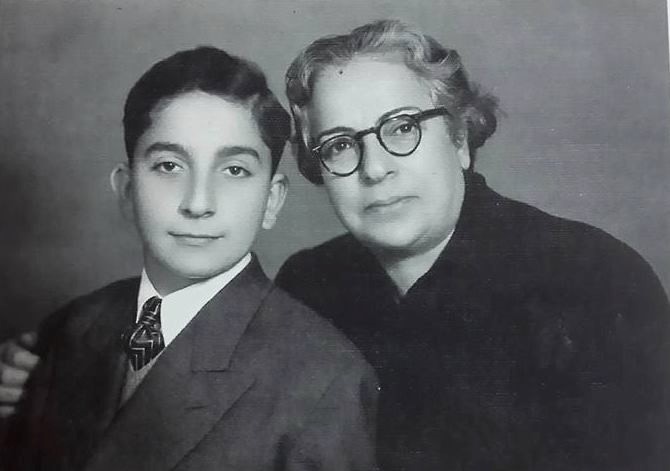
She belongs to the lineage of the Bedirkhanian (Azizan) princes, famous in Kurdistan and the Middle East, and stands as one of the pioneers and pillars of Kurdish culture. Despite forced migration and displacement from Kurdistan, she continued to speak the language of “Prince Bedirkhan” with her two children, Princess Sinem Khan and Prince Jemshid. This was at a time when the remaining Bedirkhanians had forgotten their mother tongue, speaking various other languages instead. Among them were Ahmad and his son, Ali Bedirkhan, who are considered among the most famous cinema directing stars in Cairo, as well as the (Wali) family living in Fayoum, Egypt. On the other hand, there are the Bedirkhanians living in Turkey, where they were forced to change their surname, adopting the title “Çınar” instead of “Bedirkhan,” in addition to other Bedirkhanians who carry the surname “Kotay.”
Although Princess Rewshen Bedirkhan had reached the age of 83, one would stand amazed by her vivid memory, her astuteness, her discernment, and her devotion to her national language, as well as her interactions with the nationalists among her own people.
Rewshen Bedirkhan was born on July 11, 1909, in the city of Kayseri, while her father (Prince Salih Bedirkhan) was exiled there. She was Bedirkhanian on both her mother’s and father’s sides. She spent four years of her childhood in Istanbul. In 1913, the Turks exiled the Bedirkhanians once again to different regions of the Middle East; consequently, she was forced to settle in Damascus, accompanied by her father, Prince Salih, and her paternal uncles, such as Yusuf Bedirkhan.
Her father was Prince Muhammad Salih Bedirkhan, born in the city of Latakia in 1874. He completed his primary education in Latakia and his intermediate education in Istanbul and Damascus. He married Samia, the daughter of his maternal uncle, Badri Pasha Bedirkhan, who was the governor (Mutasarrif) of Houran in Syria. At that time, he accompanied his uncle Badri Pasha and worked with him for a period in Houran. In 1900, he published the newspaper Omid (Hope) in Cairo. Due to his anti-Sultan Abdul Hamid stances, he was arrested several times and exiled to the Greek island of Rhodes.
In 1908, following the Constitutional Monarchy (Meshrotia), he returned to Istanbul and began publishing numerous articles in the Kurdish newspapers of that era, such as Kurdistan, Yekbûn, Rojî Kurd, Hetawey Kurd, etc. In 1909, he was exiled to the Turkish city of Kayseri, where God blessed him with his daughter (Rewshen), whose biography we are addressing here. Prince Muhammad Salih Bedirkhan passed away in 1915 in Damascus.
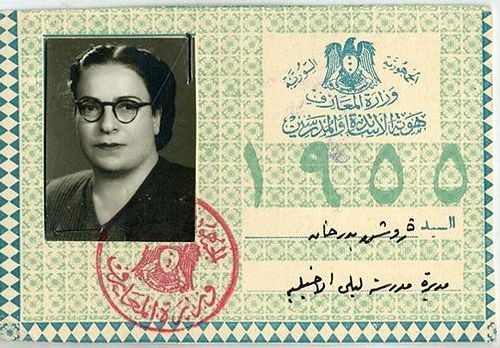
Princess Rewshen Bedirkhan studied in the schools of Damascus until she completed her education at the Women’s Teachers’ Institute in 1923, becoming one of the first Syrian female teachers. She worked for a period of time in Transjordan, in the cities of Amman and Karak, between 1925 and 1928. In 1928, she returned to Damascus and taught French at the French Lycée school. Afterwards, she was appointed as a teacher in Damascus schools, such as the (Khawla bint al-Azwar) school, and as the principal of the (Layla al-Akhyaliyya) school. In 1934, she joined the (Syrian Women’s Union) association and represented Syria at the Cairo Conference in 1944. In 1947, she worked for Syrian Radio, where she narrated stories and tales on the Children’s Corner program; she has many stories and lectures that were broadcasted and published in various newspapers and magazines.
In 1935, she married her cousin, Prince Celadet Bedirkhan, the researcher and linguist, after her divorce from her first husband, Umar Malik Hamdi, with whom she had a daughter named (Asima Khan) in 1931. Asima Khan married (Zuhair Ali Agha Zilfo) and lived with him in Damascus and Cairo; she spoke Kurdish fluently and would always repeat: (“I was raised by Prince Celadet Bedirkhan…”). Thus, Princess Rewshen Bedirkhan spent seventeen years with Prince Celadet Bedirkhan, until the Prince’s passing on July 15, 1951, at Bir al-Qadr in Hijaneh village near Damascus. She gave birth to his daughter, Sinem Khan, on March 21, 1938, and a son, Jemshid, born in Damascus on November 9, 1939, who completed his medical studies in Germany, passed away on December 10, 1999, in Brazil, and was buried in Koblenz, Germany.
Following the death of Prince Celadet, Princess Rewshen became a dwelling place for sorrows and worries, and a prey to hardships, especially after Prince Jemshid went to Germany to pursue his university studies in medicine in 1958, and Princess Sinem Khan’s marriage to Salah Saadallah in 1961. Despite the hardship, she walked the path forged by her cousin, Prince Celadet Bedirkhan. In 1955, she contributed, along with a group of Kurdish intellectuals in Damascus, to establishing the (Association for the Revival of Kurdish Culture: Anjuman), including Osman Sabri, Dr. Nuri Dersimi, Abdul Hamid Haj Darwish, and others. In 1956, alongside Dr. Nuri Dersimi, Hasan Hishyar, and others in Aleppo and Damascus, she participated in founding the (Kurdish Knowledge and Cooperation Association). Through Princess Rewshen and her strong friendship with the Lebanese journalist (Youssef Malik), a friend of the Bedirkhan family, the association’s relations were consolidated with the Greek anti-racist EOKA party. In 1957, as a result of the association’s activities, Princess Rewshen Bedirkhan was the only Kurd who went to Greece to represent her Kurdish people at the (Anti-Colonialism and Anti-Racism) conference.
Also as a result of the association’s activities, Professor Qanatê Kurdo sent a letter to the association members in 1956, stating:
“Brothers! I thank you for your struggle… No matter what difficulties obstruct your path, you must raise high the name of Kurdistan in every newsletter, magazine, and newspaper, whether small or large. We are in the twentieth century, the century of scientific progress and the atom; peoples who do not demand their freedom today dissolve and wither away rapidly. If the child does not cry, its mother will not nurse it despite her tenderness…”.
She also holds a prominent name in the book Syrian Women Writers: 1892–1987 by the authors Marwan Al-Masri and Muhammad Ali Al-Alani, who dedicated a full page to her biography and literary works, considering her one of the pioneering Syrian women writers.
In addition to her mother tongue—Kurdish—the deceased was fluent in the following languages: Arabic, French, Turkish, and English, with some knowledge of German. She is well known for her prominence in the field of translation from Kurdish and Turkish into Arabic, alongside authoring books. Until the very last day of her life, she practiced this sacred profession, working on translations, compositions, and preparations that remained incomplete, such as: Celadet Bedirkhan as I Knew Him (Authoring), The True Factors Behind the Fall of Adrianople (Translation), and The Memoirs of Rewshen Bedirkhan.
On Monday, June 1, 1992, the writer and Princess Rewshen Bedirkhan passed away. The residents of the Syrian city of Baniyas escorted her in a large funeral procession to rest beside her grandfather (Bedirkhan Pasha) in the Sheikh Khalid al-Naqshbandi Cemetery in the Kurdish Quarter of Damascus.
“From an extended article by the Kurdish writer Konê Reş. Al-Hiwar Magazine – Issue 80 – Year 29 – 2022”
Note: This text is translated from the original Arabic version… Read the Arabic version:Click here